Social Media Marketing for Home Décor and Furnishing Brands: Selling a Look, Not Just a Product
How home décor and furnishing product brands can plan social content around rooms and looks, show products honestly at true scale and colour, and use Pinterest and customer homes without overclaiming.
A cushion cover sells out after it appears on a styled sofa with a jute rug, a brass lamp and late-afternoon light. Two weeks later, the brand gets messages saying the colour looks different at home and the cover is smaller than expected. The photo sold a look. The product page didn't prepare people for the product. Home décor brands live in that gap between the room people imagine and the item that arrives.
Quick answer
Social media marketing for home decor brands works when content moves between the room and the product. Show complete looks people want to recreate, then show each item in context, at true scale, colour and material, with care and dimensions spelled out. Use real customer homes with permission, plan Pinterest for saves and search, and make sure styling never promises what the product alone can't deliver. Honest detail reduces returns and builds trust.
Why décor content has to sell a look
Very few people need a new vase. They want a corner that feels finished, a bedroom that feels calm, a dining table that's ready for guests. That's why decor content that performs usually starts with the space, not the SKU. The risk is that the look becomes the promise. If the room is lit by a professional, styled with props you don't sell and edited for warmth, the buyer's home will look different.
This article is for product brands: furnishings, soft furnishings, lighting, tableware, decor and small furniture. If you run an interior design studio, our guide to social media marketing for interior designers covers turning client projects into content.
The room-and-product content framework
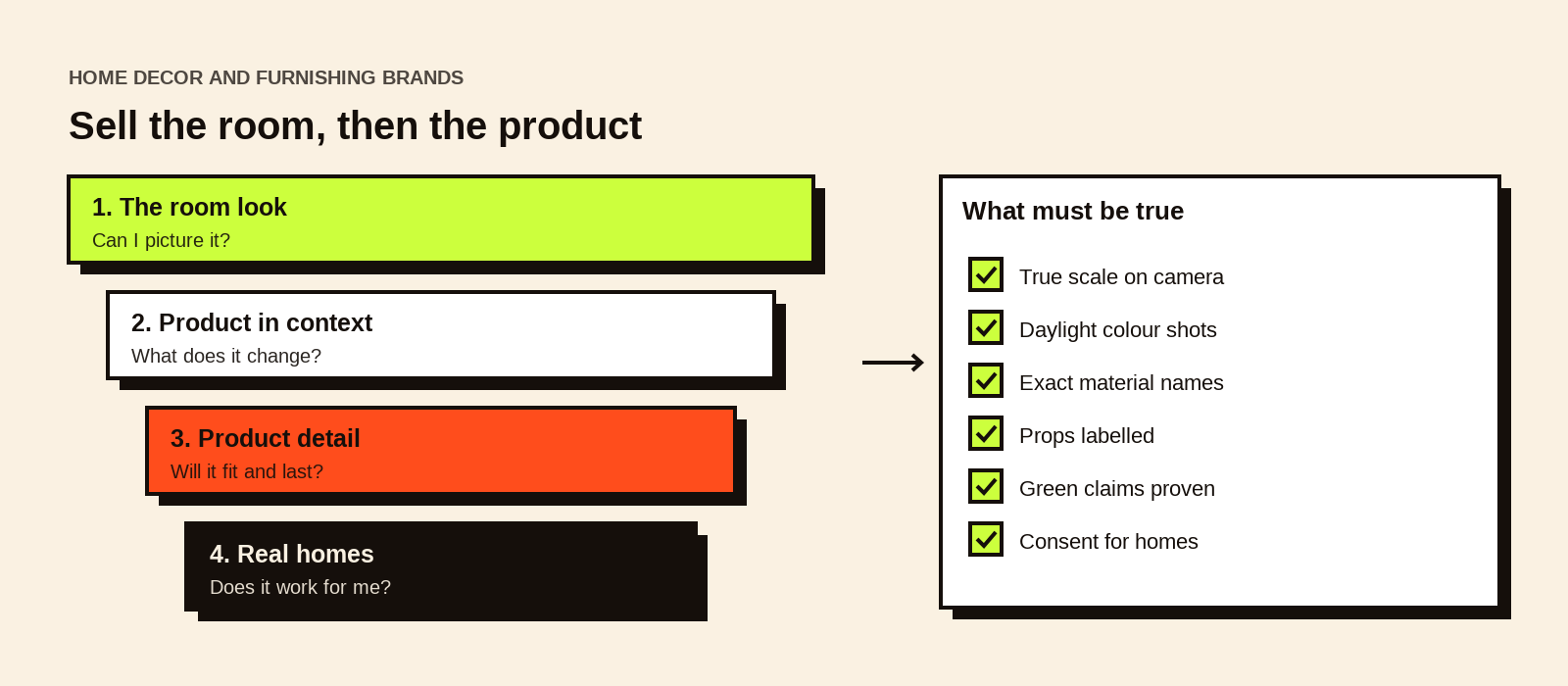
Plan content in four layers. Each layer answers a different buyer question, and a healthy month includes all four. A brand that posts only layer one looks beautiful and confuses buyers; a brand that posts only layer three looks like a catalogue.
| Layer | Buyer question | Content formats | What must be true |
|---|---|---|---|
| 1. The room look | Can I picture this in my home? | Styled room Reels, mood carousels, seasonal room refreshes | Products you sell are named; props you don't sell are identified as styling |
| 2. Product in context | How does this one piece change a space? | Before and after of one corner, 'one cushion, three sofas', swap videos | Same lighting for before and after; no editing that changes the product's colour |
| 3. Product detail | Will it fit, last and look right? | Measure-on-camera clips, fabric close-ups, care demos, size against common objects | Dimensions, materials and finish match the product page exactly |
| 4. Proof from real homes | Does it work in homes like mine? | Customer photos, review responses, 'how customers styled it' roundups | Shared with permission; not edited to hide flaws or change the look |
Room shoot brief template
ROOM SHOOT BRIEF
Look name: ____________ (e.g. 'monsoon living room')
Room type and size: ____________  Real home or studio set: ________

Products we sell in frame (SKU and name):
1) ________ 2) ________ 3) ________
Styling props we do NOT sell (to be labelled in caption): ________

Shots needed
[ ] Wide room shot (layer 1)
[ ] One-product swap: same angle, same light (layer 2)
[ ] Measuring tape on camera for each hero product (layer 3)
[ ] Fabric or finish close-up in daylight (layer 3)
[ ] Product next to a familiar object for scale (layer 3)

Colour check: compare final edit with the physical sample before posting
Caption must include: dimensions, material, care link, 'styling props not included' where relevant
Home owner consent on file (if a real home): yes / no
Dimensions, colour and material honesty
Most décor complaints come down to three things: it was smaller, a different colour, or a different material than expected. Social content can prevent all three if you treat accuracy as part of the creative, not a footnote.
- Show scale on camera: a hand, a measuring tape, a standard mug or a cushion of known size.
- Shoot colour in daylight as well as styled light, and say if colours vary between batches or screens.
- Name materials precisely: 'cotton-linen blend' if it's a blend, 'engineered wood with veneer' if that's what it is.
- Say what's handmade only if it is, and explain what variation buyers should expect.
- Put care instructions in the caption or a pinned comment, not only on the label.
- Label any AI-generated or rendered room images clearly as visualisations, not photographs.
Sustainability claims need extra care. The Central Consumer Protection Authority issued guidelines on greenwashing and misleading environmental claims in October 2024, which require specific environmental claims to be backed by credible certification or reliable scientific evidence, and words such as 'eco-friendly', 'natural' or 'sustainable' to carry accurate qualifiers. The ASCI Code also requires factual claims to be capable of substantiation. If you can't document it, don't post it.
A month of content ideas by layer
- Room look: 'one shelf, four seasons'; a small-flat living room under a fixed list of your products; festive table setting.
- Product in context: swap the cushions on the same sofa; one lamp, three corners; before and after of a bare wall with your frames.
- Product detail: 'how big is it really' series; fabric rub and wash demo; what the back, base and joints look like.
- Proof: customers' rooms with their permission; answers to the three most common review comments; how a product looks after a year of use, if you have that evidence.
- People: the weaver, potter or workshop you source from, shown with consent and described accurately.
Short-form video does much of this work well. For broader format planning, see our guide to an Instagram Reels strategy built around products and customers.
Pinterest: plan for saves and seasons
Home décor is one of the categories where people plan visually over weeks, which makes Pinterest worth considering alongside Instagram. Pinterest Help says Pins can resurface seasonally and recommends publishing fresh Pins regularly rather than repeatedly re-saving the same one. It also describes visual search, which lets people look for similar items within a Pin. Organise boards by room and look rather than by product category, and link each Pin to the matching product or collection page.
If you sell mainly through marketplaces, note that Pinterest's help pages say you need to own a domain to claim a website, and marketplace store pages usually can't be claimed. Our guide to Pinterest marketing for business covers boards, Pin formats and analytics in detail.
View-in-room and visualisation tools
Some e-commerce platforms and marketplaces offer ways to preview a product in your own room. Availability varies by platform, category and region, so we haven't named specific tools. If your product page offers one, mention it in social content only for the products where it actually works, and test it on a few phones first. Never present a rendered room as a customer's real home.
Customer homes and creators
Photos from real customers' homes are the most persuasive proof a décor brand has, and the most sensitive. Homes show addresses, family photos, children and valuables. Ask for permission before reposting, crop or blur personal details, and keep the customer's caption meaning intact. Our guide to customer testimonials and UGC explains permission records. If you also work with home and interior creators, our home and interior influencer marketing guide covers that programme separately.
Common mistakes
- Styling with props you don't sell and not saying so, then fielding 'where's the lamp from?' in every comment.
- Warm, heavy edits that change the product's real colour.
- Dimensions only on the product page, never in the content that sold the look.
- 'Eco-friendly' or 'sustainable' in captions with no certification or evidence behind it.
- Reposting customer rooms without asking, or with house numbers and family photos visible.
- Planning Pinterest like Instagram, with daily posts and no boards organised by room.
Where to start
Audit your last 20 posts against the four layers and you'll probably find one or two missing. Fill the gap with a 'how big is it really' series and a monthly customer-homes roundup, and add dimensions and materials to every caption that features a product.
If you want help running this calendar, Kudozz's creative design and social media management work covers planning, design, Reels editing from footage you supply and publishing, with styled photo shoots scoped separately.