Social Media Marketing for Jewellery Brands: Building Desire, Trust and Product Discovery
How a jewellery brand can run its own social accounts: product storytelling, craftsmanship, launches, festive and wedding calendars, honest visuals, hallmark education and the path from a post to a store visit or WhatsApp enquiry.
A customer saves a necklace from your Reel, then messages two days later: 'Is this 22 karat? What's the price? Is it available at your Andheri store?' The Reel looked lovely, but the caption said none of this, the store isn't tagged, and the person answering DMs isn't sure whether that design is in stock. Jewellery is bought on desire and trust together, and social media has to serve both.
Quick answer
Social media marketing for jewellery brands works when it builds desire through storytelling, craftsmanship and styling, and builds trust through true-to-life visuals, product education and accurate details. Plan around festive and wedding seasons, use customer content only with consent, and make it easy to move from a post to a WhatsApp enquiry, appointment or store visit. Never state purity, certification, price or investment claims unless they are verified for that specific piece.
What jewellery buyers need from social
Buying jewellery is rarely impulsive above a certain price. People want to see how a piece looks on someone, how it catches light, how big it really is, what it is made of and whether the seller can be trusted. Many will still visit a store, or ask for a video call, before buying. Social content should answer those questions in advance, so the conversation that follows is about choosing, not doubting.
| Content type | What it does | What it needs to be accurate |
|---|---|---|
| Product storytelling | The design inspiration, the occasion, the story of a collection | Design facts only; no invented heritage or provenance |
| Craftsmanship | Karigars at work, setting stones, polishing, enamelling | Craftspeople's consent; real process, not stock footage |
| Styling | How to wear a piece, layering, outfit pairing, day to night | True colour and true scale |
| Product education | Karat, hallmarks, care, stone basics, how to choose a size | Facts from official sources and your own verified product data |
| Collection launches | Teasers, reveals, piece-by-piece features | Availability and product details checked before posting |
| Customer stories | Brides, gifting moments, anniversaries | Written consent; no edits that change the piece |
| Store and service | Store tours, appointments, exchange or repair process explained | Current store details and policies |
Product education: karat, hallmarks and HUID
Education builds trust, especially for first-time buyers, and hallmarking is one of the most useful topics. According to the Bureau of Indian Standards (BIS), the Hallmarking of Gold Jewellery and Gold Artefacts Order, 2020 made hallmarking mandatory in notified districts from 23 June 2021, and the district list has been extended through several amendments since, including in 2026. Since 1 July 2021, a BIS hallmark on gold jewellery has three marks: the BIS logo, the purity mark (karat and fineness, such as 22K916) and a six-digit alphanumeric HUID. BIS lists 14, 18, 20, 22, 23 and 24 karat as the grades covered.
BIS also tells consumers they can check a HUID using the 'Verify HUID' feature in the BIS Care app. A short Reel showing a customer how to find the hallmark on a piece and check it in the app is useful, neutral education. There are exemptions too: BIS's FAQs for jewellers list, among others, jewellers with annual turnover up to Rs 40 lakh, articles weighing under 2 grams, and kundan, polki and jadau jewellery. Coverage changes, so check the current order and district list on the BIS website before you post anything about it.
The rule for your content team: explain hallmarking in general terms, but only say a specific piece is hallmarked, or state its karat, when that is verified for that exact piece. Silver, platinum, diamonds and coloured stones have their own standards and grading systems; describe them only from your verified product information or the certificate that actually accompanies the piece.
Showing pieces as they really are
Jewellery photography is almost always edited, and some editing is fine: cleaning dust, correcting white balance, straightening a frame. The line is crossed when editing changes what the customer will receive. Over-saturated gold, stones made more brilliant, scale cheated with props, or diamonds that sparkle with added effects all set expectations the piece can't meet in a store.
- Shoot in consistent, neutral light and keep a colour reference card in the studio.
- Show the piece on a person or next to a familiar object, so scale is clear.
- Add a short unedited video of the piece in daylight for key designs.
- No sparkle overlays, filters that alter metal colour, or added stones.
- If a visual is a render or a design concept, label it.
Reels suit jewellery well because movement shows how a piece catches light. Slow rotations, try-ons, close-ups of clasps and settings, and a karigar's hands at work all make strong short videos. Our guide to an Instagram Reels strategy for brands covers series planning, and creative design for consistent product visuals sits within our creative design scope.
The resource: a festive and wedding season calendar
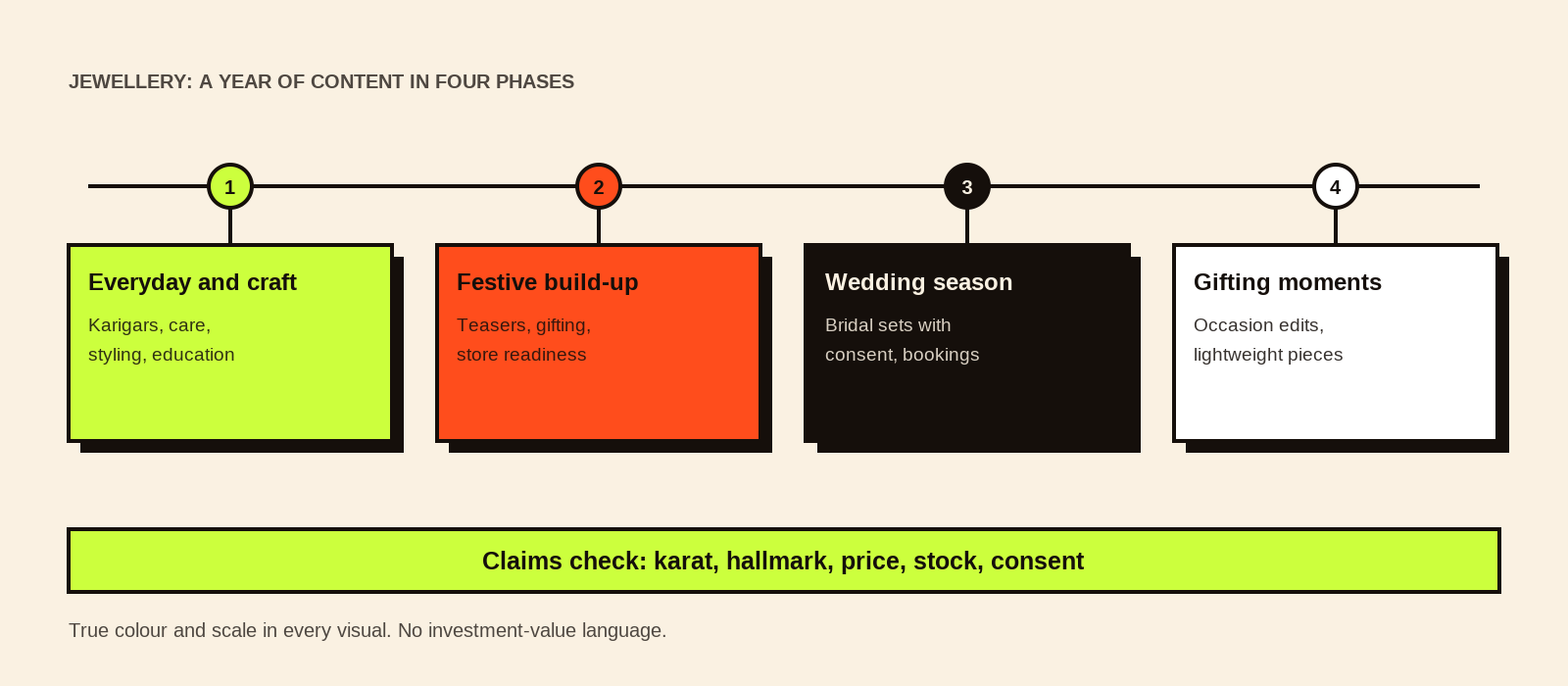
Indian jewellery demand follows festivals, wedding seasons and gifting occasions, which vary by region and community and shift each year with the calendar. Rather than fixed dates, plan in phases and fill them with the occasions that matter to your customers. The structure below is generic; adjust it for your region.
| Phase | Content focus | Formats | Planning note |
|---|---|---|---|
| Everyday and craft months | Craftsmanship, care guides, styling for work and daily wear, education | Reels, carousels | Build the trust you will rely on in peak season |
| Festive build-up (4 to 6 weeks before key festivals) | Collection teasers, festive styling, gifting guides, store readiness | Teaser Reels, carousels, Stories | Confirm stock, store hours and any offer terms before posting |
| Festival days | Greetings, store moments, customer celebrations shared with consent | Stories, short Reels | Keep promotional posts light on the day itself |
| Wedding season | Bridal sets, trousseau planning, family jewellery stories, appointment booking | Carousels, Reels, Highlights | Bridal content needs consent from every person shown |
| Gifting moments (anniversaries, birthdays, Raksha Bandhan and others relevant to you) | Gift edits by budget band or occasion, lightweight pieces | Carousels, Stories | Describe price bands only if accurate in every store |
If you also run creator campaigns around these moments, plan them alongside this calendar. Our guide to seasonal influencer marketing around Indian festivals covers the creator side, and launch planning across owned channels and creators is part of our product launch work.
Customer stories and creators
A bride wearing your set, or a customer gifting a first gold chain to a parent, is the most persuasive content a jeweller can share. It needs written consent from each person shown, a clear agreement on where it will be used, and no editing that changes the jewellery. Our guide to customer testimonials and UGC covers permission and evidence rules in detail.
Creators bring styling range and reach your own feed can't. When they are paid, gifted or loaned jewellery, their posts need a clear disclosure under ASCI's influencer guidelines. Choosing and briefing creators is covered in influencer marketing for jewellery brands; this guide is about your brand's own accounts.
From post to enquiry or store visit
Most jewellery sales still close in a store, on a video call or over WhatsApp. Plan each post's next step: a WhatsApp number in the bio, a catalogue or product link, a store locator, or an appointment booking for bridal consultations. WhatsApp's Business app supports a product catalogue, which some jewellers use to share designs in chat. Tag the relevant store in location-specific posts and keep store details current.
- Give DM and WhatsApp responders a product code for every piece posted, with stock status by store.
- Agree a standard reply for price questions: the current price depends on the day's metal rate and the final weight, so share it privately once confirmed.
- Never confirm availability, karat or certification in a reply without checking the specific piece.
- For multi-store brands, route enquiries to the nearest store with a clear handover.
If you run several stores, our guide to managing social media for multiple locations covers local pages and store-level content.
Pre-publish claims checklist
Run every jewellery post through this check. Under the ASCI Code, factual claims in advertising must be capable of substantiation, and jewellery claims are mostly factual.
- Karat, purity or hallmark stated only if verified for this exact piece.
- Diamond, stone or lab-grown descriptions match the piece's own certificate or product record.
- Any certificate or certifying lab named actually covers this piece.
- Prices, making charges or offers are current, apply in every store mentioned and state their conditions clearly.
- No investment-value, appreciation or 'guaranteed returns' language about any piece.
- Visuals show true colour and scale; renders are labelled.
- Consent recorded for every customer, model or karigar shown.
- Creator content carries a disclosure label.
- Store details, timings and availability checked on the day of posting.
Common mistakes
The mistakes we see most are predictable: posting beautiful Reels with no product code or next step; editing metal colour so it no longer matches the piece; using phrases such as 'pure gold' or 'certified' loosely in captions; talking about gold as an investment in promotional content; and leaving DM responders without stock or price guidance in peak season, when enquiries are highest.
Where to start
Fix the basics first: a product code and stock status for everything you post, a claims checklist that every caption passes, and a lighting set-up that shows true colour. Then map the coming festive and wedding season into the phases above and plan your craft and education content for the quieter months in between.
If you want help running the calendar, creative and community replies day to day, Kudozz's day-to-day social media support covers planning, design, publishing and community management within an agreed scope, while product claims stay with your team.