Social Media Marketing for Packaged Food and Beverage Brands: Building Trust Without Overclaiming
How packaged food and beverage brands can run social media that sells without overclaiming: what FSSAI's advertising and claims rules mean for posts, a content pillar table, recipe and label content, honest availability updates and a pre-publish claims checklist.
A millet snack brand is about to post its first Reel for a new flavour. The draft caption says 'guilt-free, boosts immunity, 100% natural, made fresh every day', and the on-screen text adds 'doctor recommended'. Every one of those phrases came from a well-meaning team member, and almost every one of them is a claim the brand would struggle to stand behind. This is the everyday problem for food and beverage brands on social media: the content that feels most persuasive is often the content that needs the most checking.
Quick answer
Social media marketing for food brands works when it builds trust through usefulness rather than adjectives. Post recipes, usage ideas, pack and label explainers, honest sourcing stories and accurate 'where to buy' updates. Treat every caption, on-screen line and reply as advertising: in India, FSSAI's Advertising and Claims Regulations, 2018 require claims to be truthful and consistent with the label, and restrict health, disease and wording such as 'natural' or 'fresh'. Run a claims check before anything goes live.
Why food brands need a claims-first content system
Food is a repeat purchase built on trust. A shopper who feels misled by a 'high protein' post that the nutrition panel doesn't support rarely gives the brand a second chance, and they often say so in the comments. Social media also multiplies the number of people writing about your product: the founder, an agency copywriter, a community manager replying at night, creators, and retail partners resharing your posts.
A claims-first system means the approved product facts live in one place, everyone writes from it, and anything outside it goes to the person who owns regulatory sign-off. The general D2C playbook still applies, and our guide to social media management for D2C brands covers community, cadence and content mix. This article covers what is different when the product is something people eat or drink.
What FSSAI's advertising and claims rules mean for social posts
The Food Safety and Standards (Advertising and Claims) Regulations, 2018 were notified on 19 November 2018, with food businesses required to comply by 1 July 2019. Their definition of advertisement covers electronic media, the internet and websites, so brand posts, Reels, Stories and captions are in scope. The summary below is based on FSSAI's consolidated compendium of the regulations (Version II, dated 16 November 2021). FSSAI has amended the regulations several times, including amendments dated 9 October 2020, 30 August 2022 and 13 December 2022, so check the current consolidated text on FSSAI's website and confirm anything specific with your regulatory or legal adviser. This is a plain-language summary, not legal advice.
| Provision (FSS Advertising and Claims Regulations, 2018) | What it says, in short | What it means for a post |
|---|---|---|
| Reg. 4(1) | Claims must be truthful, unambiguous, meaningful and not misleading | No vague superlatives presented as fact. 'Tastiest' as opinion is different from '2x protein' as a fact. |
| Reg. 4(2) | Claims must not encourage or condone excess consumption | Avoid 'finish the whole pack' or binge framing, even as a joke |
| Reg. 4(3) | Claims must not imply a balanced, varied diet can't provide the nutrients the body needs | No 'you can't get enough X from food alone' angles |
| Reg. 4(6) | Nutritional or health attributes must be scientifically substantiated by validated methods | Every nutrition number comes from the brand's tested data, not memory |
| Reg. 4(7) and Reg. 9(2) | Words such as natural, fresh, pure, original, traditional, authentic, genuine and real are restricted to the conditions in Schedule V; brand names using them may need a disclaimer | Don't use these words loosely in captions. Check Schedule V or ask your regulatory owner first. |
| Reg. 4(9) | No claim or promotion may use the FSSAI logo and licence number, beyond the mandatory label declaration | Don't post 'FSSAI approved' badges or use the licence number as a selling point |
| Reg. 4(10) and 4(11) | Advertisements must not undermine healthy lifestyles or portray a food as a meal replacement unless specifically permitted | No 'skip lunch, grab this' positioning |
| Reg. 4(12) | Claims in advertisements must be consistent with the label | If the pack doesn't say it, the post shouldn't either |
| Reg. 10(1) | No claims about preventing, alleviating, treating or curing a disease, disorder or physiological condition unless specifically permitted | No immunity, diabetes, gut-healing or weight-loss promises |
| Reg. 10(5) and 10(7) | No claims that create doubt about the safety of similar foods or arouse fear, and no undermining other manufacturers' products | No 'other brands are full of chemicals' fear posts or competitor bashing |
| Reg. 11 | Reduction of disease risk claims not already defined in the regulations need FSSAI's prior approval | Escalate any 'reduces the risk of' line before drafting it |
Nutrition claims such as 'source of protein', 'low fat' or 'no added sugar' have specific conditions in the regulations (for example, regulation 6 sets out when a non-addition of sugars claim can be made). The rule of thumb for a social team is simple: only use a nutrition or health phrase if it already appears on the approved label or in the brand's approved claims sheet. Separately, the ASCI Code requires that claims of objectively ascertainable fact are capable of substantiation, and ASCI's self-regulation guidelines on advertising of foods and beverages (1 February 2013) also say food advertising should not undermine healthy lifestyles, should not encourage excessive consumption and should not undermine parental guidance on children's food choices.
Content pillars for a packaged food brand
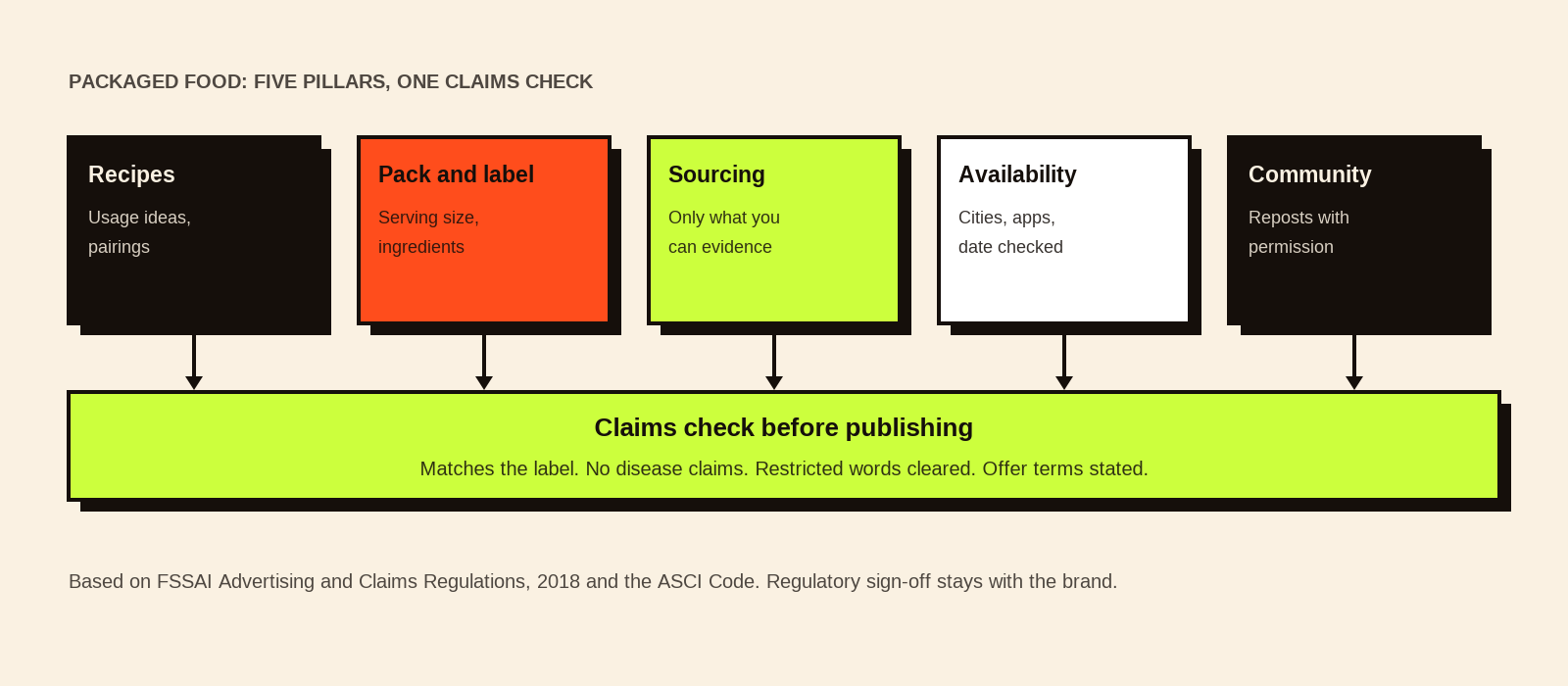
Pillars give the calendar a shape, and they also tell you where the claims risk sits. Use this table to plan, then decide who checks each pillar before publishing.
| Pillar | What to post | Claims risk | Who checks |
|---|---|---|---|
| Usage and recipes | Three-ingredient recipes, pairings, lunchbox and travel ideas, 'how we eat it' from the team | Low, unless the recipe is framed as healthy or diet-friendly | Content lead |
| Pack and label education | How to read the nutrition panel, what each ingredient does, storage after opening, serving size | Medium: every number must match the label | Content lead plus product or QA owner |
| Making and sourcing | Where an ingredient comes from, how a batch is made, the people involved | Medium: origin, process and 'traditional' wording need evidence | Founder or operations owner |
| Availability | Which cities, stores and apps carry which SKUs, new listings, restocks | Medium: must be true on the day it's posted | Sales or supply owner |
| Community and customers | Reposts of customer recipes (with permission), comment replies turned into posts, polls on flavours | Medium: reposted content can carry claims you didn't make | Community manager |
| Nutrition and health topics | Only label-backed facts, with any qualifiers shown clearly | High | Regulatory or legal owner, every time |
Most feeds lean far too heavily on the last row, because nutrition feels like the strongest selling point. In practice, the first two pillars do more for repeat purchase: people buy again when they know what to do with the product. Our guide on product explainer content covers how to produce demos, comparisons and ingredient explainers, and it applies directly to food packs.
Recipes, usage and label education that sell honestly
- Film recipes with the actual pack in shot and the quantity used, so viewers can recreate them.
- Keep recipe captions descriptive ('a quick evening snack with curd and onion') rather than evaluative ('the healthiest snack you'll eat').
- Make a 'label in 30 seconds' series: one panel per post, explaining serving size, ingredients in order of weight and storage instructions as printed.
- Answer real questions from comments and DMs as posts, but quote the label rather than paraphrasing it.
- Show portion sizes that match the serving size on the pack, not oversized bowls.
- Where a product is aimed at families, avoid content that pits children against parents' choices.
Retail and quick-commerce availability, communicated honestly
Many food brands now sell through their own site, modern trade, local stores and quick-commerce apps at once, and listings change by city, pin code and week. Availability posts are among the most useful content you can publish, and among the easiest to get wrong. 'Now available everywhere' is rarely true. 'Now on two quick-commerce apps in Bengaluru and Pune; other cities coming, we'll post when they're live' is.
- Name the cities, store chains or apps, and the date the information was checked.
- Pin a 'where to buy' post or Story highlight, and update it when listings change.
- Don't create urgency you can't stand behind. India's CCPA Guidelines for Prevention and Regulation of Dark Patterns, issued on 30 November 2023, list false urgency among the prohibited patterns, so 'only a few packs left' must be true.
- If stock runs out or a price changes, say so plainly and give a date only when you're confident of it.
- State offer terms in the same post: what's included, where it applies, and when it ends.
For stock-outs, delays and price changes in detail, including reply templates, see our guide to communicating stock-outs and delivery delays on social media. Our guide to quick-commerce influencer marketing covers the creator side of app launches.
The CCPA guidelines were announced by the Department of Consumer Affairs through PIB.
Creators, community and reposted content
When a creator says your snack 'fixed my digestion', and you repost it on your brand account, the claim is now on your channel. Brief creators with the same approved claims sheet you use internally, require clear disclosure under ASCI's influencer guidelines, and remember that ASCI's Addendum II (6 March 2025) expects health and nutrition influencers to hold relevant qualifications and state them upfront. Creator programmes are a separate discipline: see our guides to influencer marketing for food brands and to influencer marketing for FMCG brands for briefing, selection and measurement.
For customer content, ask permission before reposting, credit the person, and check the caption for claims before you share it. A customer's own 'this cured my acidity' is their experience; your repost turns it into your advertisement.
Resource: the claims pre-publish checklist
Paste this into your content calendar or approval tool and require a tick on every line before a post is scheduled. It covers the caption, on-screen text, voiceover, hashtags, alt text and pinned comments.
POST: ____________  SKU(s): ____________  Writer: ________  Reviewer: ________

[ ] Every fact (nutrition, ingredient, origin, process) matches the current label or the approved claims sheet
[ ] No disease, cure, prevention or 'immunity' language
[ ] No 'doctor recommended', 'clinically proven' or medical endorsement unless approved in writing by the regulatory owner
[ ] 'Natural', 'fresh', 'pure', 'traditional', 'authentic', 'real' or 'original' cleared against Schedule V
[ ] No FSSAI logo or licence number used as a promotional badge
[ ] No meal-replacement framing; no binge or excess-consumption framing
[ ] No fear-based or competitor-undermining comparisons
[ ] Portion shown matches the serving size
[ ] Availability (cities, apps, stores) checked today: date ________
[ ] Offer terms stated in the post: what, where, until when
[ ] Urgency or scarcity lines are true
[ ] Creator or customer content: permission recorded, disclosure visible, their claims checked
[ ] Anything unsure escalated to: ____________ (regulatory/legal owner)

Approved by: ________  Date: ________
Common mistakes food brands make on social
- Letting the community manager improvise nutrition answers in DMs, instead of replying from the approved claims sheet.
- Using 'healthy', 'guilt-free' or 'clean' as default adjectives without asking what claim they imply.
- Posting availability once and never updating it.
- Reposting creator or customer content without reading the caption.
- Treating Stories and comments as informal and therefore outside the rules.
- Running 'last chance' offers that quietly extend every week.
Where to start
Start with two documents: an approved claims sheet per SKU, signed off by whoever owns regulatory compliance, and the checklist above. Then shift your calendar towards recipes, usage and label education, and make availability posts specific and dated. Trust in a food brand builds slowly and breaks quickly, so the safest content is often the most useful.
If you want an outside team to run this, Kudozz's social media management includes copywriting and publishing against your approved claims and approval process; regulatory sign-off stays with your team.