How Physiotherapy Clinics Can Use Social Media to Explain Treatments and Educate Patients
How physiotherapy clinics in India can use social media for movement education without prescribing exercises: the NCAHP regulatory position in November 2026, 15 educational content ideas, safe demonstration filming, team introductions and first-assessment enquiries.
A patient's son sends your clinic a YouTube video of knee exercises and asks if his father can do them three weeks after surgery. A follower wants 'the best stretch for sciatica'. Your associate would like to film a patient's first unassisted steps for a Reel. Each request is a chance to educate, and each one can go wrong if the clinic's feed starts prescribing to people it has never assessed.
Quick answer
Physiotherapy clinics should use social media for general movement education, clearly framed demonstrations and honest information about what happens at an assessment, never for individual exercise prescription. Every demonstration should say it is not a substitute for an assessment. Physiotherapy is regulated under the NCAHP Act, 2021; at the time of writing (November 2026) its professional conduct and ethics regulations are still a draft, so follow their direction cautiously and check with your State Council.
Who regulates physiotherapy, as of November 2026
This is orientation, not legal advice. The rules for allied and healthcare professions are being built out, so check the current position with your State Allied and Healthcare Council or legal adviser.
| Source | Status (checked 13 November 2026) | What it means for your posts |
|---|---|---|
| National Commission for Allied and Healthcare Professions (NCAHP) Act, 2021 | Notified in the Gazette on 28 March 2021; the NCAHP lists physiotherapy as one of its ten professional categories | Physiotherapists are regulated as allied and healthcare professionals, not under the NMC |
| Registration of Allied and Healthcare Professionals Regulations, 2026 | Listed by the NCAHP among final regulations, uploaded 15 September 2026 | Registration details are what you should show in introductions, once you have them |
| Registered Allied and Healthcare Professionals (Professional Conduct & Ethics) Regulations, 2026 | Draft, placed for public comment on 27 April 2026 (comments to 28 May 2026); still listed as a draft | Not yet binding, but signals the direction (see below) |
| State Allied and Healthcare Councils | Notification status varies by state; the NCAHP publishes a state-by-state table | Your State Council is the body to ask about local requirements |
| Clinical Establishments (Registration and Regulation) Act, 2010, or your state's law | Applies to therapeutic and diagnostic establishments in states that apply or have adopted it | Your clinic may need registration; ask your state authority |
Sources: the NCAHP's list of the professions it regulates, its regulations page, its draft regulations page and its state councils table, and the Clinical Establishments portal. We found no physiotherapy-specific advertising code in force at the time of writing. General advertising rules still apply, including the ASCI Code's requirement that claims be capable of substantiation. If a doctor practises at your clinic, the NMC's October 2026 guidelines also govern that doctor's content.
What the draft ethics regulations propose
The April 2026 draft (NCAHP notice No. M-13/4/2026-NCAHP) proposes that registered professionals shall not solicit patients (regulation 6), shall not endorse products (regulation 8), may make formal announcements and do public education without soliciting (regulation 9), and should follow a social media guideline. That guideline says information should be evidence-based and verifiable; professionals should avoid discussing patients' treatment on public social media and guide anyone who asks towards a consultation; patients' photographs or scans need written consent; no buying likes or followers; no requesting or sharing testimonials or reviews; no images of 'healed/cured patients' or procedure videos 'displaying impressive results'; and education should stay within the professional's expertise. Because it is a draft, wording may change before it is notified.
Education, not prescription
A practical way to keep every post on the right side is to check which of three layers it sits in. Only the first two belong on a public feed; the third happens in the clinic.
- Layer 1, general information: what a condition or term means, how physiotherapy assessment works, everyday habits. Reviewed by a registered physiotherapist.
- Layer 2, demonstration with safety framing: how a common movement is generally performed, with who should not try it and a clear line that it is not a substitute for assessment.
- Layer 3, individual prescription: which exercises, how many, how hard and when to progress for a specific person. Never on social media, in comments or in DMs.
General information only, not a substitute for an assessment. Don't try this if you have pain, a recent injury or surgery, or a condition your doctor or physiotherapist hasn't cleared you for. Stop if it hurts and get assessed.
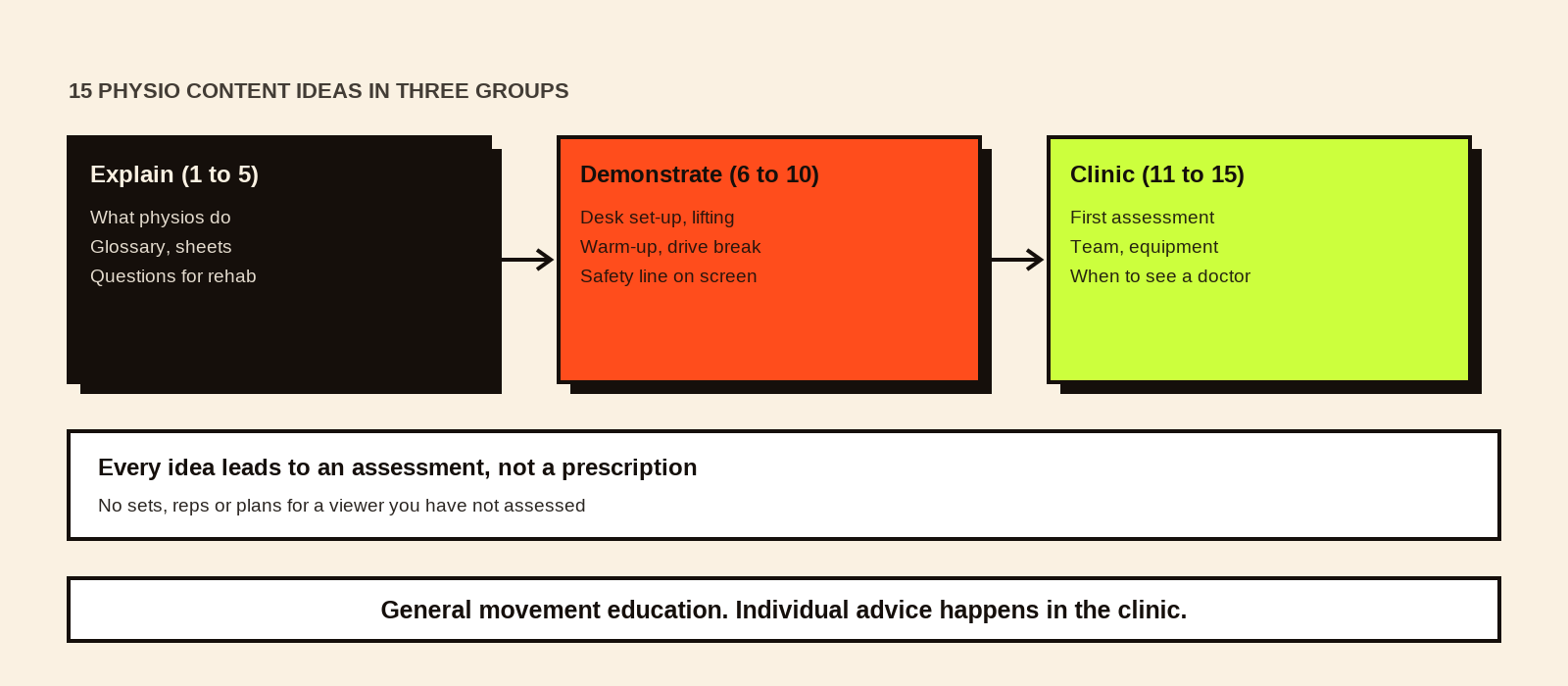
15 educational content ideas for a physiotherapy clinic
Each idea is specific enough to brief and shoot. Have the lead physiotherapist approve the script, and where an idea contains a health fact, keep it general and source it.
| # | Idea | Format | Guardrail |
|---|---|---|---|
| Group 1: Explain, generally | |||
| 1 | 'What a physiotherapist actually does': assessment, treatment and education, explained by the lead physio | Carousel | Describe your clinic's real services only |
| 2 | Glossary: range of motion, mobility, strength, load and other words patients hear at physio | Carousel | Plain definitions, no claims |
| 3 | 'Why your exercises differ from your neighbour's': how assessment shapes a plan | Talking-head Reel | No example plans for named conditions |
| 4 | How to read a home exercise sheet, using a blank sample | Screen-recorded walk-through | Use a dummy sheet, never a patient's |
| 5 | Questions to ask your surgeon about rehab before an operation | Checklist post | Questions only; answers come from the patient's own team |
| Group 2: Demonstrate, with safety framing | |||
| 6 | Desk set-up walk-through: chair height, screen position, taking breaks | Reel filmed at a clinic desk | Safety line; 'see a professional if pain persists' |
| 7 | Using a walking aid: the common handling errors to watch for | Short demo with staff | Say height and fit are set by the treating physio |
| 8 | A general warm-up before weekend sport | Reel | Safety line; no claims about preventing injury |
| 9 | Lifting a suitcase or shopping bags: technique basics | Reel | Safety line; no medical claims |
| 10 | A posture and breathing break for long drives | Story series | Only when parked; safety line |
| Group 3: The clinic and the first visit | |||
| 11 | 'What happens at your first assessment', step by step | Reel with a staff volunteer | Process only; no outcome language |
| 12 | What to wear and bring: reports, prescriptions, comfortable clothing | Carousel | Keep it current |
| 13 | Meet the team: names, qualifications and registration details as issued, areas they have trained in, languages | Profile posts | Copy credentials from certificates |
| 14 | Inside the treatment area: what each piece of equipment is used for | Walk-through video | Factual; no superiority claims |
| 15 | 'When to see a doctor first': signs that need medical review before physio, as agreed with your referring doctors | Carousel | General; reviewed by a doctor and a physio |
For turning these into a steady Reels rhythm, our guide to an Instagram Reels strategy covers formats and planning, and our guide to content from customer questions explains how to collect the questions patients actually ask at the front desk.
Filming demonstrations safely
- Use staff or consenting adult volunteers, never patients mid-treatment.
- Show the starting position, the movement and the finish clearly, at real speed, with no exaggerated range.
- Put the safety line on screen for the whole video, not just in the caption.
- Avoid numbers of repetitions, sets or durations that read as a prescription; say 'your physio will set the amount'.
- Don't promise outcomes ('fix your back in 7 days', 'never have knee pain again').
- Film in a tidy space with no files, screens or patients in frame.
- Get written consent from everyone who appears, covering platforms and how long you'll keep the video up.
Introducing the clinic and the team
Team introductions are where trust is built, and where overclaiming creeps in. State each person's qualifications exactly as on their certificates, their registration details once issued, the areas they have actually trained in, and the languages they speak. Titles and prefixes for physiotherapists have been the subject of official directives and public disputes in recent years, so use only the title your registration supports and check the current position with your State Council rather than following what other clinics do. Avoid 'expert', 'specialist' or 'best' unless you can show exactly what supports the word.
Answering 'what happens at the first visit?'
Most enquiries to a physio clinic are some version of 'can you help with my problem?' and 'what will happen?'. You can't answer the first without an assessment, but you can answer the second fully, and doing so honestly is what turns an anxious enquiry into a booking.
Thanks for reaching out. We can't advise on your condition here, but we can tell you what happens next. At a first assessment (about [duration] at [clinic]), the physiotherapist asks about your history, looks at how you move and explains what they find. If physiotherapy is suitable, they'll agree a plan with you; if you need to see a doctor first, they'll tell you. Please bring any reports or prescriptions. Fee: [amount]. To book, call or WhatsApp [number]. If you have severe or sudden symptoms, please seek medical care urgently.
Pin a post with the same information, and keep the address, timings, accessibility details and fees current. Clear process information, not promises, is what you want people to find on your profile.
Patient progress videos and stories
Rehab progress videos are emotionally powerful and the most common way physio clinics get this wrong. The draft NCAHP guideline proposes no requesting or sharing of testimonials and no images of 'healed/cured patients' or videos 'displaying impressive results'. Even before it is final, these posts also risk misleading viewers about what treatment will do for them, and health information is personal data under the Digital Personal Data Protection Act, 2023, whose Rules were notified on 14 November 2025 with phased compliance (PIB, 17 November 2025). The cautious policy: no patient progress videos or testimonials on the clinic's feed, and no identifiable patients in any content.
Common mistakes
- Answering 'which exercise for my disc problem?' in comments with a specific routine.
- Posting '10 exercises for knee pain' with sets and reps and no safety framing.
- Filming a patient's session because they said it was fine.
- Claiming a technique or machine 'cures' or 'permanently fixes' anything.
- Paying a marketing partner per new patient; the draft regulations also propose banning fee-splitting tied to referrals.
Where to start
Fix your profile and pinned 'first visit' post, agree the safety line and the enquiry reply, and pick five of the fifteen ideas for your first month. Check your registration position with your State Council, and if a doctor also practises at the clinic, see our guide to social media management for clinics for the NMC side.
If you want help turning footage your team records into Reels, an agency such as Kudozz can handle short-form editing and scheduling, while every script and final cut stays with your lead physiotherapist for approval.