How Pilates and Boutique Fitness Studios Can Build a Consistent Social Media Presence
How small-capacity Pilates, barre and boutique studios can post steadily: explain formats without medical claims, ease beginner nerves, communicate schedule and capacity honestly, and run trial and class-pack journeys.
Picture a reformer studio with eight machines and a waitlist on weekday evenings. It goes silent on Instagram whenever the founder teaches back-to-back, then posts a week's worth at once, mostly beautiful shots of the machines. New followers keep asking the same things in DMs: 'Is reformer harder than mat?', 'I've never done Pilates, can I join a regular class?', 'Anything at 7 am?'. The answers exist, just nowhere a stranger can find them.
Quick answer
Social media marketing for Pilates studios works when it is steady and explanatory: explain each format in plain words, ease beginner nerves, make the schedule and real capacity easy to read, and give trial classes and class packs a clear enquiry path. Describe what a class involves instead of promising posture, pain or body-shape results. A small team can sustain it with one filming session a fortnight and a fixed set of content concepts.
Why small-capacity studios need a different approach
A gym sells access to a floor; a boutique studio sells a place in a specific class with a specific instructor. That changes what your content has to do. The general fitness content mix is in our guide to social media strategy for fitness brands, and the gym membership journey is in our guide to social media marketing for gyms. For a studio with a handful of reformers or a small barre room, these are the differences:
- People must choose a format before they book, so explaining formats is core content, not filler.
- Every place in a class counts, so schedule changes, waitlists and cancellations need fast, clear communication.
- Beginners worry more, because a small class feels visible.
- Pricing is usually by single class or pack, which raises 'which pack?' questions that a gym rarely gets.
Explaining your formats without medical claims
Pilates is often marketed with lines like 'fixes your posture', 'cures back pain' or 'long, lean muscles'. The first two are health claims that the ASCI Code would expect you to substantiate; the third leans on body ideals that ASCI's guidelines on harmful gender stereotypes caution against. Describe what happens in the class and let people decide.
| Format | Describe it like this | Avoid |
|---|---|---|
| Mat Pilates | Floor-based class using body weight and small props such as balls and bands; [x] people per class | 'Fixes your posture', 'flattens your stomach' |
| Reformer Pilates | Class on a reformer, a sliding carriage with springs the instructor helps you set; [x] machines, so [x] places | 'Rehab for back pain' |
| Barre | Ballet-inspired class at a barre with small, repeated movements and light weights; no dance experience needed | 'A dancer's body' |
| Private sessions (if offered) | One-to-one session with [instructor], [training as named on the certificate] | Treatment claims of any kind |
| Boutique HIIT or cycle | [x]-minute interval class to music; the instructor shows lower-intensity options | 'Burn 800 calories' |
If physiotherapists run clinical sessions at your studio, they should describe their own work and registration accurately, and health questions should go to them. Our guide for physiotherapy clinics covers that side.
Content that answers beginner nerves
Start from the worries people actually voice in DMs and at the desk, and give each one a post that answers it. Here is a starting set:
| The worry | Content that answers it |
|---|---|
| 'Everyone will know what they're doing except me' | Your real policy: is there a foundations class, or can beginners join any class? Say it in one sentence. |
| 'The machine looks complicated' | An instructor sets up a reformer slowly, naming each part and spring. |
| 'I'm not flexible or fit enough' | Instructors showing the easier option for three common moves, without commentary on bodies. |
| 'What do I wear? Do I need special socks?' | A pinned 'what to bring' post with your actual rules on grip socks and water. |
| 'What if I'm late or have to cancel?' | Your arrival and cancellation policy, stated plainly, in a highlight. |
| 'I have an old injury' | A clear line: tell your instructor before class and check with your doctor or physiotherapist first. |
Schedule and capacity, communicated honestly
For a boutique studio the timetable is the product. Post the week's schedule on the same day each week, show availability only from your live booking system, and say when it was checked. A class that really has two places left can say so; a class that doesn't shouldn't. ASCI's guidelines on online deceptive design patterns treat implying that availability is more limited than it is as misleading, and false urgency also features in the CCPA's 2023 dark patterns guidelines.
THIS WEEK AT [STUDIO]
Mon 7:00  Reformer Foundations (beginners)  [instructor]
Mon 19:00  Mat Pilates  [instructor]
Tue 8:00  Barre  [instructor]
[...]

Availability is from our booking system at [time] on [date] and changes quickly.
Cancellation: free up to [x] hours before class; after that, [your policy].
Waitlist: we'll message you if a place opens; please confirm within [x] minutes.
New here? Start with [your beginner option].
Two enquiry journeys: trial class and class pack
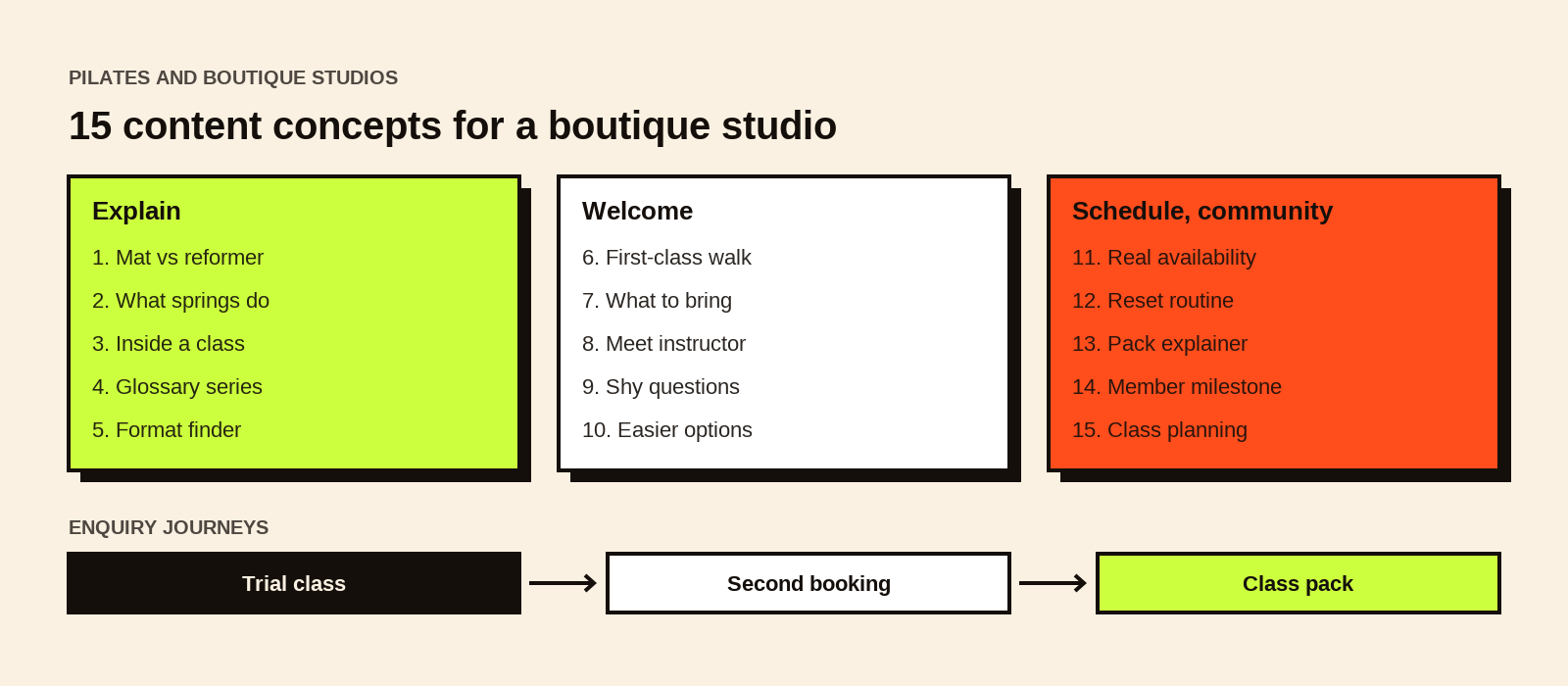
Most boutique enquiries follow one of two routes. Map both so every post knows which step it supports and every reply moves the person one step on.
| Step | Trial-class journey | Class-pack journey |
|---|---|---|
| Trigger | Sees a format explainer or beginner Reel | Has attended once, or a friend recommends you |
| Question | 'Is there something for complete beginners?' | 'Which pack suits me?' |
| Content that answers | 'Start here' highlight; first-class walkthrough | Pack comparison carousel with validity, freeze and expiry terms |
| Action | Books through the link in bio or a WhatsApp message | Buys online or at the desk |
| Follow-up | A message after class: how did it feel, which class next | A factual reminder before the pack expires |
| Signal to count | Trials booked and attended; second bookings | Packs bought; classes used per pack |
Great question! It depends mostly on how often you can come.

About once a week: [pack name], [number] classes, valid [period], [price]
Two or three times a week: [pack name], [number] classes, valid [period], [price]

Packs [can / can't] be paused for [reason, if allowed] and [can / can't] be shared.
If you're not sure yet, a single class at [price] is a fine way to start; there's no pressure to commit.
15 content concepts for a boutique studio
These concepts are grouped by job. Rotate through them and most weeks are planned before you sit down.
| # | Concept | Group | Format |
|---|---|---|---|
| 1 | 'Mat vs reformer in 30 seconds': the same movement shown on the floor and on the machine | Explain | Reel |
| 2 | 'What the springs do': an instructor changes the setting and explains lighter vs heavier | Explain | Reel |
| 3 | Inside a 50-minute class: warm-up, main sequence, cool-down, mapped slide by slide | Explain | Carousel |
| 4 | Glossary series: one term a week, such as footbar, carriage or neutral spine | Explain | Carousel series |
| 5 | Format finder: 'If you like slow and steady, try X', sorted by pace and setting, not results | Explain | Carousel |
| 6 | First-class walkthrough filmed from the front door to the reformer | Welcome | Reel |
| 7 | Grip socks, water and arrival time: the three things to know | Welcome | Stories highlight |
| 8 | Instructor introduction: name, training as on the certificate, one cue they always use | Welcome | Reel |
| 9 | 'Questions you were too shy to ask', answered by an instructor | Welcome | Reel series |
| 10 | Easier options for three common moves, shown side by side | Welcome | Reel |
| 11 | Weekly timetable with real availability and any new class or instructor | Schedule and community | Stories and pinned post |
| 12 | Reset between classes: wiping down, re-setting springs and props, described factually | Schedule and community | Reel |
| 13 | Class-pack explainer: validity, pausing, sharing and expiry rules in one place | Schedule and community | Carousel |
| 14 | A member's milestone in their own words, such as a first full class without stopping, with consent | Schedule and community | Carousel |
| 15 | An instructor plans a themed class: playlist, sequence sketch, props laid out | Schedule and community | Reel or Stories |
Staying consistent with a small team
Consistency in a small studio comes from batching, not from finding spare time each day. Book a quiet slot every fortnight, film 10 to 12 short clips against your concept list, and schedule them across the next two weeks. Have the lead instructor check every exercise clip for technique and safety cues before it goes out. One person owns DMs at fixed times, so waitlist and trial messages don't sit overnight. Our guide to planning a month of Reels shows how to turn one filming session into varied posts.
- Batch-day shot list: two format explainers, two instructor clips, one walkthrough, one reset clip, three easier-option demos, two spare B-roll clips of the empty room.
- Film members only with written consent; otherwise film instructors or the empty studio.
- Keep a running list of DM questions to feed the next batch day.
- Check every caption against the 'avoid' column before scheduling.
A steady presence, week by week
Begin with three fixed points: a weekly timetable post on the same day, one format explainer and one beginner post. Add the enquiry replies above to your saved replies, then work through the 15 concepts over the next six weeks. The mistakes to avoid are the ones that break trust in a small room: fake 'almost full' notices, posture and pain claims, and members filmed without asking.
If you'd like a team to plan, edit and schedule from your fortnightly footage, Kudozz's social media management includes Reels and short-form editing within an agreed scope; filming days and paid promotion are scoped separately.