Social Media Marketing for Wellness Brands: Educating Customers Without Making Unsupported Health Claims
How supplement, nutraceutical, Ayurvedic and wellness-service brands in India can educate on social media without health claims they can't support: which rulebook applies, a claims ladder, testimonials and a copy-ready content verification checklist.
Your ashwagandha capsules are selling, and a customer DMs a glowing message: 'My anxiety is gone and I finally sleep.' The founder wants it on the feed tomorrow. Your copywriter has drafted 'Nature's answer to stress' and an AI tool has offered a before-and-after image of a tired face turning radiant. All three would sit naturally on a wellness feed, and all three could put the brand on the wrong side of Indian advertising law.
Quick answer
Wellness brands can market well on social media by describing products accurately, educating on lifestyle in general terms, and making only those benefit claims they can substantiate and that their regulatory category allows. Disease claims, such as treating, curing or preventing a condition, are off-limits for supplements and nutraceuticals and restricted for medicines. Check every post against the label, the evidence file and a written checklist before it goes live.
First, which rulebook is your product under?
'Wellness' is a marketing word, not a legal category. The rules that apply depend on what you actually sell, and the same brand can sit in more than one row.
| What you sell | Main rules (verify for your product) | What it means for posts |
|---|---|---|
| Health supplements and nutraceuticals (FSSAI-licensed foods) | FSS (Health Supplements, Nutraceuticals...) Regulations, 2016 as amended; FSS (Advertising and Claims) Regulations, 2018; ASCI Code | No disease prevention, treatment or cure claims; structure or function statements only where allowed and supported |
| Ayurvedic, Siddha, Unani or Homoeopathic medicines (licensed as drugs) | Drugs and Cosmetics Act, 1940 and Rules; Drugs and Magic Remedies (Objectionable Advertisements) Act, 1954; ASCI Code | No advertising for the purposes in section 3 of the 1954 Act; no false or misleading drug claims (section 4) |
| Herbal cosmetics, oils and skincare | Cosmetics rules and ASCI Code | See our guide to beauty and skincare brands |
| Wellness services: studios, retreats, therapy centres | ASCI Code and consumer protection law; practitioners follow their own council's code | Describe the experience; no therapeutic outcomes |
If you're not sure which row you are in, your licence tells you: an FSSAI licence for a health supplement and an AYUSH drug manufacturing licence lead to different rules. For cosmetics, see social media marketing for beauty and skincare brands.
The claims ladder
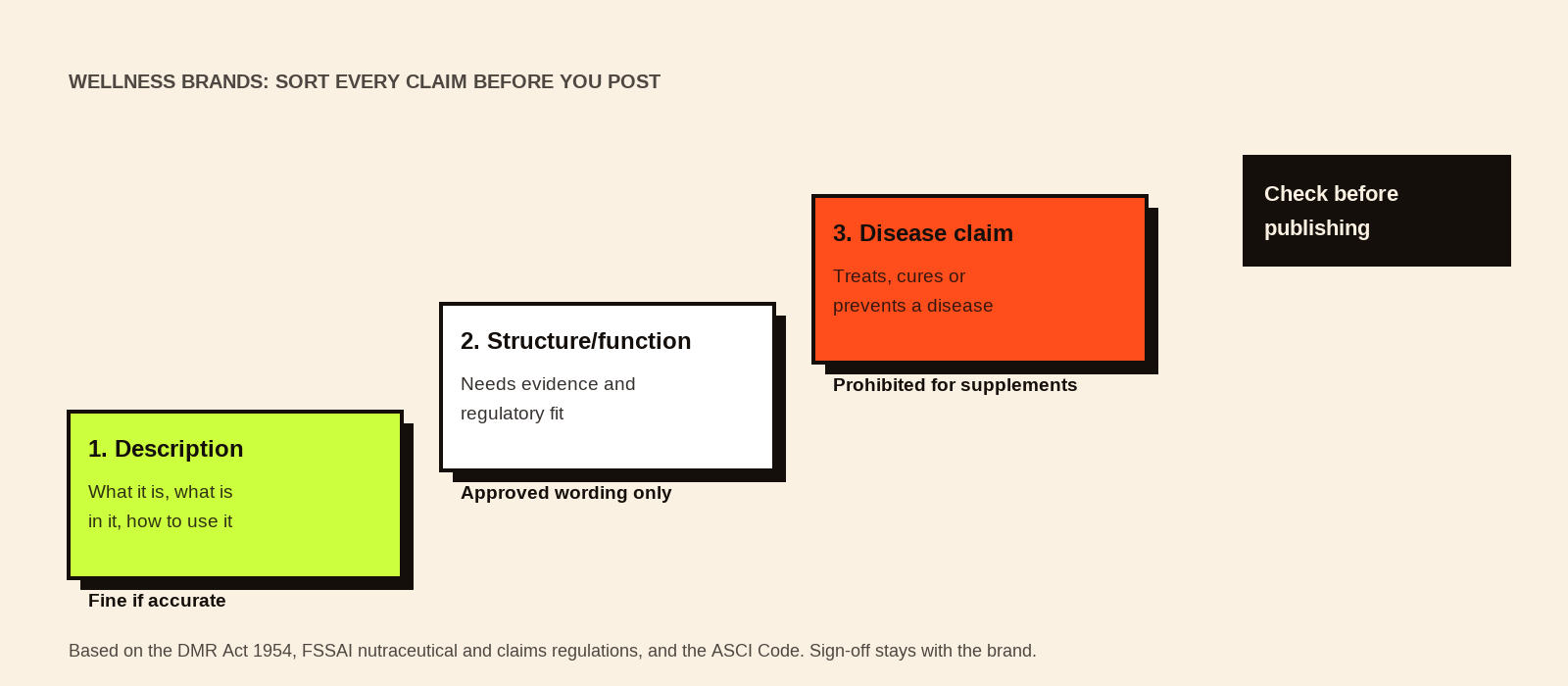
Sort every sentence in a draft onto one of three rungs before anyone designs a graphic. The higher the rung, the more evidence and regulatory fit it needs, until the top rung, which is simply not available to supplements and nutraceuticals.
| Rung | What it looks like | What you need | Example (hypothetical) |
|---|---|---|---|
| 1. Description | What the product is, what is in it, how to use it, how it tastes, where it comes from | Accuracy against the label and your supplier records | 'Each capsule contains [ingredient] extract. Take as directed on the pack.' |
| 2. Nutrient, structure or function claim | A statement about a nutrient or about a normal body function or general well-being | Generally accepted scientific data, the claim must fit your category and any FSSAI approval needed, and the evidence file must be ready if asked | Only wording your regulatory owner has approved for this product |
| 3. Disease claim | Prevents, treats, cures, mitigates or reverses a disease or condition, including by implication | Not allowed for health supplements and nutraceuticals; restricted for drugs under the 1954 Act | 'Cures anxiety', 'controls sugar', 'boosts immunity against infections' |
Implied claims count. FSSAI's nutraceutical regulations prohibit implied claims of curing disease or drug-like efficacy, and implied cure claims through a product's name or through pictures and symbols, giving an ECG tracing and a lipid profile as examples (regulation 4(8)(vii) and (viii)). A heart-shaped graphic next to 'cholesterol care' can climb the ladder without a single word saying 'cure'.
What the rules say, as of November 2026
This is orientation, not legal advice. Your regulatory affairs owner or legal adviser approves any claim, and the current consolidated texts on the regulators' websites prevail over this summary.
| Source | What it says (summarised) | Status note |
|---|---|---|
| Drugs and Magic Remedies (Objectionable Advertisements) Act, 1954 | Section 3: no advertisement suggesting a drug for diagnosing, curing, mitigating, treating or preventing diseases in its Schedule, among other purposes. Section 4: no false or misleading drug advertisements. Section 5: no advertising magic remedies for those purposes | In force; 'advertisement' is defined broadly, including any notice or announcement by light or sound |
| FSS (Health Supplements, Nutraceuticals...) Regulations, 2016 | Regulations 6(3)(i) and 7(4)(i): labelling, presentation and advertisement shall not claim the product prevents, treats or cures a human disease. Structure or function statements may be allowed if supported by generally accepted scientific data. Labels carry 'NOT FOR MEDICINAL USE' | FSSAI compendium Version I, 29 September 2021; FSSAI has issued amendments and directions since, so check the current text |
| FSS (Advertising and Claims) Regulations, 2018 | Claims must be truthful and not misleading; no prevention, treatment or cure claims unless the regulations permit them; no promotion using the FSSAI logo and licence number | Amended several times; check the current text |
| ASCI Code, Chapter I | Claims of objectively ascertainable fact must be capable of substantiation | Self-regulatory code |
| ASCI influencer guidelines (6 March 2025) | Anyone posting health or nutrition advice must have and state relevant qualifications upfront | Applies to creators and to experts you feature |
| ASCI guidelines on synthetically generated content (17 September 2026) | Prohibit AI-fabricated testimonials and misleading AI before-and-after visuals; label material AI content | Stated to take effect three months after publication |
| Rule 170, Drugs and Cosmetics Rules, 1945 (state pre-approval of Ayurvedic, Siddha and Unani ads) | Omitted by a Ministry of AYUSH notification of 1 July 2024; the Supreme Court stayed the omission in August 2024 and vacated that stay on 11 August 2025, as reported by Bar and Bench | We could not confirm the current position from an official source. Check with counsel; the 1954 Act and ASCI Code apply either way |
Sources: the 1954 Act on India Code, FSSAI's nutraceutical regulations compendium, FSSAI's advertising and claims compendium, the ASCI Code and ASCI's guidelines page.
The Rule 170 history is summarised from court reporting by Bar and Bench; treat it as a point to confirm with your legal adviser, not settled guidance.
Education that informs without advising
The line to hold is between lifestyle education and medical advice. 'Here is what the label means' and 'here is how people commonly build an evening routine' are education. 'If you have thyroid issues, take two of these' is medical advice, and a brand account is the wrong place for it. Keep these content pillars and the line will mostly take care of itself.
- Label literacy: what each line on your pack means, the serving size and the warnings, read straight from the label.
- Ingredient origins: where an ingredient comes from and how it is processed, only with records you can produce.
- How to use: dosage as printed, timing, storage, what not to combine it with if the label says so.
- Routines: sleep hygiene, movement, hydration and meals described as general habits, with sources such as the Ministry of Health or WHO.
- Expert explainers: qualified nutritionists, dietitians or Ayurveda practitioners who state their qualifications upfront, speaking generally and not about your product's effect on a disease.
- Behind the brand: sourcing trips, quality checks you actually perform, and the team, with consent.
Every educational post should close with a line such as 'This is general information. If you have a health condition, are pregnant or take medicines, speak to your doctor before using supplements.' Have the wording reviewed once by your regulatory owner and reuse it.
Testimonials, reviews and customer stories
Customer stories are where wellness brands most often slip into disease claims, because customers describe their experience in medical words. A testimonial that says a product 'cured my PCOS' is a disease claim when the brand publishes it, whoever wrote it.
- Only use genuine experiences, with written consent that names the post, platform and duration.
- Edit out disease and outcome language rather than publishing it with a disclaimer; ASCI's guidelines say a disclaimer cannot correct a misleading claim.
- Prefer experience words (taste, ease of use, routine, packaging) over results.
- Never show 'typical results' you can't substantiate, and never pay or discount for reviews without clear disclosure.
- Never use AI to create or alter a testimonial or a body or face transformation.
- Celebrities and creators need the same discipline; our guide to Ayurveda and nutraceutical influencer marketing covers creator briefs.
Our guide to customer testimonials and UGC covers permissions and evidence in more depth, and Ayurveda and nutraceutical influencer marketing covers the creator side.
Wellness content verification checklist
Copy this into your approval tool and complete it for every post, Reel, Story and reply template. A post that fails any line goes back to the writer, not to design.
POST ID: ________  PRODUCT(S): ________  WRITER: ________  REVIEWER: ________

CATEGORY
[ ] Regulatory category confirmed (health supplement / nutraceutical / AYUSH drug / cosmetic / service)

CLAIMS
[ ] Every sentence sorted onto the claims ladder (description / structure-function / disease)
[ ] No prevention, treatment, cure or mitigation of any disease, stated or implied
[ ] No implied cure through product name, imagery, symbols or medical-looking graphics
[ ] Any structure or function statement matches approved wording and the evidence file
[ ] Every fact matches the current label (ingredients, dose, warnings, 'NOT FOR MEDICINAL USE' where required)
[ ] No 'doctor recommended', 'clinically proven' or official endorsement without written proof
[ ] No FSSAI logo or licence number used as a selling point

PEOPLE AND PROOF
[ ] Experts shown have stated relevant qualifications upfront
[ ] Testimonials genuine, consented in writing, and free of disease or outcome claims
[ ] No AI-generated testimonial, person, or before-and-after visual; any material AI content labelled
[ ] Paid, gifted or affiliate relationships disclosed

FINAL
[ ] 'General information, speak to your doctor' line included where relevant
[ ] Offer terms (if any) stated in full; no false urgency
[ ] Regulatory or legal owner signed off: ________ DATE: ________
Phrases that usually climb the ladder
| Draft phrase | Problem | Safer direction |
|---|---|---|
| 'Boosts immunity' | Immunity claims for foods need approval and specific wording | Use only approved wording, or describe the ingredient |
| 'Detox your body' | Implies a physiological effect you probably can't substantiate | Describe the ritual or ingredients |
| 'Natural, so no side effects' | A safety claim, and 'natural' is a restricted word for foods | State the label warnings plainly |
| 'Stress relief in a capsule' | Edges towards treating a condition | Describe when and how people use it |
| 'Doctor approved' | An endorsement claim that needs proof | Name the qualified expert and what they actually said |
Wellness studios and retreats
Service brands have the same problem in a different form. 'A 60-minute Abhyanga massage with warm oil, followed by rest' sets expectations; 'heals back pain and insomnia' is a therapeutic claim. Describe duration, what happens, what to wear, who leads the session and their actual qualifications, and leave outcomes out. Where an Ayurveda or other AYUSH practitioner is involved, they follow their own commission's code, so ask them what they may say publicly. Spas without a medical element can follow our guide to Instagram marketing for spas.
Where to begin
Start by writing down your regulatory category for each product, building a short approved-claims sheet with your regulatory owner, and adopting the checklist above. Then audit your last 30 posts against the claims ladder and quietly archive anything on the top rung. Education-led content takes longer to plan, but it builds the kind of trust that unsupported claims can't.
What an agency like Kudozz includes for wellness brands is planning, copywriting, design and publishing within an agreed scope, with claims approved by the brand's regulatory or legal owner; a social media team does not replace that sign-off.