Social Media Marketing for Beauty and Skincare Brands: A Practical Content Strategy
How a beauty or skincare brand can run its own social accounts: education, ingredient explainers, honest demonstrations, routines, creators, UGC and community care, with the claims and disclosure rules that apply in India.
A customer comments under your new serum post: 'Will this work on my acne scars?' Two hours later nobody has replied, and three other people have asked the same thing. Meanwhile your feed is mostly product shots on pastel backgrounds. Beauty buyers come to social media to learn, compare and check whether a product suits someone like them, and a feed that only announces products gives them very little to go on.
Quick answer
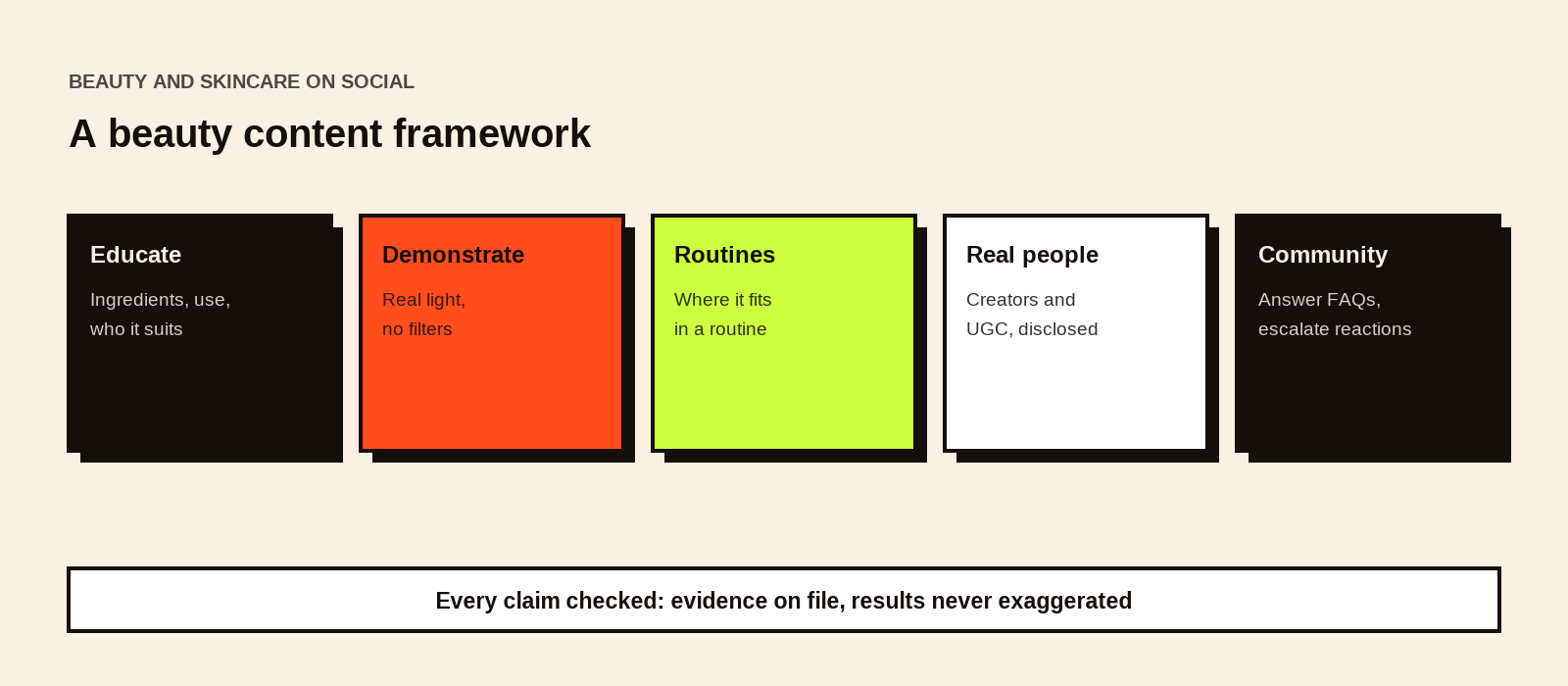
Social media marketing for beauty brands works best as a teaching channel. Build the calendar around product education, ingredient explainers, honest demonstrations, routines, creator content and customer UGC, and answer questions quickly. Every claim needs evidence under the ASCI Code, skin results must never be filtered or exaggerated, and paid creators must disclose. Adverse reactions are a brand matter: social managers acknowledge and escalate, never diagnose.
What beauty buyers look for on social
Most beauty purchases involve a question the product page can't fully answer. What does the texture feel like? Will this shade match my undertone? Can I use it with retinol? Is it suitable for oily skin in Chennai humidity? Social content is where you answer these questions visually and repeatedly, in the formats people actually watch.
That shifts the job of your feed. Instead of 'what do we want to announce this week', the planning question becomes 'what does a buyer need to see or understand before trusting this product'. Launches and offers still matter, but they land better on a feed that has been useful in between.
The content pillars that carry a beauty feed
These pillars cover most of what a beauty or skincare brand needs. The mix will differ by brand: a colour cosmetics label leans on demonstrations and shade content, while an actives-led skincare brand leans on education and routines.
| Pillar | What it looks like | Watch-out |
|---|---|---|
| Product education | What the product is for, who it suits, how much to use, what it pairs with | Describe purpose, not promised results |
| Ingredient explainers | What an ingredient is, why it's in the formula, how to patch test | No efficacy or medical claims beyond what you can substantiate |
| Demonstrations and tutorials | Texture, application, swatches across skin tones, wear through the day | No filters, smoothing or colour effects on skin or product |
| Routines | Morning and night routines, layering order, routines by skin type or season | Note that routines are general guidance, not personalised advice |
| Creator partnerships | Creator tutorials, reviews and routines, shared or co-posted | Disclosure, approved claims, usage rights |
| Customer UGC | Reposted customer videos and photos, with permission and credit | Never edit to change the result; never imply paid content is organic |
| Customer FAQs | Short answers to the questions in comments and DMs | Route skin concerns and reactions to the brand team |
| Launches | Teasers, reveals, how-to-use content, first customer reactions | Launch claims need the same evidence as any other claim |
| Community | Replies, polls, 'you asked' Stories, behind the formulation | Reactions and complaints follow the escalation path |
Education and ingredient explainers without efficacy claims
Education posts build trust, but they are also where brands slip into claims they can't support. 'Niacinamide is a form of vitamin B3' is a description. 'Our serum fades dark spots in two weeks' is an efficacy claim, and it needs evidence on file. The ASCI Code says claims relating to objectively ascertainable facts must be capable of substantiation, and that advertisers must produce that substantiation when ASCI asks.
A safe working rule for your content team: explain what an ingredient is and why it's in the formula, use only claims your product team has signed off with evidence, and leave anything that sounds like treatment out. Words such as 'cures', 'heals', 'treats acne' or 'clinically proven' should never appear in a caption unless your regulatory team has approved that exact wording.
Cosmetics in India also sit under law, not only self-regulation: CDSCO publishes the Cosmetics Rules, 2020 alongside the Drugs and Cosmetics Act, 1940. Where a claim starts to sound medical, or where you're unsure what a cosmetic can be described as doing, check with your regulatory or legal team before it goes into the calendar. A social media manager can flag the risk; they shouldn't be the one deciding it.
Demonstrations, tutorials and before-and-after content
Demonstrations are the most persuasive beauty content because they show the product doing something. They also carry the most risk, because editing can change what the viewer sees. Film texture and swatches in natural light, show shades on a range of skin tones, and keep beauty modes and skin-smoothing filters off. ASCI's guidance for influencer advertising tells brands not to ask creators to use filters that enhance the impression of a product's benefit, and the same standard should apply to your own posts.
Before-and-after content needs particular care. Use the same lighting, angle and camera, state the timeframe and how the product was used, and make sure the result is typical rather than your best case. If you sell skin-lightening or fairness-related products, ASCI has a specific guideline for that category, listed with its other guidelines; read it before planning any comparison visuals.
- Same light, angle and distance in before and after shots.
- No filters, retouching or colour correction on skin or product.
- Timeframe and usage stated in the caption.
- Result is typical, and the claim behind it has evidence on file.
- Written consent from the person shown, including for reuse in ads.
- Approved by the person who owns claims on your side, not only by the content team.
Routines, creators and customer UGC
Routine content works because it shows where a product fits rather than selling it alone. A 'night routine for oily skin' Reel can include your cleanser and moisturiser alongside generic steps such as sunscreen in the morning. It's useful, it's shareable and it doesn't need a claim.
Creators add range your brand can't show by itself: different skin types, tones, ages and budgets. When creators post about your product in exchange for money, free product or any other benefit, the post needs a disclosure. ASCI's do's and don'ts list labels such as #Ad, #Collaboration and #Partnership, and say disclosures shouldn't be hidden in a bio or buried in a caption. On Instagram, the paid partnership label is Meta's own tool for branded content. Choosing and briefing creators is covered in influencer marketing for beauty brands in India, and creator search is part of our creator discovery service.
Customer UGC is the most believable content on a beauty feed, provided you repost it with permission, credit the customer and never edit it to improve the result. For formats, briefs and testing, see UGC for beauty and skincare brands. If you need a steady supply of UGC-style videos made for your own channels, that's what UGC content production covers.
Customer FAQs and launches
Keep a running list of every question that appears in comments and DMs, and turn the repeats into content: a carousel on layering order, a Reel on patch testing, a Story answering 'can I use this in pregnancy?' with 'please check with your doctor' rather than a guess. Our guide to turning customer questions into social media content shows how to build these into recurring series.
For launches, plan a short sequence rather than one big post: tease the texture or the problem the product addresses, reveal the product with how-to-use content, then share early customer and creator content once it exists. Make sure claims in launch copy were approved before the teaser, because the teaser often sets the language everything else repeats.
Community management: reactions and complaints
Beauty comment sections carry a specific risk: someone reports a rash, burning or breakout after using your product. Your social team's job is to respond kindly, avoid any diagnosis or argument, move the conversation to a private channel and escalate to the brand team the same day. The brand decides on product safety follow-up, refunds and any regulatory reporting. The boundary between public replies and customer support is set out in community management vs customer support.
We're really sorry to hear this, and thank you for telling us. Please stop using the product for now. We'd like to understand what happened, so we've sent you a DM to collect a few details. If symptoms are severe or don't settle, please see a doctor.
Common mistakes
- Posting 'results' content with beauty filters or retouching left on.
- Letting captions use claim words ('clinically proven', 'heals') nobody has approved.
- Showing shades or results on one skin tone only.
- Reposting customer photos without asking, or cropping out their credit.
- Answering a reported reaction publicly with product defence or medical advice.
- Treating creator content as organic customer content.
Practical recommendations
- Keep an approved claims list, with the evidence behind each, and share it with everyone who writes captions.
- Add a claims and filter check to your approval step for every beauty post.
- Film demonstrations in natural light and across the skin tones you sell to.
- Keep a living FAQ document fed by comments and DMs, and plan from it monthly.
- Write an escalation path for reactions, with a named person and a same-day response target.
- Get written permission before reusing any customer or creator content.
If you'd rather hand the day-to-day running to a team, our social media management for brands covers planning, design, Reels editing, publishing and community management within an agreed scope, with claims approval staying with you.
Where to start
Start with the questions your customers already ask, and make the answers your core content. Put a claims list and a no-filters rule in place before you scale production, and agree how reactions get escalated. A beauty feed that teaches honestly earns more trust than one that only shows products looking perfect.