UGC Content for E-commerce: How Brands Can Use Creator Content to Increase Product Sales
UGC does different work at different points in the e-commerce journey. Where it actually belongs, from a product page to a post-purchase email, and what it can realistically be expected to do.
Most brands think of UGC as an ad-creative problem and stop there. But the same content, a demo video, a genuine testimonial, does real work sitting on a product page next to the buy button, in a post-purchase email, or on a marketplace listing, places most teams never get around to putting it.
Quick answer
UGC supports e-commerce sales by providing proof at the specific moments a buyer is deciding, whether that's a paid ad first introducing the product, a product page demo removing uncertainty, or a retargeting ad addressing hesitation after someone leaves without buying. It's not a guarantee of increased sales on its own, its effect depends on placement, relevance, and execution, but it consistently addresses trust and clarity gaps that plain product photography and copy leave open.
The UGC E-commerce Funnel
| Stage | What the buyer needs | How UGC helps |
|---|---|---|
| Discovery | To notice the product at all | Native-feeling UGC ad creative in a paid or organic feed |
| Product interest | A reason to look closer | A hook-driven demo or first-impression video |
| Proof | Evidence the product does what it claims | Testimonials, reviews, and demonstration content |
| Product page | Clarity on fit, use, and quality before buying | Embedded video demos and reviews addressing common questions |
| Consideration | Reassurance while comparing options | Comparison-style or FAQ UGC addressing hesitation |
| Purchase | A final nudge to complete the transaction | A clear, specific testimonial or offer-driven content |
| Post-purchase | Confirmation the decision was right | Usage and routine content reinforcing satisfaction |
| Advocacy | A reason to share their own experience | An easy way to submit their own content, feeding the next cycle |
UGC on product pages and in product descriptions
A short demo video embedded directly on a product page addresses questions a static photo and bullet-point description can't, how something actually fits, sounds, moves, or gets used. This tends to matter most for products where the buyer has a real, specific uncertainty, sizing, texture, technical function, rather than for simple, well-understood items.
Putting UGC on product pages: an implementation checklist
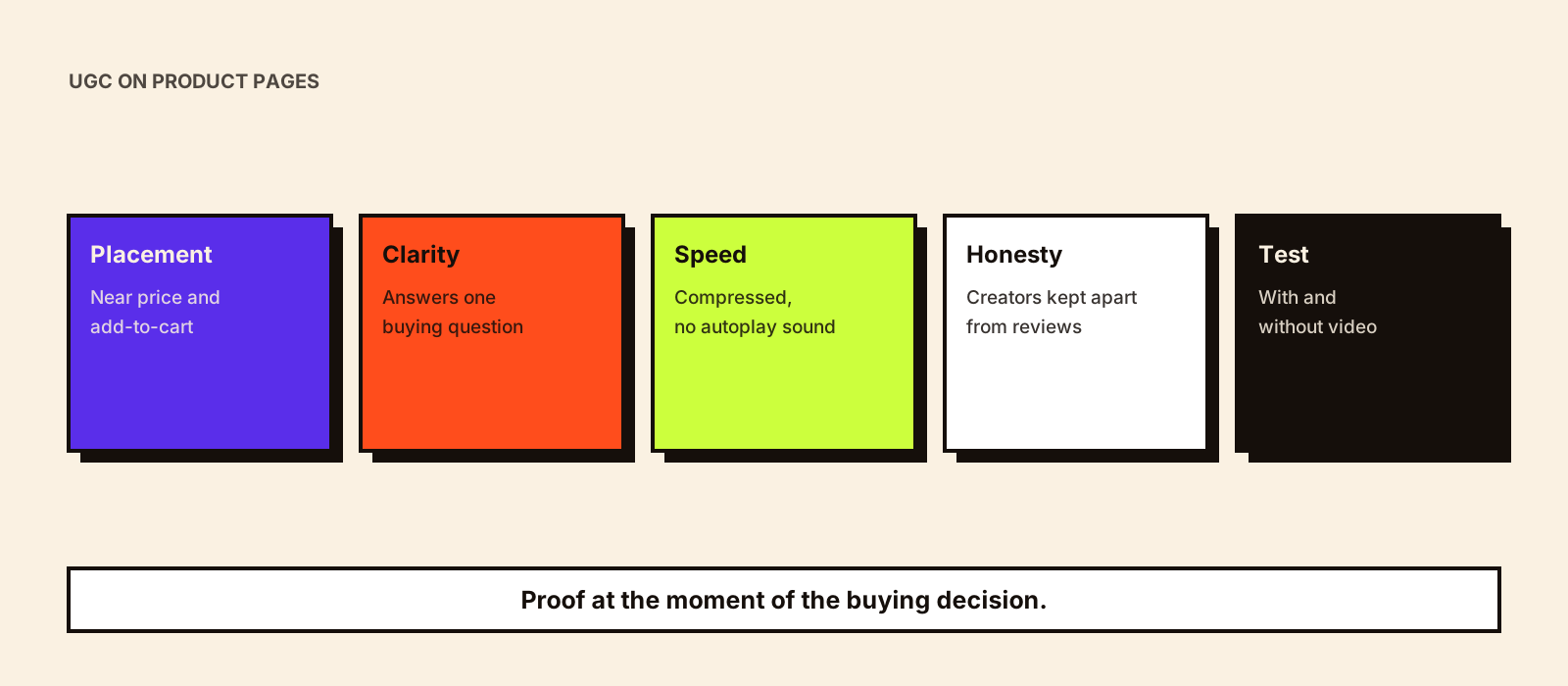
- Place the video near the price and add-to-cart, answering the page's main buying question.
- Use a clear poster frame and don't autoplay with sound.
- Keep pages fast: compress video, load it only when needed, and check mobile load times after adding it.
- Add captions and a short text summary or transcript, which helps shoppers who can't play sound and makes the content readable for search engines.
- Keep commissioned creator videos separate from customer reviews, and don't label paid content as a customer review.
- Show only content whose usage rights cover your website, and remove it when rights expire.
- Test pages with and without the video (or with different videos) and compare conversion rate, not just play rate.
If you host video on the page, Google's video structured data guidance explains how to help search engines understand it. Rules on presenting reviews and testimonials honestly are covered in customer testimonials and UGC without losing trust.
Reviews, testimonials, and social proof
Video testimonials carry more weight than text reviews alone for buyers who are still uncertain, since tone, specificity, and visible authenticity are harder to convey in text. This works best paired with, not replacing, a standard text review system, which serves buyers who want to scan quickly.
UGC in ads, email, and WhatsApp
The same core UGC assets can be adapted across channels: a full-length demo for a product page, a trimmed version for a paid ad, a still frame or short clip for an email campaign, and, where a brand uses WhatsApp for customer communication or catalog sharing, a short clip that fits that more personal, conversational context.
UGC on marketplaces
Where a marketplace listing supports video content, the same demo and testimonial content used on a brand's own site can be uploaded there too, since marketplace buyers face the same trust and clarity questions, often with even less brand familiarity than a direct-site visitor.
Sellers who depend mainly on Amazon or Flipkart face extra rules on reviews and limited tracking; see influencer marketing for Amazon and Flipkart sellers.
UGC in retargeting
A visitor who left without buying often has a specific, addressable hesitation, price, fit, whether it actually works as claimed. Retargeting UGC that speaks to a likely objection, rather than simply repeating the original ad, tends to be a more useful second touch.
Shoppable and conversion-focused UGC
Where the platform supports it, tagging products directly within UGC-style content, on social posts or product pages, shortens the path from seeing the content to reaching checkout. This is a distribution and tagging decision more than a content-creation one, the underlying UGC still needs to earn attention and trust on its own.
Building a creator content library for product pages
Brands that run several campaigns a year end up with hundreds of creator videos and photos scattered across drives and inboxes. A library makes them usable: anyone building a product page, email or ad can find the right asset and see whether they're allowed to use it.
| Field | Why it matters |
|---|---|
| Product and variant (SKU) | Find content for a specific page; spot products with none |
| Format and length | Vertical video, square, still, under 15 seconds |
| Use case or question answered | Fit, setup, comparison, routine |
| Creator and audience | Match content to the page's audience and language |
| Usage rights and expiry | Which channels are allowed, until when |
| Claims made | Check claims are approved before reuse |
| Performance where known | Reuse what has worked in ads or email |
Review the library per product: which top-selling products have no demonstration, which only have content whose rights expire soon, and which questions from reviews have no answering video. Usage periods and channels are explained in influencer usage rights.
Text versions of what creators say (captions, transcripts, summarized tips) also make product pages clearer for search engines and AI shopping assistants; see creator reviews and AI shopping assistants.
Matching content to email, landing pages and product pages
| Channel | Best content | Notes |
|---|---|---|
| Product page | Demonstrations answering the main purchase question | Keep it near the price and add-to-cart; add captions |
| Landing page for a campaign | The same creator the visitor just saw | Message match reduces drop-off |
| Email and WhatsApp | A still or GIF linking to the full video | Video often doesn't play inside email |
| Post-purchase messages | Setup and first-use tutorials | See influencer marketing for customer retention |
| Paid ads | Short cuts with a strong opening | Needs paid-usage rights |
Post-purchase sequences are covered in influencer marketing for customer retention.
Creator content on comparison pages
Comparison pages ('our product vs the leading alternative') are useful to buyers, and creator demonstrations can make them more convincing. They also carry the most risk. Comparative claims in advertising must be fair, factual and verifiable under ASCI's code, so a creator saying 'this one lasts twice as long' needs the same evidence as your own copy. Prefer creators showing both products in use and describing differences in their own words, avoid disparaging competitors, keep evidence on file for any measurable claim, and remove content when products change. Wider disclosure and claims rules are in influencer marketing compliance.
UGC for product launches specifically
A launch benefits from UGC across the full funnel at once, pre-launch teaser content, day-of demonstration content, and post-launch testimonials, rather than a single asset expected to do all of that work. See how to find the right influencers for a product launch for the creator-sourcing side of a launch specifically.
UGC supports conversion, it doesn't guarantee it. Actual impact on sales depends on product fit, offer, pricing, and execution quality, and should be measured directly rather than assumed from general claims about the format.
The product page is where a buyer makes the actual decision. Most brands put their best UGC in an ad and their worst description on the page that closes the sale.— Kudozz Strategy Team
Related reading: How Indian e-commerce brands can grow with influencer marketing.