How to Work With an Influencer Marketing Agency as a Creator
How influencer marketing agencies work with creators in India: getting on their lists, the campaign flow, legitimacy checks, red flags and reply templates.
An email lands from an agency you have never heard of: a skincare brand, three Reels, a tight deadline, and a request for your rates by tonight. Is it real, what happens next, and how do you look professional without overcommitting? This guide explains how influencer marketing agencies usually work with creators in India, how to check them, and how to run a campaign cleanly from brief to payment.
Quick answer
An influencer marketing agency runs campaigns for brands and hires creators for specific deliverables. To work with one, keep a clear profile and media kit ready, get onto agency lists through their creator application forms or by replying well to inbound briefs, and confirm deliverables, timelines, usage rights and payment terms in writing before you create anything. A legitimate agency has verifiable company details and a real domain email, and it never asks you for a fee, OTP or password. Registering with an agency does not guarantee you any campaigns.
Campaign agencies vs talent managers
The word "agency" covers two different jobs, and mixing them up causes most of the confusion creators run into.
| Campaign agency (influencer marketing agency) | Talent manager or creator management agency | |
|---|---|---|
| Who it works for | The brand. The brand is its client. | You. You are its client or signed talent. |
| What it does for you | Offers you specific campaigns with a brief and a fee | Finds deals, negotiates, handles admin across many brands |
| Typical relationship | Campaign by campaign, often non-exclusive | Ongoing contract, sometimes exclusive |
| How it is paid | By the brand | Usually a share of your deals, as agreed in your contract |
Both can be useful, and some companies do both. If you are deciding whether to sign with someone long-term, read our comparison of a creator manager vs an agency before you sign anything exclusive. The rest of this guide is about the first kind: agencies that bring you a campaign on behalf of a brand.
How creators usually get onto agency lists
Agencies need a steady supply of creators who fit different briefs, so most use some mix of these routes:
- Creator application forms. Many agencies have a page where you share your handles, niche, languages, city and audience. Your details go into their database so the team can find you when a fitting brief comes in.
- Rosters and shortlists. For each campaign, the agency shortlists creators who match the brand's category, audience and budget, then sends the list to the brand for approval. Being in the database is not the same as being shortlisted.
- Inbound discovery. Agency teams also search Instagram and YouTube directly for a niche or city, so a clear bio and a business email still matter.
- Referrals and past work. Creators who delivered on time and reported cleanly are easier to recommend for the next brief.
If you want to see what an application looks like, here is what agencies ask for when you apply to a creator network. Kudozz, for example, reviews applications personally, does not charge creators to join, and there is no obligation until a campaign fits. The same rule applies to every agency, including Kudozz: joining a list is a way to be considered, not a promise of work.
What to prepare before an agency contacts you
- A tidy profile: bio that says your niche, language and city, a business email, and pinned posts that show your best work.
- A one-page media kit with audience basics, formats you make and a few past collaborations (or sample content if you are new).
- Rate card basics: a starting range per format and what is included, so you can reply the same day without guessing.
- Recent screenshots of your analytics, because agencies often ask for reach, views and audience location before shortlisting.
- Payment paperwork: PAN, GSTIN if you are registered, bank details and an invoice format.
Our guide to building a creator media kit covers the kit itself, and the influencer rate card guide covers pricing, so we will not repeat them here.
How a legitimate agency campaign flows
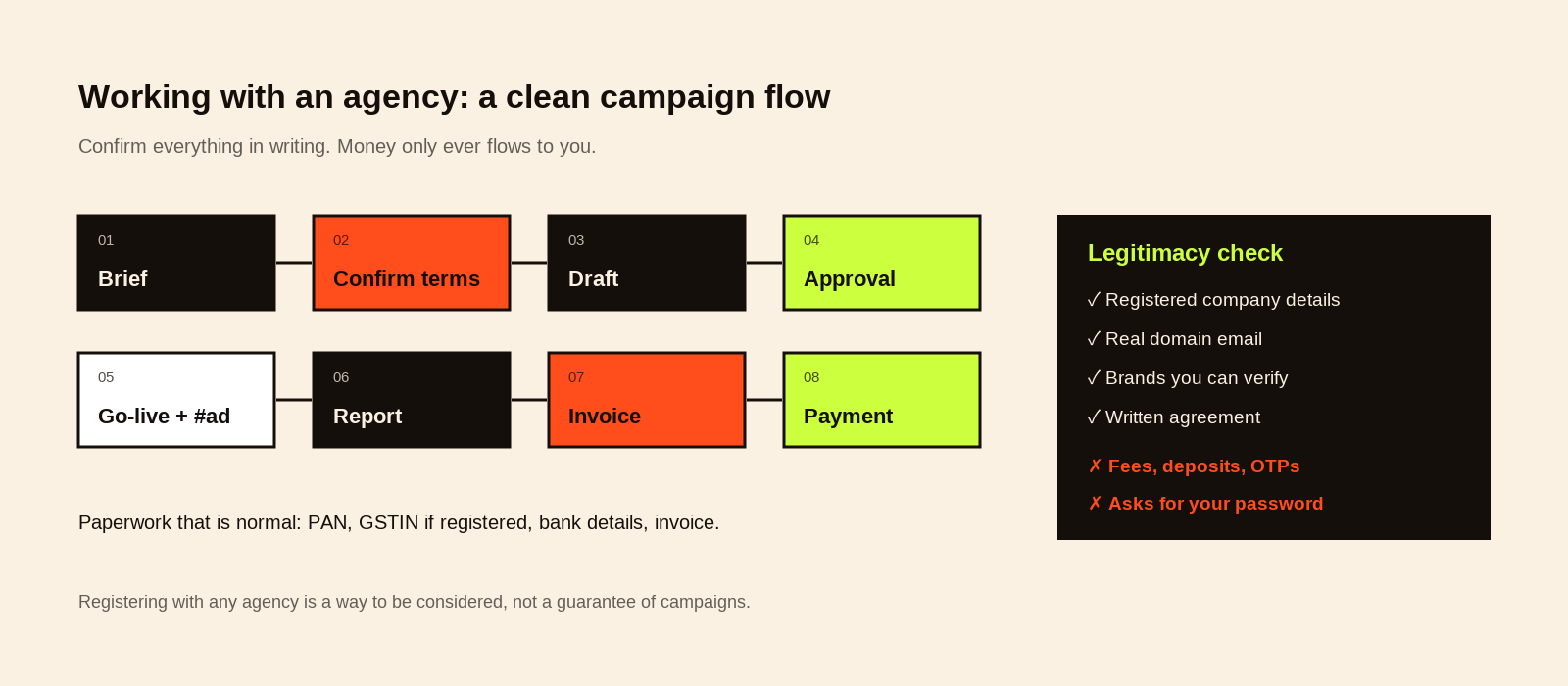
Details vary, but a well-run campaign follows roughly the same sequence. Use it as a checklist so nothing is left to memory or a deleted WhatsApp chat.
- Brief: you receive the brand, product, key messages, deliverables, dos and don'ts and timelines. Read it slowly and note anything unclear.
- Fit check: decide whether the product suits your audience and whether you would actually use it.
- Written confirmation: agree deliverables, number of revisions, posting dates, usage rights (where and for how long the brand can reuse your content), exclusivity, fee, and when and how you will be paid. Email or a signed agreement, not only a call.
- Draft or script: share it by the agreed date.
- Approval: get approval in writing before posting. Note how many revision rounds you agreed.
- Go-live: post on the agreed date with the correct disclosure, then send live links.
- Report: share the agreed metrics with screenshots.
- Invoice and payment: send your invoice as agreed and track the due date.
Two links help with the steps people most often rush: what to clarify in a brand brief before you reply, and how to put together a campaign report after the post goes live. Before you say yes, run the deal past a quick brand fit check too.
How to check an agency is legitimate
- Company details: a registered business name, a working website and a real office city you can look up.
- Real domain email: briefs come from an address on the agency's own domain, not only a free email or a random WhatsApp number.
- Verifiable brands: the brands they name exist, and the agency's past campaigns can be found publicly. If unsure, you can ask the brand directly whether the agency represents it.
- A written agreement or confirmation email that states deliverables, fee and payment terms.
- Payment flows to you, never from you. A legitimate agency never asks for a registration fee, onboarding fee, deposit, OTP, UPI PIN or account password.
Some requests look intrusive but are normal. Agencies usually ask for PAN, GSTIN if you have one, bank details and an invoice because they need them for payment paperwork, and TDS may be deducted as per current tax rules. Our TDS guide for influencers explains what that means for you. Sending documents by email to a verified company address is different from sharing an OTP, which no genuine business needs.
Red flags vs legitimate processes
The most common fraud aimed at creators copies the language of agency work. The RBI advisory on part-time job and investment frauds describes the pattern: an "earn online" message leads to a chat, you are paid a small amount for simple tasks to build trust, then asked to deposit money to unlock bigger tasks, after which the scammer disappears.
| Red flag | What a legitimate agency does instead |
|---|---|
| Asks you to pay a fee to join, get verified or unlock a campaign | Never charges creators to be considered or to receive a brief |
| Pays you for liking videos or rating products, then asks for a deposit | Pays for agreed content deliverables after posting, as per written terms |
| Asks for an OTP, UPI PIN or your Instagram password | Only needs PAN, GST and bank details for invoicing; never login access |
| Contacts you only on WhatsApp or Telegram with no company email | Sends briefs from a company domain email and can share a written agreement |
| Pressures you to decide within minutes | Gives a deadline but answers questions about usage, fees and payment |
| Sends a link to a lookalike website or a free site-builder domain | Uses its own domain and names brands you can verify |
If you receive a suspicious call, SMS or WhatsApp message, you can report it on Sanchar Saathi Chakshu. If you have already lost money, Chakshu is not the right channel: call 1930 or report at cybercrime.gov.in as soon as possible. Our guide to spotting fake brand collaborations walks through more examples.
Templates for professional communication
Hi [Name],

Thanks for sharing the brief for [Brand]. I'm interested and the product fits my audience of [niche/city/language].

Before I confirm, could you share:
1. Final deliverables (format, count, duration) and posting dates
2. Number of revision rounds
3. Usage rights: platforms, paid ads or not, and duration
4. Any exclusivity period and category
5. Fee, payment timeline after go-live, and invoicing details

My rate for this scope is [range] (illustrative; use your own). Once we agree, please send a written confirmation or agreement.

Thanks,
[Your name] | [Handle] | [Business email]
Hi [Name],

Hope you're well. Following up on invoice [number] dated [date] for the [Brand] campaign (posted on [date], links and report shared on [date]). As per our agreement, payment was due on [date].

Could you confirm the payment status and expected date? Happy to resend the invoice or any paperwork you need.

Thanks,
[Your name]
Keep your tone polite and factual, keep every confirmation in one email thread, and attach the invoice each time. If you have not invoiced a brand or agency before, start with our guide on how to invoice brands as a creator in India.
Disclosure is still your responsibility
Working through an agency does not move the disclosure duty off you. Under the ASCI influencer guidelines, responsibility for disclosing a paid or gifted collaboration lies with both the advertiser and the influencer, and the advertiser can ask you to edit content or the disclosure label where needed. Use a clear, upfront disclosure label whenever there is a material connection: money, free product or other perks. The creator disclosure guide covers placement and wording.
What registering with an agency does and doesn't mean
| Registering means | Registering does not mean |
|---|---|
| The agency can find you when a matching brief comes in | You are guaranteed campaigns or a fixed number of deals |
| You may be shortlisted and shown to brands | The brand will approve you; brands make the final choice |
| You can decline briefs that don't fit | You owe the agency exclusivity, unless you signed a contract that says so |
| Your profile is reviewed against future campaigns | You should stop pitching brands yourself |
Treat agency work as one channel alongside direct brand outreach, affiliate income and your own products. Before accepting any offer, agency or direct, run it through the creator brand deal checklist.
Conclusion
Agencies are a practical way to reach brands you might not pitch alone, but the relationship works best when you behave like a small business. Keep your profile and media kit ready, confirm every detail in writing, post with proper disclosure, report on time and invoice cleanly. Check every agency the same way, including well-known ones: real company, real email, real brands, and money only ever flowing to you.