B2B Social Media Strategy: How to Turn Industry Expertise Into Consistent Brand Content
A practical B2B social media strategy: capture expertise through subject expert interviews and question banks, organise it into content pillars, publish through the company page and experts, and measure more than likes.
Your head of engineering spends forty minutes on a call explaining to a prospect why one design approach fails on humid sites. The prospect is impressed. None of it reaches the company's LinkedIn page, which this week announced an award and a webinar that few people registered for. Most B2B companies have more expertise than content. What's missing is a system for capturing it.
Quick answer
A B2B social media strategy turns the knowledge inside your company into a steady stream of useful posts. Capture expertise through short interviews with subject experts and a bank of real buyer questions, sort it into a few content pillars, and publish through the company page plus the founders and experts willing to post. Build in approvals for technical and client claims, and measure conversations and pipeline signals, not likes.
Why B2B content shouldn't sound like a brochure
B2B buyers are usually experts in their own jobs. They have read every 'end-to-end solution' and 'customer-centric approach' line before, and they skip them. What makes them stop is a specific problem they recognise, explained by someone who has clearly dealt with it. The difference is easy to see side by side (all examples hypothetical):
| Brochure line | Expert version |
|---|---|
| We offer end-to-end logistics solutions. | Three paperwork errors that keep inbound containers waiting at port, and how to catch them before arrival. |
| Industry-leading quality. | What our inspectors check in the first twenty minutes of a new production run, and why. |
| A customer-centric approach. | The one question we ask in every kick-off meeting that prevents a round of revisions later. |
| Innovative HR technology. | Why most leave policies break down at 50 employees, and the three rules that need rewriting first. |
The expert version is more useful, more specific and easier to trust. It is also harder to produce, because it has to come from people who know the work. That's why B2B content needs a system, not just a calendar.
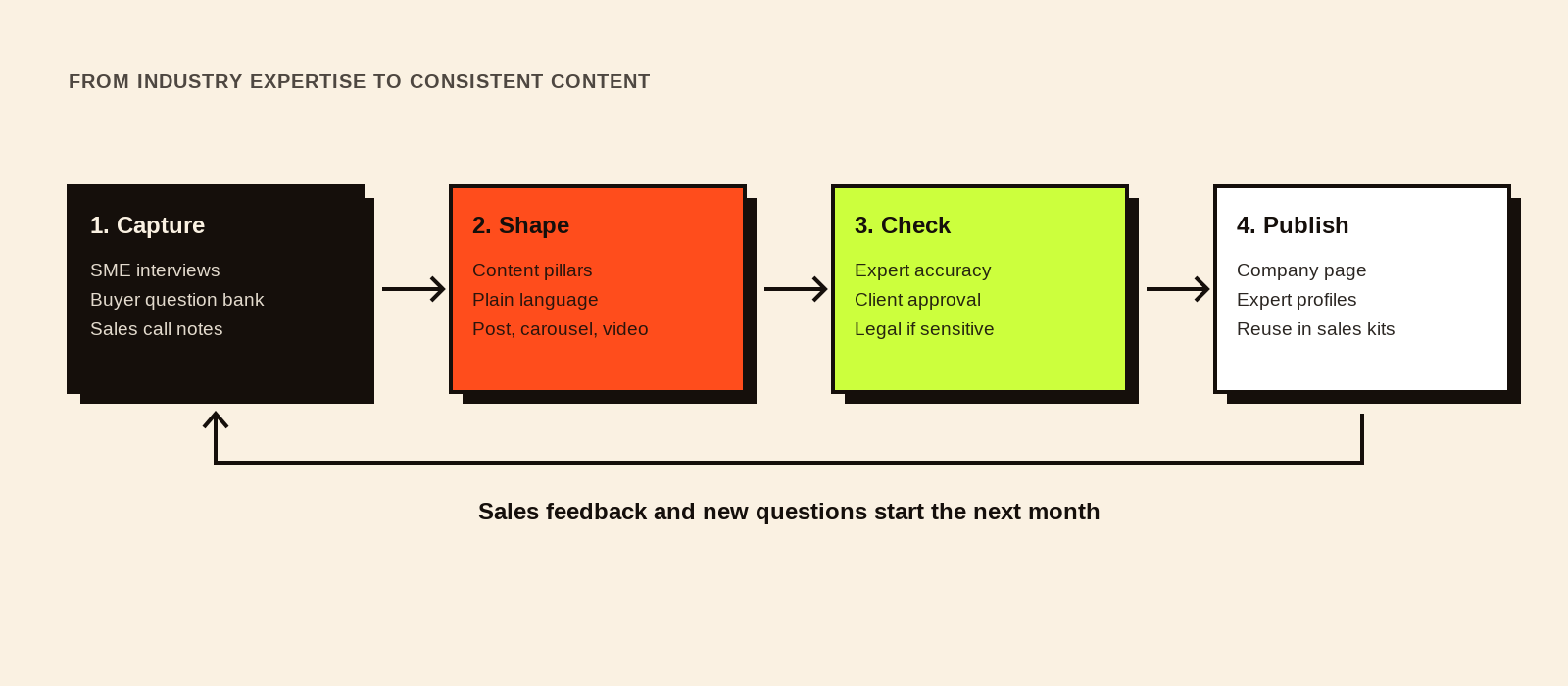
Build an expertise-to-content system
- Capture: short recorded interviews with subject experts, plus a running bank of real questions from buyers.
- Shape: marketing turns each idea into a post, carousel, short video or article, in plain language.
- Check: the expert confirms technical accuracy; legal or the client checks anything sensitive.
- Publish: through the company page, and through the expert's own profile if they want to post.
- Reuse: strong pieces become sales material, newsletter items, event talks and longer articles.
Running short SME interviews
Most experts won't write posts, but nearly all of them will talk for twenty minutes about their work. Record a monthly call with each subject expert (an engineer, consultant, product lead or account manager), and one call can produce several posts. Send the questions ahead, keep it informal, and let them tell stories.
1. What question did a client or prospect ask you this month that surprised you?
2. What do people in our industry commonly get wrong about [topic]?
3. Walk me through a recent problem you solved, without naming the client.
4. What changed in your field this quarter, and what does it mean in practice?
5. If a new buyer had five minutes with you, what would you want them to understand?
6. Is there anything here we must not publish (client details, pricing, unreleased work)?
Keeping a question bank
Collect questions from sales calls, RFPs, onboarding sessions, support tickets, event conversations and comments in one shared sheet, tagged by topic and buyer role. Each repeated question is a ready-made post. Our guide on turning customer questions into social media content covers the formats in detail.
A practical B2B content pillar framework
Pillars stop the calendar drifting into announcements. Use this framework to choose four or five that fit your business; each pillar has a job, a source and a proof requirement.
| Pillar | Job it does | Example post (hypothetical) | Typical source | Proof or approval needed |
|---|---|---|---|---|
| Point of view | Shows how you think about the industry's problems | Why we stopped recommending a common approach for small sites | Founders, senior experts | Leadership sign-off |
| Problem education | Helps buyers name and understand a problem | Carousel on early warning signs of a failing process | Subject experts, support | Technical check |
| How we work | Reduces the perceived risk of buying | Walkthrough of your onboarding or quality process | Delivery and operations | Operations head |
| Proof | Shows outcomes with real clients | Case study told from the client's side | Account teams | Client's written approval |
| Industry insight | Interprets news, standards and published data | What a new rule or standard means in practice | Experts, research | Source check; legal for regulatory topics |
| People and culture | Builds trust in the team and supports hiring | An engineer explains what their role involves | HR and teams | Consent from people shown |
There's no correct split between pillars. Weight them by what the business needs this quarter: more proof during a sales push, more problem education when entering a new segment, more culture during hiring. For industry-specific versions of this approach, see our guide to social media management for manufacturing companies.
Who posts: the company page, founders and experts
The company page is the official record: accurate, consistent and on brand. It shouldn't carry the whole strategy alone. How to run the page itself, from admin roles to posting rhythm and formats, is covered in LinkedIn company page management, so we won't repeat it here.
Founders and subject experts often reach buyers more personally, because people respond to people. If they're willing to post, marketing can help draft from their own ideas and interview notes, but the expert should read and approve every word that goes out under their name. Ghostwritten opinions the expert doesn't hold are easy to spot and hard to defend in a sales meeting.
Wider employee sharing should be encouraged, not required, and employees promoting the company should make their connection clear. LinkedIn's Help Centre says the My Company and Employee Advocacy tabs were gradually discontinued from November 2024, and that Page admins can still reshare employees' mentions from the Page's Feed tab. Our guide to employee influencer marketing covers how to run an employee programme.
External voices are a separate lever. Industry creators, analysts and practitioners with their own audience can introduce you to buyers you don't reach yet; B2B influencer marketing in India explains how those partnerships work. This guide is about the content you publish yourself.
Case studies and industry insight
Case studies are the strongest proof in B2B, and the easiest to get wrong. The story belongs partly to the client, who may have strict rules about being named, quoted or associated with a supplier. Tell the story from their side: the problem they faced, what changed, and what they would tell a peer. Never invent a composite client and present it as real.
Case-study approval checklist
- Written approval for the client's name, logo and any quote, in the exact final wording.
- Approval for every number used, and agreement on how it was measured.
- Agreement on which channels the story can appear on, and for how long.
- A check that screenshots and photos show no client data or confidential material.
- If the client can't be named, a version that genuinely can't identify them.
Industry insight posts work when they interpret something buyers care about: a new regulation, a standard, a published dataset. Link to the primary source, give its date, and separate what it says from your view of what it means. Predictions should be labelled as predictions.
Generating leads without aggressive selling
Most B2B buying is slow and involves several people, so most posts won't produce an enquiry, and they don't need to. Their job is to make sure that when a buyer is ready, they already know who you are and trust that you understand the problem. Give interested people an easy, low-pressure next step: a useful checklist, an open session or a newsletter, or simply an invitation to reply with their question.
Keep direct messages for people who have engaged and where you have something relevant to say. Pass warm conversations to sales with context, such as which post they responded to, so the follow-up feels like a continuation rather than a cold pitch. Automated pitch sequences sent to everyone who reacted to a post tend to damage the trust the content built.
Approvals that don't stall the calendar
B2B content often waits weeks for sign-off because every post goes to the same busy people. Tier it instead: routine posts approved by marketing, technical posts by the relevant expert, and anything involving clients, regulation or pricing by legal or the account owner. Agree turnaround times for each tier. The social media content approval process guide covers stages, owners and tools.
Measuring beyond likes
Likes tell you a post was pleasant. B2B strategy needs to know whether the right people saw it and whether it moved a conversation forward. Combine platform metrics with sales signals.
| Signal | Where to find it | What it tells you |
|---|---|---|
| Members reached | LinkedIn post analytics | How many distinct members and Pages saw the post |
| Clicks and click-through rate | LinkedIn Page content analytics | Whether the post made people want more |
| Comments from target roles | Manual review of comments | Whether the right people are engaging |
| Enquiries that mention content | A 'how did you hear about us' field, sales notes | Whether content is part of the buying journey |
| Posts sales reuses | Ask the sales team monthly | Whether content helps live deals |
At the time of writing (November 2026), LinkedIn's Help Centre defines members reached as the number of distinct members and Pages who viewed a post, without counting repeat views, and its Page content analytics define click-through rate as clicks divided by impressions. Our guide to social media KPIs explains how to pick metrics by goal.
Common mistakes
- Publishing announcements and awards, but no expertise.
- Waiting for experts to write posts instead of interviewing them.
- Ghostwriting opinions the founder or expert doesn't actually hold.
- Naming clients or using logos without written approval.
- Pitching everyone who reacts to a post in their inbox.
- Sending every post to the same senior approver.
- Judging the strategy on follower counts after two months.
Where to start
Pick three subject experts, book a twenty-minute interview with each, and start a shared question bank this week. Choose four pillars from the framework, agree approval tiers, and plan one month from what those conversations produce. Review it with sales at the end of the month.
If you'd like help running that system, a managed social media service such as Kudozz's can handle interviews, writing, design and company page publishing, while your experts keep the final say on accuracy.