Influencer Campaign Risk Management: A Practical Framework for Brands
The risks that actually derail creator campaigns, from creator selection and claims to delivery, rights and measurement, with a risk register, a simple pre-launch risk assessment, controls proportionate to the campaign, and who owns each risk.
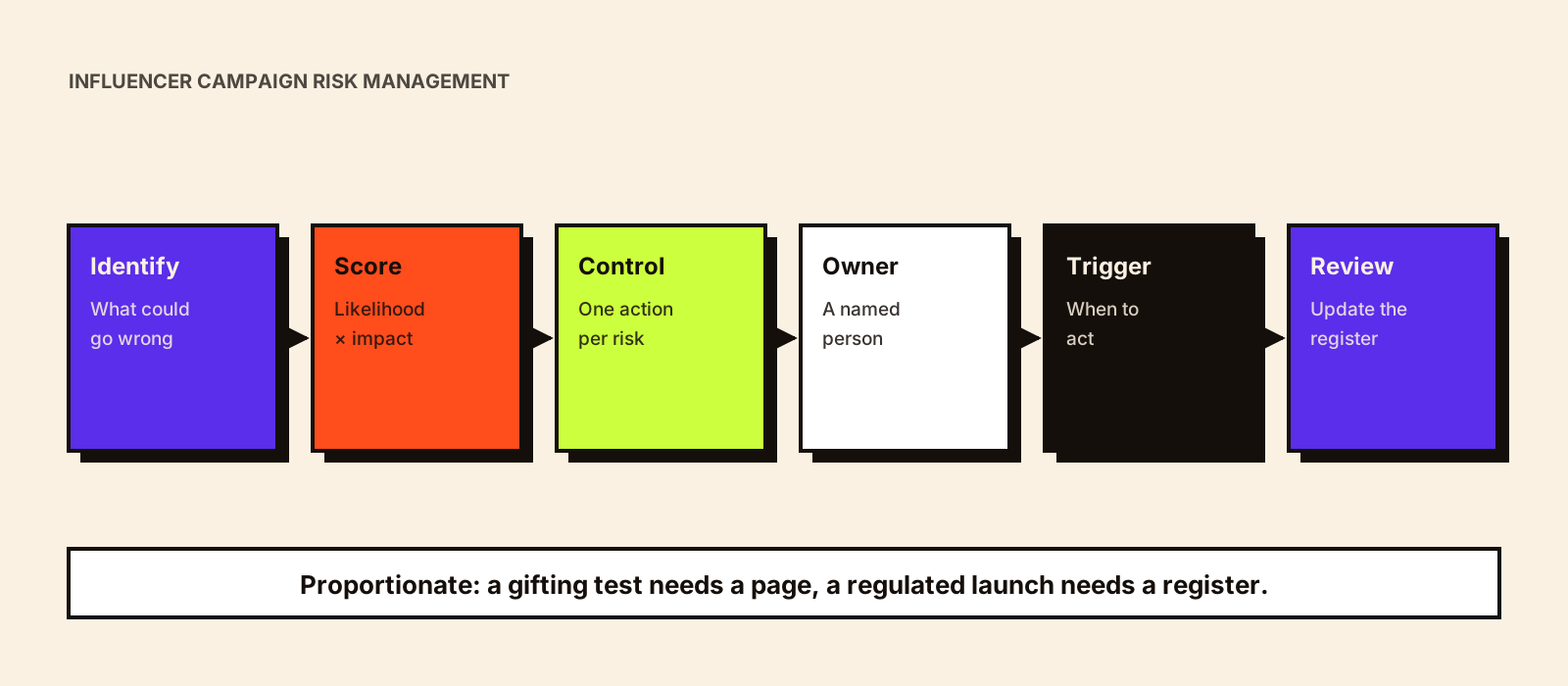
Most influencer campaigns that go wrong don't fail in dramatic ways. A creator delivers late and the launch-day posts slip. A Reel goes live with a claim nobody checked. The best-performing video can't be used in ads because nobody agreed paid usage. Each of these was predictable, and each had a cheap control that would have prevented it. Risk management is simply deciding, before launch, which of these your campaign is exposed to and what you'll do about them.
Quick answer
Influencer campaign risk management means listing what could go wrong across the campaign (creator selection, audience quality, claims and disclosure, brand safety, delivery, rights, exclusivity, budget, measurement and platform issues), scoring each risk by likelihood and impact before launch, adding a control for the ones that matter, naming an owner, and agreeing what will trigger action during the campaign. Keep it proportionate: a small gifting test needs a one-page check, while a launch with health claims and ads running through creators' handles needs a full register.
The risks that matter in creator campaigns
| Risk area | What can go wrong | Early signal | Typical control |
|---|---|---|---|
| Creator selection | Poor audience fit, unreliable creator | Vague answers on audience data, slow replies | Structured vetting before contract |
| Audience quality | Inflated followers or engagement | Sudden follower spikes, generic comments | Authenticity checks on recent posts |
| Claims and disclosure | Unsupported claims, missing or hidden disclosure | Script drafts adding claims; past posts without labels | Approved claims list and exact disclosure wording in the brief |
| Brand safety and reputation | Creator content or conduct that reflects badly on the brand | Past controversies, inflammatory content | Brand-safety review, monitoring, response plan |
| Content quality | Off-brief or unusable content | Weak first drafts, unclear brief | Clear brief, review stage, revision limits |
| Delivery and timeline | Late drafts, missed posting dates | Product shipped late, slow approvals | Buffers, fixed review turnaround, backup creators |
| Communication | Mixed messages from several brand contacts | Creators asking different people the same question | One point of contact per creator |
| Rights and usage | Content can't be reused as planned | Paid plans not reflected in agreements | Usage rights agreed before production |
| Exclusivity | Creator promotes a competitor during your campaign | Undisclosed existing deals | Scoped exclusivity or a competitor gap |
| Budget | Costs exceed plan | Unpriced extras (rights, edits, travel) | Full cost lines and contingency |
| Measurement | Results can't be attributed or compared | Links and codes not set up before posting | Tracking set up and tested before go-live |
| Platform | Feature changes, account restrictions, takedowns | Platform policy updates, account warnings | Spread across creators; avoid single points of failure |
| Payments | Disputes over what is owed | Unclear payment triggers | Written payment terms and records |
Most controls already have a guide: how to vet influencers, influencer brand safety, influencer marketing compliance, influencer usage rights, influencer exclusivity, influencer campaign delays and influencer payment terms. The register's job is to make sure each one is actually applied to this campaign.
A pre-launch risk assessment
Before launch, go through the register for this campaign and score each risk on two simple scales. Precision isn't the point; the scores are there to force a conversation about where to spend effort.
- Likelihood: 1 unlikely, 2 possible, 3 likely, given this category, these creators and this timeline
- Impact: 1 minor inconvenience, 2 hurts results or timeline, 3 legal, reputational or launch-critical
- Score = likelihood × impact. Anything scoring 6 or 9 needs a named control and owner before launch; 3 or 4 needs a control or a conscious decision to accept it; 1 or 2 can be accepted
| Hypothetical risk: skincare launch, 12 creators | Likelihood | Impact | Score | Control and owner |
|---|---|---|---|---|
| Creators add efficacy claims beyond what the brand can substantiate | 2 | 3 | 6 | Approved claims list in brief; claims check at review (brand manager) |
| Product reaches creators late in two cities | 2 | 2 | 4 | Ship 10 days earlier; courier tracking shared (operations) |
| Partnership ads can't run because permissions aren't granted in time | 2 | 2 | 4 | Request permissions at contract stage (performance team) |
| A creator posts for a competing sunscreen during the launch | 1 | 2 | 2 | Accepted; competitor gap clause for the four lead creators |
| Old content from a lead creator resurfaces | 1 | 3 | 3 | Brand-safety review done; response plan agreed (brand lead) |
Illustrative only. The value is in the controls column: each high score now has a concrete action and a person responsible for it.
Keep it proportionate
| Campaign | Risk level | What's enough |
|---|---|---|
| Product seeding with no required posts | Low | Basic vetting, disclosure guidance in the note, a tracker |
| Paid posts in a general consumer category | Moderate | Vetting, brand-safety check, brief with claims and disclosure, review stage, tracking |
| Launch with fixed dates, many creators and paid ads through creators' handles | High | Full register, backup creators, rights and permissions confirmed in advance, daily monitoring in launch week |
| Health, nutrition, finance or children's categories | High | All of the above plus claims substantiation, creator qualifications where technical claims are made, and legal review |
During the campaign: triggers, not constant worry
For each high-scoring risk, agree in advance what will make you act. For example: a draft more than two days late moves to the backup creator; a post live without disclosure gets a same-day correction request; negative sentiment on a creator's post above what's normal for them goes to the brand lead within the hour. Pre-agreed triggers stop small issues becoming debates. Influencer campaign escalation sets out severity levels and response times, and influencer controversy response covers the rare cases where a creator becomes the story.
Who owns which risk
| Risk | Usually owned by |
|---|---|
| Creator selection, vetting, brand safety | Brand or agency campaign lead |
| Claims and regulated content | Brand manager with legal or regulatory input |
| Disclosure on live posts | Whoever runs go-live checks |
| Delivery and timeline | Campaign manager |
| Rights, permissions and exclusivity | Whoever manages creator agreements |
| Paid amplification permissions | Performance or media team |
| Measurement and tracking | Analytics or performance lead |
If an agency runs the campaign, write down which risks it owns and which stay with the brand; claims substantiation and final legal sign-off usually stay with the brand. Influencer marketing governance covers approvals and policies across teams.
Risks specific to Indian campaigns
- Regulated categories: technical health, nutrition and financial claims carry qualification expectations under ASCI's guidelines, regulated financial entities face SEBI restrictions on associating with unregistered finfluencers, and promoting online money games is prohibited. Check current rules for your category.
- Multi-language review: if creators post in several languages, someone fluent needs to review claims and disclosure in each.
- Festive timelines: creator availability tightens and courier timelines stretch around major festivals and sale events.
- Attribution gaps: cash-on-delivery, marketplace and WhatsApp-driven purchases often leave no code or link trail, so a campaign can look weaker than it was.
- Many small creators: nano and micro-heavy campaigns multiply contracts, shipments and approvals, so delivery risk rises with creator count.
Regulatory detail for brands is in influencer marketing compliance; measurement gaps in how to measure influencer marketing ROI.
After the campaign
Add what actually happened to the register: which risks materialised, which controls worked, and which risks you didn't see coming. Carry it into the next campaign's assessment. The influencer campaign post-mortem is the natural place to do this.
Common mistakes
- Treating risk as only brand safety, while delivery, rights and measurement cause most of the actual damage
- A register written once and never used during the campaign
- Risks with no named owner
- The same heavy process for a gifting test and a regulated-category launch
- No pre-agreed triggers, so every issue becomes a debate
Conclusion
Good risk management in influencer marketing is unglamorous: a list of what could go wrong, a score, a control, an owner and a trigger. Done before launch, it takes an hour for most campaigns and saves the scramble later. This guide is general information; for regulated categories, check current rules and take legal advice.