Influencer Campaign Escalation: How Brands Should Handle Creator Issues Before They Grow
A brand-side escalation framework for creator campaigns: severity levels, who handles what, response times, common issues (missed deadlines, wrong content, backlash, product problems, compliance) and how to escalate without damaging the relationship.
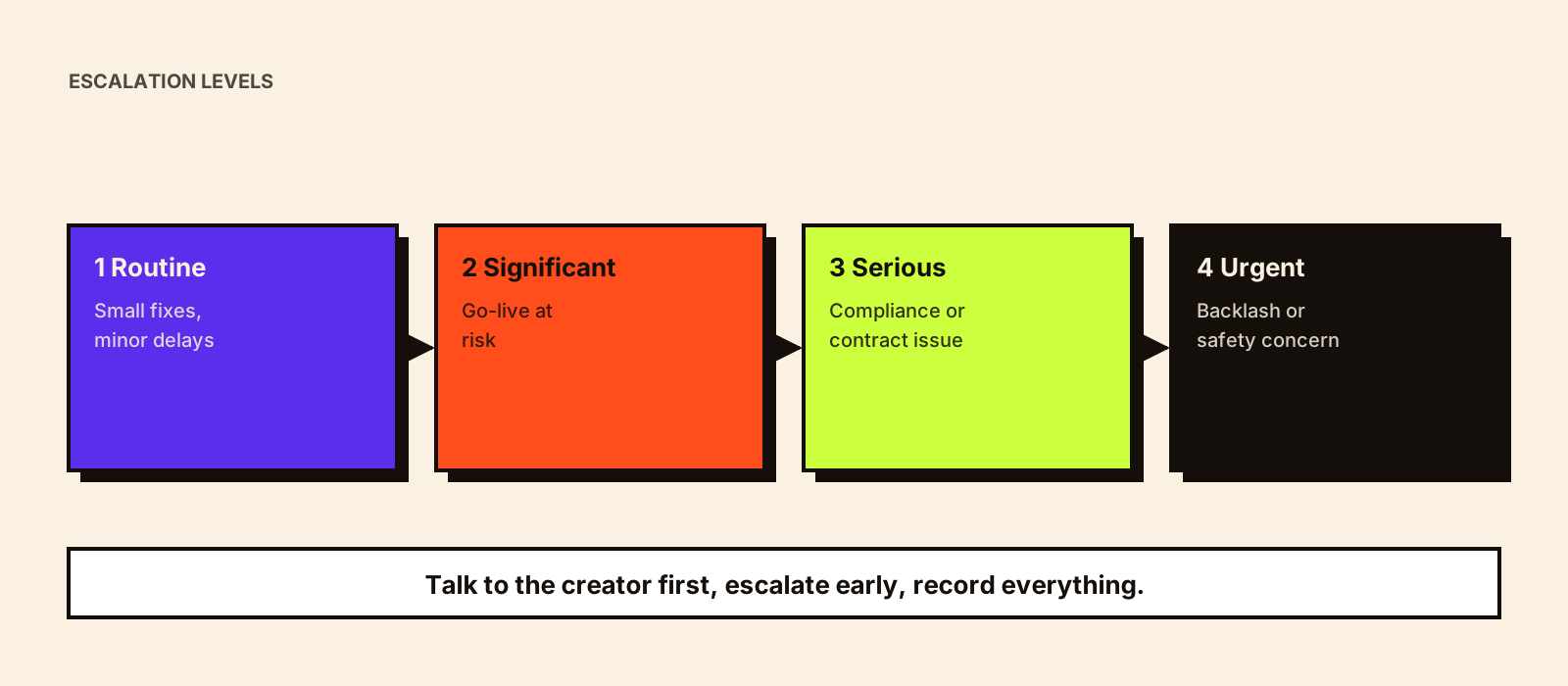
Most creator campaign problems are small when they start: a draft a day late, a wrong code, a negative comment thread. They grow when nobody knows whose problem it is, when to involve someone senior, or how fast to act. An escalation framework answers those questions in advance, so the team reacts proportionately instead of either ignoring issues or panicking.
Quick answer
An influencer campaign escalation framework sorts issues by severity, names who handles each level and how fast, and sets out when to involve senior people, legal or PR. Most issues (minor delays, small content fixes) are resolved directly between the campaign manager and the creator. Serious issues (missed launch dates, compliance breaches, public backlash, product safety concerns) go to named senior owners quickly. Always talk to the creator first, record what happened and fix the cause afterwards.
Severity levels
| Level | Examples | Owner | Response |
|---|---|---|---|
| 1. Routine | Draft a day late; small caption or link fix; minor question | Campaign manager | Same or next working day |
| 2. Significant | Draft several days late with go-live at risk; repeated missed requirements; product not received | Campaign manager + influencer lead | Within a working day; agree a plan |
| 3. Serious | Missed launch date; disclosure or claims breach in a live post; content not matching approval; contract dispute | Influencer lead + legal or senior marketing | Same day |
| 4. Urgent brand risk | Public backlash; product safety concern; creator controversy; misleading claim spreading | Senior marketing + PR + legal | Immediately; agreed holding response |
Define your own examples by category. A wrong claim in a skincare post may be level 3; the same mistake in a food post making a health claim may be level 4.
Escalation principles
- Talk to the creator first, privately, unless the issue is urgent brand risk.
- Assume a mistake before bad faith.
- Escalate early: it's easier to stand down than to catch up.
- One owner at each level; others are informed, not all acting.
- Agree what to say externally before anyone posts publicly.
- Record the issue, actions and outcome.
- After resolution, fix the cause in the process.
Common issues and first responses
| Issue | First response |
|---|---|
| Creator misses draft deadline | Ask what's happening; agree a new date; check go-live impact; see influencer campaign delays |
| Live post missing disclosure | Ask the creator to add it right away; check the platform label; record; see creator non-compliance |
| Live post differs from approved version | Ask for correction to the approved version; record |
| Wrong discount code or broken link | Ask creator to fix; check landing page and code on your side |
| Negative comments about the product | Brand responds to genuine product questions; creator not asked to delete critical comments |
| Backlash against the creator unrelated to the brand | Pause amplification; assess; agree with creator before any public action |
| Product safety complaint in comments | Escalate to level 4; product and legal involved; agreed response |
| Creator unresponsive | Try manager or alternate channel; set a deadline; prepare reserve |
Escalating without damaging the relationship
- Be specific and factual: what's wrong, what's needed, by when.
- Avoid accusatory language; most problems are honest mistakes.
- Acknowledge brand-side causes openly (late product, late feedback).
- Keep escalation internal where possible; the creator should hear one consistent voice.
- Once resolved, say thank you and move on.
Hi [name], flagging something on [deliverable]: [specific issue, e.g. 'the live Reel doesn't have the Ad label in the first lines of the caption']. Could you [specific fix] by [time]? This is needed because [reason: ASCI guidelines / brief / launch timing]. Thanks for sorting it quickly, and shout if anything's unclear.
Incident log
Date · Campaign · Creator · Issue · Level · Owner · Actions taken (with times) · Resolution · Root cause (brand / creator / external) · Process change · Closed date
Review the log monthly. Repeated causes point to process fixes; repeated creators point to a conversation or a different role in future. Agencies running creator campaigns use a similar log; creator campaign escalation describes the agency-side process.
Prepare before the campaign
- Share an escalation contact with creators at kickoff.
- Name level 3 and 4 owners inside the brand and their backups.
- Prepare a holding statement template for public issues.
- Agree with creators how negative comments will be handled.
- Keep reserve creators for fixed-date campaigns.
Influencer campaign kickoff covers sharing escalation contacts, and influencer brand safety covers wider reputational risk. A pre-launch risk register, covered in influencer campaign risk management, makes these triggers easier to agree.
Escalation in Indian campaigns
- Agree in advance who decides on public responses in regional languages, and who checks the wording.
- For managed creators, include the manager in level 2 and above.
- Festival and sale periods compress timelines; lower the threshold for escalating go-live risks during them.
- For regulated categories (health, finance, food claims), treat any live claims issue as at least level 3.
- Keep a holding response ready in Hindi and English, and in the languages of your main regional campaigns.
Regional influencer marketing in India covers wider language planning.
Common mistakes
- Escalating everything to senior people, so nothing is prioritised.
- Escalating nothing until a launch is missed.
- Several brand team members contacting the creator at once.
- Public responses before facts are clear.
- No record, so the same issue repeats next campaign.
Conclusion
A clear escalation framework keeps small creator issues small and gets serious ones to the right people fast. Define severity levels with examples, name owners and response times, talk to creators first, record everything and fix causes afterwards. When the issue is a creator not meeting agreed requirements, see creator non-compliance. When the issue is a creator's public controversy rather than a campaign problem, see influencer controversy response.