Influencer Marketing Glossary: 60+ Terms Brands Should Know
Plain-English definitions of the terms that come up in creator quotes, contracts and reports: tiers, deal types, usage rights and whitelisting, deliverables, metrics like CPM, EMV and incrementality, and disclosure rules. Each section points to the full guide.
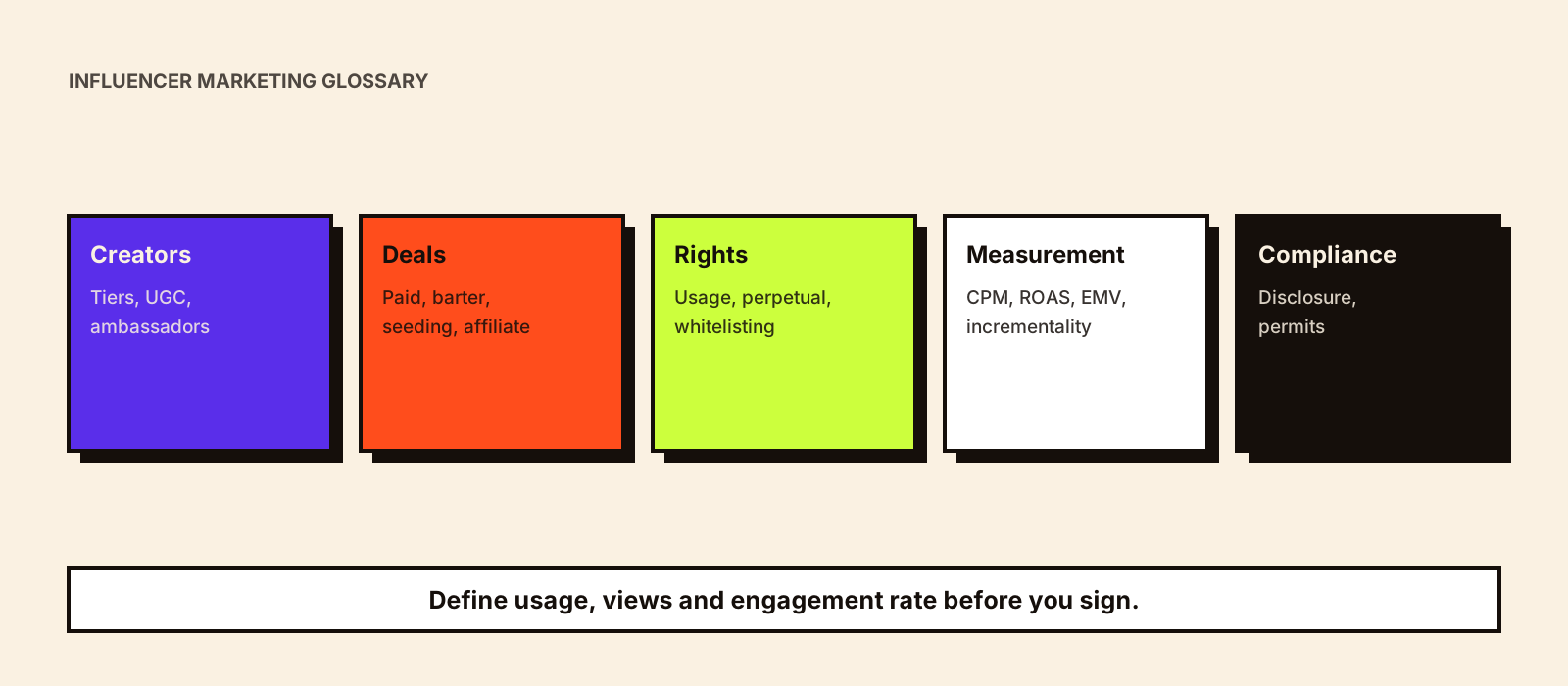
Creator quotes, agency proposals and campaign reports use a lot of shorthand. Two people can use the same word, such as 'views' or 'usage', to mean different things. These definitions are the ones used across Kudozz's guides, written for brand teams who need to agree terms and read results.
Quick answer
Influencer marketing is paying or gifting creators to feature a product or service for their audience. The terms that matter most in practice are the deal type (paid, barter, seeding or affiliate), the deliverables, usage rights (how and for how long the brand can reuse content, for example 30 days of paid usage or perpetual rights), whitelisting (running ads through the creator's account) and the metrics used to judge results, such as reach, engagement rate, cost per acquisition and incrementality. Disclosure, such as an 'Ad' or 'Collaboration' label, is required in every market Kudozz works in.
Creators and tiers
| Term | Meaning |
|---|---|
| Creator / influencer | Someone who publishes content to an audience that trusts their view. 'Creator' is broader and includes people valued for content more than reach |
| Nano, micro, macro, mega | Follower tiers. Common cut-offs are roughly under 10k, 10k-100k, 100k-1M and over 1M, but agencies and tools draw the lines differently |
| UGC creator | Someone paid to make content for the brand's own channels and ads, not to post it to their audience |
| Brand ambassador | A creator on a longer agreement, often with exclusivity, recurring content and a deeper relationship |
| Creator roster | The group of creators an agency manages or a brand works with repeatedly |
| Audience fit | How closely a creator's actual audience, by location, age, language and interests, matches the brand's customers |
| Audience quality | How much of the audience is real and active, as opposed to bots, inactive or purchased followers |
Go deeper: choosing between tiers is covered in nano vs micro influencers and micro, macro or celebrity influencers.
Deal types and commercial terms
| Term | Meaning |
|---|---|
| Paid collaboration | The creator receives a fee for agreed deliverables |
| Barter | The creator receives products or services instead of a fee, in exchange for agreed deliverables |
| Seeding / gifting | Sending products with no obligation to post; any post is the creator's choice |
| Affiliate | The creator earns a commission on sales tracked to their link or code |
| Hybrid deal | A lower fixed fee plus a performance element such as commission or a bonus |
| Retainer | A recurring monthly or quarterly fee for an agreed volume of content |
| Rate card | A creator's list of standard prices per deliverable; a starting point, not a final price |
| Statement of work (SOW) | The document listing deliverables, timelines, fees and responsibilities for a campaign |
| Kill fee | The amount paid if the brand cancels after work has started |
| Make-good | A replacement post or credit if a deliverable doesn't run as agreed |
| Exclusivity | A restriction on the creator working with competitors for a set period and category |
Go deeper: barter influencer collaborations, influencer exclusivity and influencer marketing contracts.
Content rights and ads
| Term | Meaning |
|---|---|
| Usage rights | Permission for the brand to reuse a creator's content, defined by channel, duration, territory and paid or organic use |
| Organic usage | Reposting on the brand's own social accounts, website or email without paying to promote it |
| Paid usage / ad rights | Permission to run the content as paid ads. Usually priced separately from the post |
| 30-day (or 90-day) ad rights | Paid usage for that period from the agreed start date, after which the ads must stop unless renewed |
| Perpetual rights | Usage with no end date. Usually the most expensive option, and still limited to the uses listed |
| Buyout | A one-off payment for broad or perpetual rights, sometimes including raw footage |
| Ownership | Who holds copyright in the content. Different from usage rights; ownership often stays with the creator |
| Whitelisting / creator licensing | The brand runs ads through the creator's account or identity, with the creator's authorisation |
| Partnership ads | Meta's format for running ads that show both the creator's and the brand's names |
| Spark Ads | TikTok's equivalent format for boosting a creator's post as an ad |
| Raw footage | Unedited files, needed for recutting content into new ads; usually agreed and priced separately |
Go deeper: influencer usage rights, who owns influencer content and influencer whitelisting.
Content and deliverables
| Term | Meaning |
|---|---|
| Deliverable | One agreed piece of content, such as a Reel, a YouTube integration or a set of Stories |
| Integration vs dedicated video | An integration is a segment inside a creator's normal video; a dedicated video is entirely about the brand |
| Collab post | An Instagram post published jointly so it appears on both the creator's and the brand's profiles |
| Brief | The document telling creators the objective, key messages, requirements and rules, without scripting their voice |
| Hook | The first one to three seconds of a video, designed to stop the scroll |
| Talking points | The facts or angles a creator should cover, in their own words |
| Approval round | One cycle of brand feedback on a draft. Contracts usually limit how many are included |
| Go-live date | The agreed date and time a deliverable is published |
| Content library | The brand's organised store of creator assets, with rights and expiry dates attached |
Go deeper: how to write an influencer campaign brief and the creator content approval process.
Measurement
| Term | Meaning |
|---|---|
| Reach | The number of unique accounts that saw the content |
| Impressions | Total times the content was shown, including repeat views by the same person |
| Views | Platform-defined plays. Definitions differ by platform and change: since 24 August 2026 YouTube counts a view when a video starts playing, and calls its older measure 'engaged views' |
| Engagement rate | Engagements (likes, comments, shares, saves) divided by reach, followers or impressions. Always state which denominator |
| CPM | Cost per thousand impressions: cost ÷ impressions × 1,000 |
| CPE / CPC / CPA | Cost per engagement, per click and per acquisition (a sale, sign-up or other goal) |
| ROAS | Revenue ÷ ad or campaign cost. Ignores product costs |
| ROI | Return after costs, usually (contribution − cost) ÷ cost. More useful than ROAS for deciding whether a campaign paid off |
| Attribution | Assigning a sale or conversion to a touchpoint, such as a creator's code or link |
| Incrementality | The sales or actions that wouldn't have happened without the campaign, estimated with a test or comparison group |
| Halo effect | Sales the campaign influenced through other channels, such as search or retail, that codes and links don't capture |
| Brand lift | A measured change in awareness, consideration or preference, usually from surveys of exposed and unexposed groups |
| EMV (earned media value) | An estimate of what the exposure would have cost as paid media. Methods vary by tool; it isn't revenue |
| Baseline | Normal performance before or without the campaign, used as the comparison point |
Go deeper: influencer marketing KPIs, how to measure influencer marketing ROI, influencer marketing incrementality and earned media value explained. The YouTube view change is described on YouTube's official blog.
Compliance and safety
| Term | Meaning |
|---|---|
| Disclosure | A clear label telling the audience the content is advertising or involves a brand relationship |
| Material connection | Any relationship that could affect how the audience sees the endorsement: payment, free products, discounts, family or employment |
| Paid partnership label | A platform's built-in tag for branded content. Useful, but not always enough on its own to meet local rules |
| ASCI | The Advertising Standards Council of India, whose influencer guidelines set disclosure labels such as 'Ad', 'Collaboration' or 'Free gift' |
| CCPA | India's Central Consumer Protection Authority, which issued 2022 guidelines on misleading advertisements and endorsements |
| ASA and CMA | The UK's advertising regulator and its competition and consumer authority; both publish influencer guidance |
| UAE advertiser permit | The federal permit that creators in the UAE need to publish paid or gifted advertising content |
| Brand safety | Checking that a creator's content and history won't damage the brand by association |
| Fake followers | Purchased or bot accounts that inflate a creator's audience and distort results |
Go deeper: influencer disclosure rules by country and the UAE advertiser permit.
Terms that cause the most disputes
- 'Usage': always write down channels, paid or organic, duration, territory and start date. 'Usage included' on its own means nothing.
- 'Views': agree which platform metric counts, and when it's measured, because definitions differ and change.
- 'Engagement rate': agree the denominator. Engagement by followers and engagement by reach give very different numbers for the same post.
- 'Exclusivity': name the competitor category, the platforms and the period, and pay for it.
- 'Revision': say how many rounds are included and what counts as a revision versus a new brief.
Conclusion
Most influencer marketing disagreements come from a word both sides used differently. Define the terms in the brief and the contract, especially usage, views and engagement rate, and the rest of the campaign gets easier. If you're new to the channel, start with what influencer marketing is and how it works.