How to Run a Quarterly Influencer Marketing Review for Senior Leadership
Senior leaders don't want a deck of reach screenshots. A quarterly influencer marketing review should answer four questions: what did we spend, what did we get, what did we learn and what do we do next quarter. An agenda, a one-page template and the decisions it should produce.
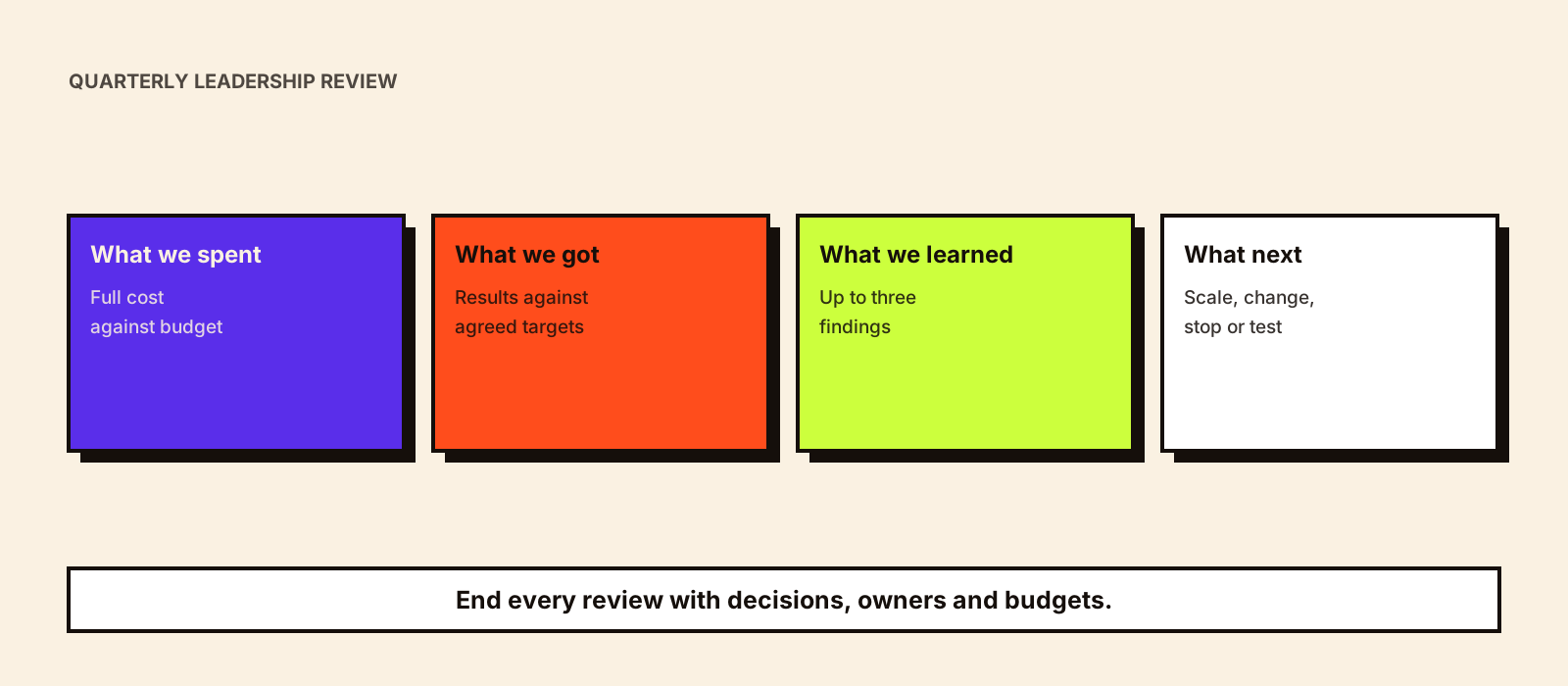
Most influencer reporting is built for the people running campaigns: post-by-post reach, engagement and creator lists. Senior leaders need something different. They want to know whether the channel is earning its budget, what's changed since last quarter and what they're being asked to approve. A quarterly review gives them that, and it's often what decides whether influencer marketing gets more budget or less next year.
Quick answer
Hold a 45-minute review each quarter built around four questions: what did we spend, what did we get for it against the targets set last quarter, what did we learn, and what do we recommend for next quarter. Send a one-page summary two days before the meeting, keep detail in an appendix, compare results with targets and other channels using consistent definitions, be honest about what you can't measure, and end with specific decisions for leadership to make.
How this differs from your other reports
| Format | Audience | Frequency | Job |
|---|---|---|---|
| Campaign report | Marketing team, agency | After each campaign | What happened in one campaign |
| Dashboard | Marketing team, sometimes leaders | Live or weekly | Monitor performance as it happens |
| Quarterly review | Senior leadership, finance | Every quarter | Decide budget, priorities and changes |
| Program audit | Marketing lead, leadership | Before scaling or once a year | Check the whole program's foundations |
| Agency review | Marketing lead | Quarterly or twice a year | Judge the agency's work and relationship |
The quarterly review draws on the others but doesn't replace them. For the live tracking it pulls from, see what an influencer marketing dashboard should track; for the deeper health check, how to audit an influencer marketing program; and for evaluating an agency partner, the influencer agency performance review.
Before the meeting: get the numbers straight
- Use the same definitions as last quarter (what counts as a new customer, which orders are attributed, how cost is calculated). If something changed, say so on the page.
- Reconcile creator platform numbers with your own analytics and order data, and explain any gaps.
- Include full cost: creator fees, product, paid amplification, agency or team time and tools.
- Compare with the targets agreed at the last review, not with targets invented afterwards.
- Get finance to check the cost and revenue figures before they're presented.
If platform and website numbers don't match, why creator reports and analytics don't match covers how to reconcile them before leadership sees two versions of the truth.
A 45-minute agenda
| Time | Section | What to cover |
|---|---|---|
| 5 min | Headline | One sentence on how the quarter went against its targets, and the decisions you'll ask for |
| 10 min | Spend and results | Spend vs budget; results vs targets for the two or three agreed metrics; comparison with last quarter |
| 10 min | What worked and what didn't | Top and bottom creators, formats and products, with the reason, not just the ranking |
| 5 min | Risks and issues | Compliance, brand safety, creator problems, measurement gaps |
| 10 min | Recommendations | Scale, change or stop; next quarter's budget, targets and tests |
| 5 min | Decisions | Confirm what leadership has approved, owners and dates |
The one-page summary
Quarter: [Q_ FY__]          Prepared by: [name]          Checked by finance: [yes/no]

HEADLINE
[One sentence: on track / ahead / behind, and why.]

SPEND
Budget ₹[  ]   Actual ₹[  ]   Variance [  ]%
Split: creator fees ₹[  ] | product and shipping ₹[  ] | paid amplification ₹[  ] | agency/team ₹[  ]

RESULTS VS TARGETS (definitions unchanged from last quarter: [yes/no, explain])
Primary metric: [e.g. new customers]   Target [  ]   Actual [  ]
Cost per [result]: Target ₹[  ]   Actual ₹[  ]
Secondary: [e.g. 90-day repeat rate of creator customers]   [  ]
Compared with other channels: [one line, same definitions]

WHAT WE LEARNED (max three)
1. [Finding + evidence + confidence: high/medium/low]
2.
3.

RISKS AND ISSUES
[Compliance, brand safety, measurement gaps, creator issues]

RECOMMENDATIONS FOR NEXT QUARTER
Scale: [ ]   Change: [ ]   Stop: [ ]
Test: [one question, budget, pass mark]
Proposed budget: ₹[  ]   Targets: [  ]

DECISIONS REQUESTED
1. [Approve / reject / discuss]
2.
Choosing the metrics leadership sees
Pick two or three metrics that connect to business goals and keep them stable for the year, so quarters can be compared. Show everything else in an appendix. Which metrics depend on what the program is for:
| Program objective | Headline metrics for leadership | Keep in the appendix |
|---|---|---|
| New customer acquisition | New customers, cost per new customer, repeat rate of those customers | Reach, engagement rate, clicks per creator |
| Brand awareness | Reach in the target audience, brand lift or branded search change | Likes, comments, follower changes |
| Content for ads | Cost per result when creator content runs as ads vs brand-made ads | Number of assets, organic engagement |
| B2B pipeline | Qualified leads or meetings, pipeline value influenced | Impressions, profile views |
Show confidence alongside numbers. 'Tracked orders: 1,240 (a floor; codes and links miss some sales)' is more useful to a CFO than a single confident figure that later turns out to be inflated.
Turning results into decisions
A review that ends with 'we'll keep going' wastes leadership time. Each recommendation should be one of three things: scale something that's working, change something that's underperforming, or stop something that isn't worth fixing. Use the rules from how to decide whether to scale, pause or stop an influencer campaign, and tie each one to a budget figure.
- Scale: 'Move ₹4,00,000 from awareness creators to the six creators whose customers repeat most, keeping their content and offer the same.'
- Change: 'Keep YouTube, but switch from one-off integrations to a three-video series with two creators, and judge it on qualified leads.'
- Stop: 'End the gifting-only program; it produced content we couldn't use and no measurable sales.'
- Test: 'Spend ₹1,50,000 testing regional-language creators in two states, with a pass mark agreed today.'
These examples are illustrative. Note how each names an amount, a reason and a way to judge it next quarter.
Linking quarters to the annual plan
Each quarterly review should check progress against the year's plan and adjust it. If the first two quarters show creator customers repeat more than expected, the second half of the year might shift budget toward acquisition. If a new market isn't working, the review is the moment to pause it. Influencer marketing annual plan covers building the yearly plan these reviews update.
If you'd like this reporting done for you, with costs, attribution and creator results pulled together each quarter, Kudozz's campaign reporting service produces leadership-ready reviews alongside campaign reports.
Common mistakes
- Presenting a 40-slide deck of post screenshots instead of a one-page summary.
- Changing metric definitions between quarters without saying so.
- Reporting revenue or ROAS without full cost, or without finance checking the numbers.
- Showing only successes; leaders trust reviews that also name what didn't work.
- Comparing influencer results with other channels using different attribution rules.
- Ending without clear decisions, owners and budget figures.
Conclusion
A good quarterly review is short, consistent and ends in decisions. Keep the same few metrics every quarter, include full costs, be honest about measurement limits, explain what you learned, and bring specific recommendations with budgets attached. Over a year, those reviews build the evidence that decides how much influencer marketing your business should do.