Instagram Marketing for Tutors and Private Teachers: Building Trust With Students and Parents
How private tutors and small home-tuition teachers can use Instagram to show how they teach, reassure parents and protect students' privacy, with 20 content ideas and a parent reply template.
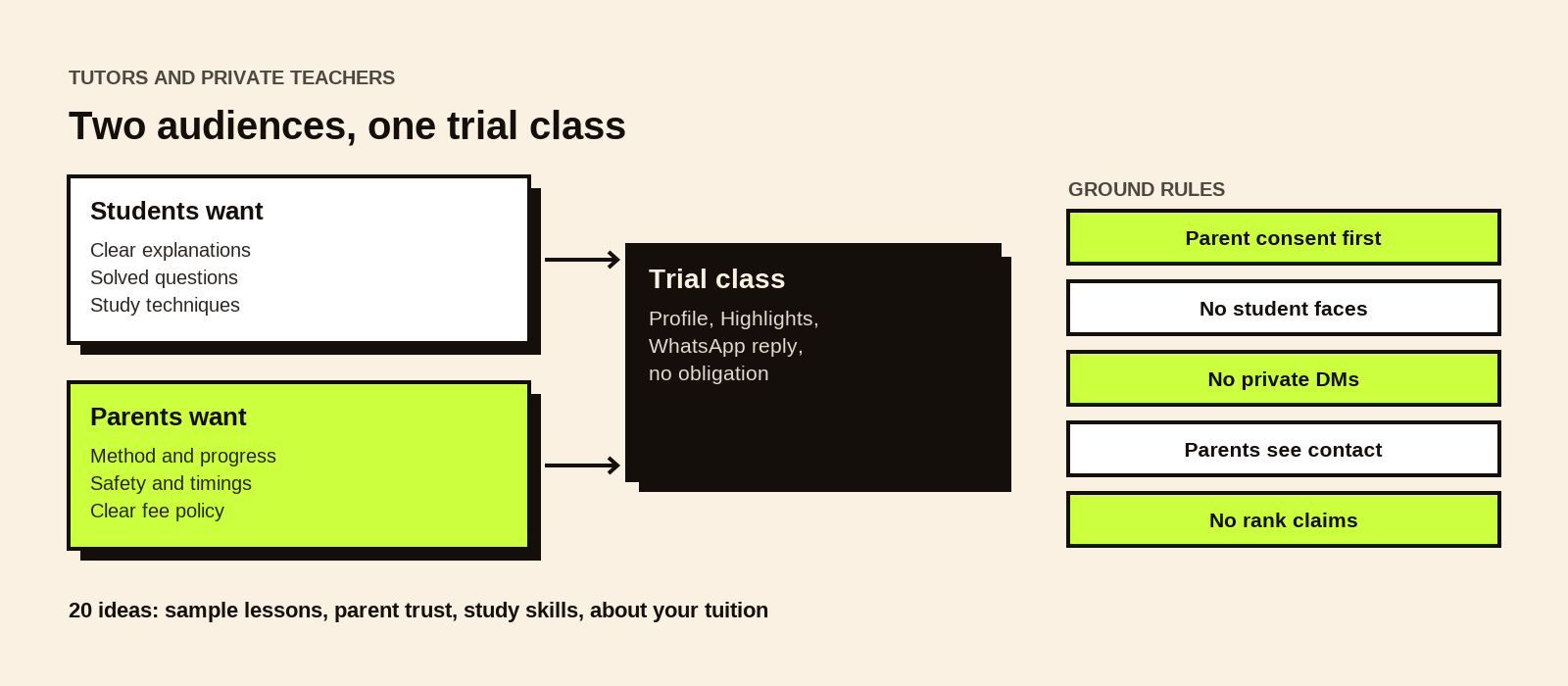
A maths tutor who teaches Class 9 and 10 students from home has three free slots after the board exams. Her WhatsApp status reaches parents she already knows. When a parent two sectors away asks a friend for 'a good maths tutor', the friend can only forward a phone number. Nothing shows how she explains a concept, how she keeps parents informed or what a trial class involves.
Quick answer
Instagram marketing for tutors works when parents can see how you teach and students find your explanations useful. Post short sample lessons, explain your method, timings and fee policy plainly, and answer the questions parents ask. Never show identifiable students without a parent's written consent, keep any contact with minors visible to their parents, and don't claim marks or ranks you can't document, because the CCPA's 2024 coaching guidelines include tuition.
Parents decide, students influence
For school-age students, a parent usually pays and decides, while the student's opinion after a trial class often settles it. Your account has to work for both, without turning into two separate feeds.
| Parents | Students | |
|---|---|---|
| What they want to know | Is this tutor qualified, safe, consistent, and worth the fee? | Will this person explain things so I actually get it? |
| Content that answers it | Method, progress updates, timings, fee and missed-class policy, your background | Short lessons, solved questions, study techniques |
| Where they act | WhatsApp or a call to the number in your bio | Saves, shares and telling a parent 'this one explains well' |
| What puts them off | Vague fees, big result claims, photos of other people's children | Long lectures, outdated syllabus, talking down |
Ground rules before your first post
Student privacy and parental consent
Under the Digital Personal Data Protection Act, 2023, a child is anyone under eighteen. Section 9 requires verifiable consent of the parent before processing a child's personal data, and bars tracking, behavioural monitoring and targeted advertising directed at children. The DPDP Rules, 2025 set out how verifiable parental consent works in Rule 10, and that rule is being phased in: the Rules say it comes into force eighteen months after their publication in November 2025. Don't wait for the date. Get a parent's written consent now before any student's face, name, voice, handwriting or marks appear on your account, and check your current obligations with a legal adviser.
Even with consent, the safest default is to keep students out of frame. Film your hands and the whiteboard, blur names on worksheets, crop out uniforms and school logos, and never tag a student's home location. If you promote posts, aim them at parents, not students.
Safeguarding on Instagram
- Don't hold private one-to-one DM conversations with students under eighteen. Move academic questions to a group or channel the parent can see, or to the parent's number.
- Don't follow students' personal accounts from your tutoring account, and don't ask them to follow you.
- Don't post screenshots of online classes that show students' faces, names or chat messages.
- Turn off or filter comments if anyone posts about a student, and report harassment through the platform.
- Agree with parents how you'll share class updates and stick to it.
- If a student tells you something that worries you about their safety, speak to the parent or the appropriate authority; don't discuss it on social media.
What the coaching guidelines mean for tutors
The CCPA's Guidelines for Prevention of Misleading Advertisement in Coaching Sector, 2024 define coaching to include academic support, guidance, study programmes and tuition. The 'coaching center' definition covers centres with more than fifty students, but the misleading-advertisement conditions in clause 3 and the obligations in clause 4 are written for any person who provides or is engaged in coaching. On a plain reading, a solo tutor's posts are covered. Our guide to social media marketing for coaching institutes summarises the clauses; the parts that matter most for tutors are in the results section below. Also check whether your state has rules for registering tuition or coaching centres, especially if you teach groups from rented premises. This is not legal advice.
20 Instagram content ideas for tutors
These ideas are grouped by the job they do. None needs a student on camera. Swap the subject examples for your own.
| # | Group | Idea | Format |
|---|---|---|---|
| 1 | Sample lessons | 'One mistake, one fix': a common error in a Class 10 trigonometry question, solved on the board | 45-second Reel |
| 2 | Sample lessons | Same question, two methods, and when to use each | Carousel |
| 3 | Sample lessons | A past board question walked through step by step, citing the board's published paper | Reel or carousel |
| 4 | Sample lessons | A concept explained with a household object, such as fractions with a roti or chapati | Reel |
| 5 | Sample lessons | A two-minute grammar or pronunciation drill for language students | Reel |
| 6 | Sample lessons | This week's most-asked doubt, typed on screen without the student's name, and your answer | Reel |
| 7 | Parent trust | How you track progress, shown on a blank progress sheet | Carousel |
| 8 | Parent trust | A week in your batch: days, timings, batch size, breaks | Single image or carousel |
| 9 | Parent trust | Fee, missed-class and refund policy in plain words | Carousel, saved to Highlights |
| 10 | Parent trust | What a parent update from you looks like, with dummy data | Screenshot-style graphic you design |
| 11 | Parent trust | Your qualifications and teaching experience, exactly as documented | Reel or carousel |
| 12 | Study skills | A 20-minute revision plan the night before a unit test | Carousel |
| 13 | Study skills | How to build a one-page formula sheet | Reel |
| 14 | Study skills | How to review a corrected test paper and find your error pattern | Carousel |
| 15 | Study skills | Questions to ask yourself when you're stuck on a problem | Single image to save |
| 16 | Study skills | Reading the syllabus: which chapters are in this year's official syllabus, with the board's source | Carousel |
| 17 | About your tuition | A tour of your teaching space, with no students present | Reel |
| 18 | About your tuition | Behind the scenes: preparing worksheets and marking | Stories |
| 19 | About your tuition | What happens in a trial class, how long it takes and what to bring | Reel, pinned |
| 20 | About your tuition | 'Is tuition right for your child?' including when it isn't the answer | Carousel |
Ideas 6 and 15 come straight from questions students ask. Our guide to turning customer questions into social content shows how to keep a running list so you never start from a blank page.
How to film a sample lesson
- One concept per video. If it needs three minutes, it's two videos.
- Start with the question on screen, not an introduction.
- Film the board or notebook from above with steady light; your phone and a window are enough.
- Speak the way you teach, in the language mix your students actually use.
- Check the content against the current syllabus and have a second subject teacher review anything you're unsure of.
- End with what to try next, not 'DM for admission'.
Talking about results honestly
Results season is when tutors are most tempted to overclaim. Clause 3 of the CCPA guidelines treats false claims about selections, ranks or success rates, and claims of guaranteed marks or admissions, as misleading. Clause 4(1)(a) requires the rank secured, the name and duration of the course and whether it was paid to be disclosed with a candidate's photograph, and clause 4(2) requires the candidate's written consent, taken after the result. For a student under eighteen, also get the parent's written consent.
- No '100% results', 'guaranteed 90+' or 'every student passed' claims.
- Don't count a student who took a two-week crash course as your full-year result.
- Don't compare one student's marks with another's in public.
- Prefer process stories, such as how a student's approach to revision changed, told with consent and without marks.
- Keep the evidence (mark sheets, consent forms) on file in case anyone asks.
[Student first name, only with consent] scored [result] in [exam, year].
Studied with me: [course or subject], [duration], [paid / free].
Shared with [the student's and parent's] written consent, given after the result.
Past results don't guarantee future results.
From profile to trial class
A parent who lands on your profile should know within seconds which subjects, classes and boards you teach, whether you teach at home, at the student's home or online, which area you cover and how to ask about a trial. Put the fee policy and trial-class post in Highlights. Our guide to turning Instagram profile visitors into enquiries covers bio, links and Highlights in detail.
Hello, thank you for getting in touch.

To suggest the right batch, could you share:
1. Your child's class and board
2. Subject(s) and what they find hardest right now
3. Preferred days and times
4. Home, my place or online?

I teach [subjects] for [classes] in [area / online]. Batches are [size]. Fees are [monthly / per session], and my missed-class and refund policy is here: [link or Highlight].

A trial class is [free / ₹__] and takes [__] minutes. After it, you and your child can decide with no obligation.
Common mistakes
- Posting group photos of students taken in class without each parent's written consent.
- Chatting with students in DMs late at night, even about homework.
- Topper banners with ranks or marks and no consent or course details.
- Copying solved questions from paid books or other tutors' videos.
- Teaching an old syllabus because the content was made last year.
- Saying 'limited seats' when the batch isn't actually full.
Where to start this term
Set up your bio and Highlights, pin a trial-class post, and write your consent and safeguarding rules in a note you share with every parent at admission. Then post two sample lessons a week for a month and see which topics parents forward. If you run a larger centre, the rules for institutes in our guide to social media management for schools and universities and the coaching-institutes guide above will matter more.
Tutors who'd rather spend their hours teaching can hand the editing, captions and scheduling to a managed social media service such as Kudozz's, while lesson accuracy, consent and parent communication stay with the tutor.