Social Media Management for Schools and Universities: Building a Consistent Digital Presence
How schools, colleges and universities in India can manage their social accounts: campus stories, academics, admissions, alumni and parents, with children's privacy, consent, safeguarding and approvals built in.
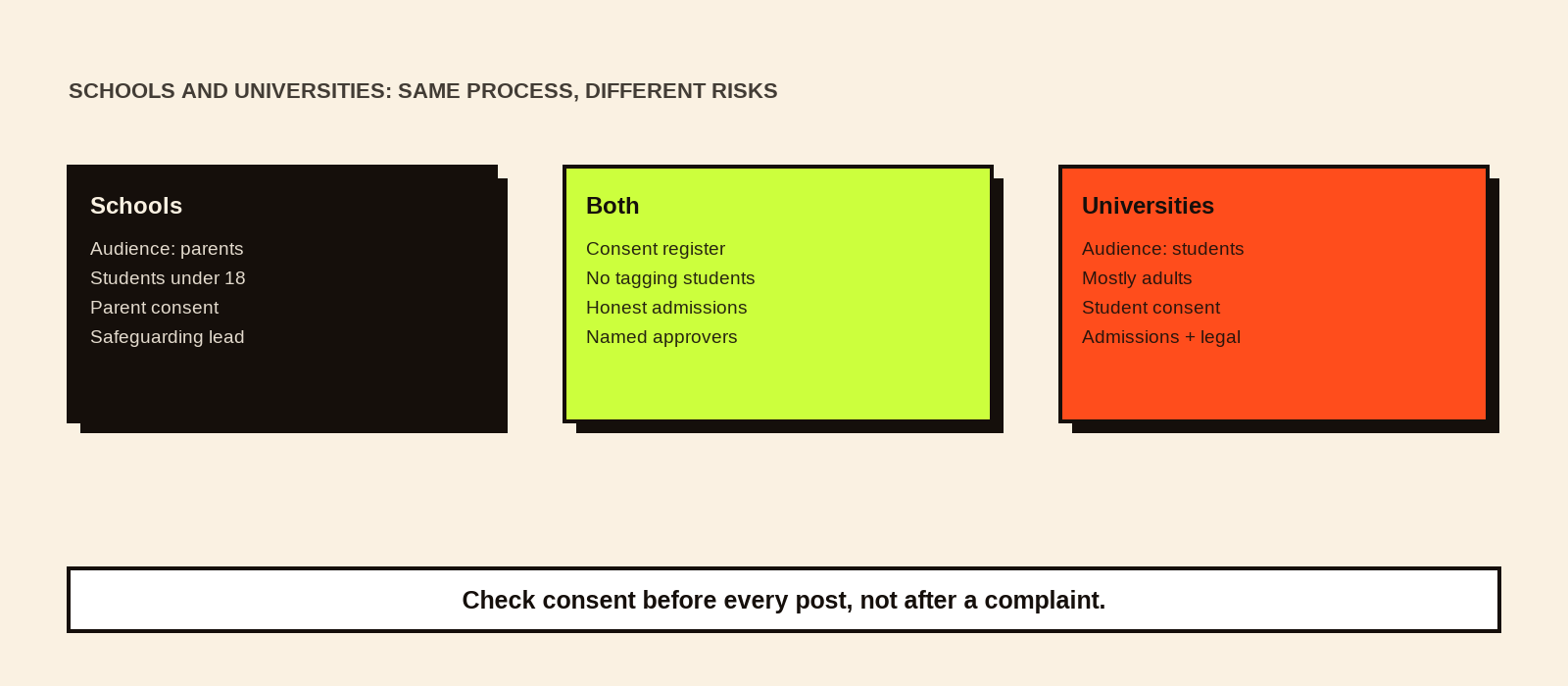
Annual day went well, and by evening a teacher has shared forty photos to the school's Instagram, several showing children's full names on their costumes. A parent who had asked for her son never to appear online sees him in the third slide. At the university across town, the admissions office has just posted '100% placement' on a banner the placement cell can't support. Both institutions have active accounts; neither has a working process.
Quick answer
Social media management for educational institutions means a steady mix of campus stories, academic updates, events, faculty expertise, consented student achievements, admissions information, alumni and parent communication, run under a written consent and approval policy. Schools work mostly with minors, so parental consent and safeguarding come first. Universities work mostly with adults but still need consent, accurate admissions claims and clear approvals.
Schools and universities need different rules
| Question | Schools | Colleges and universities |
|---|---|---|
| Main audiences | Parents, prospective parents, the local community | Prospective students, current students, alumni, recruiters, researchers |
| Who is in the photos | Mostly children under 18 | Mostly adults; some first-year students may be under 18 |
| Whose consent | Parent or guardian, in writing; the child's agreement too where age-appropriate | The student, in writing; a parent too if the student is under 18 |
| Main risks | Child safety, identification, tagging, location | Admissions and placement claims, campus incidents, student protest content |
| Typical approvers | Principal, with the safeguarding or child protection lead | Communications office, with the registrar, admissions and legal |
What to post
- Campus storytelling: classrooms, labs, libraries, sports, clubs and everyday campus life, shot to show activity rather than identifiable children.
- Academic updates: new programmes, curriculum changes, exam timetables and results announcements already shared through official channels.
- Events: annual days, fests, conferences, guest lectures and sports meets, with recap posts reviewed for consent before publishing.
- Faculty expertise: research, publications, explainers in a teacher's subject and conference talks, with faculty approval of anything in their name.
- Student achievements: competitions, scholarships, publications and sports results, with consent from the student (and parent for minors).
- Admissions: dates, eligibility, process, fees and scholarships, all matching the official prospectus.
- Alumni: career stories and reunions, shared with the alumnus's consent and reviewed for accuracy.
- Parent communication: holiday notices, safety information and how to reach the school, with urgent notices also sent through official channels.
Faculty and alumni content often works best on LinkedIn for universities; our guide to LinkedIn company page management covers that channel. Faculty hiring content overlaps with employer branding, covered in our guide to social media for recruitment and employer branding.
Admissions communication without misleading claims
Admissions posts are advertising, so ASCI's guidelines for advertising of educational institutions, programmes and platforms (9 March 2023) are the most useful reference. In summary, they say an advertisement shouldn't suggest a course or institution is official, recognised, accredited or affiliated unless that can be substantiated; shouldn't promise ranks, marks, jobs, admissions or salary rises unless substantiated, and then must carry the disclaimer 'past record is no guarantee of future prospects'; shouldn't use abstract 100% claims such as '100% placement'; should base placement, topper and ranking claims on the latest completed academic year, state the total batch size for placement numbers, and name the publisher and date of any ranking. They also warn against showing school students sacrificing sleep or meals to study, portraying average scorers as failures, or creating false urgency. ASCI's separate guidelines on awards and rankings (21 April 2022) cover educational institutions too.
Your affiliating body, university regulator or school board may have its own rules on publicity; check with them and your legal team. Coaching providers have additional, statutory rules from the CCPA, covered in our guide to social media marketing for coaching institutes.
Children's privacy and safeguarding
Under the Digital Personal Data Protection Act, 2023, a child is anyone who has not completed eighteen years. Section 9 requires a Data Fiduciary to obtain verifiable consent of the parent before processing a child's personal data, bars processing likely to harm a child's well-being, and rules out tracking, behavioural monitoring and targeted advertising directed at children. Rule 10 of the DPDP Rules, 2025 describes how verifiable parental consent is obtained, and comes into force eighteen months after the Rules were published in the Gazette in November 2025.
The Rules' Fourth Schedule exempts educational institutions from parts of section 9, but only for tracking and behavioural monitoring for their educational activities or in the interests of children's safety. Nothing in that exemption covers using children's photos or details for marketing, so treat social media posts as needing parental consent. Timelines can change, so check your current obligations with counsel.
- Never pair a child's face with their full name, class and section, or home locality.
- Don't tag or link to students' personal accounts, and turn off or moderate tagging on school accounts where you can.
- Keep a 'do not photograph' list from parents, shared with everyone who takes photos at events.
- Prefer group shots, hands-at-work and backs-of-heads for everyday posts; use close-ups only with specific consent.
- Post trips and off-campus events after the group has returned, not live.
- Remove uniforms or badges that show the school name from any close-up of an individual child, unless consent covers it.
- Take down any image within a set time when a parent asks.
- Staff use school accounts and school devices for school content, never personal ones.
Content governance and approvals
Most institution accounts drift into trouble because too many people can post and nobody owns the rules. Name one account owner, keep admin access limited and recorded, and agree who approves what. Our guide to the social media approval process explains stages and turnaround in more detail.
| Content | Drafted by | Checked by | Approved by |
|---|---|---|---|
| Everyday campus and event posts | Communications or a trained staff member | Consent register check | Account owner |
| Posts showing identifiable children | Communications | Safeguarding lead checks consent | Principal or head of school |
| Student achievements | Department or communications | Facts checked with the department; consent on file | Account owner |
| Admissions, fees, placements, rankings | Admissions office | Registrar or academic office; legal for claims | Head of institution or nominee |
| Faculty expertise | Faculty member with communications | Faculty member approves final | Account owner |
| Incidents, complaints, closures | Communications with leadership | Legal and safeguarding as needed | Head of institution |
Incidents need a plan before they happen: an accident on a trip, a viral video from a hostel, a protest or a data leak. Our guide to building a social media crisis response plan sets out severity levels and holding statements; for anything involving a child's safety, the safeguarding lead and legal team lead, and nothing identifying a child is posted.
Governance and consent checklist
- A written social media policy, approved by leadership, covering who posts, what needs approval and what is never posted.
- A consent form that names the platforms, purposes and duration, and is signed by a parent for anyone under 18.
- A consent register that every person posting can check before publishing.
- A 'do not photograph' list for every event.
- Rules on names, tagging, locations and live posting.
- Admissions and placement claims checked against documents and the ASCI education guidelines.
- Named approvers and deputies for each content type.
- A takedown process with a set response time.
- An incident route that includes the safeguarding lead and legal.
- An annual review of the policy, plus whenever DPDP obligations or board rules change.
Institution:
Student name, class or programme:
I agree that photographs and videos of the student taken at [institution activities] may be shared on: [list platforms and the website].
Purpose: [news, events, achievements, admissions material].
The student's name may / may not be shown with images. Tagging of personal accounts will not be used.
This consent lasts until: [date or end of academic year] and can be withdrawn at any time by writing to [contact]; images will be removed within [period].
Signed (student, if 18 or over):
Signed (parent or guardian, if under 18):
Date:
Common mistakes
- Collecting one-time consent at admission and never checking it again.
- Letting every teacher post from personal phones to the official account.
- Captioning children's photos with full names and classes.
- Claiming '100% placement' or a ranking without the batch size, publisher and date.
- Posting live from school trips.
- Deleting critical comments instead of responding under a clear moderation policy.
Where to start
Write the policy, set up the consent register and agree the approval table before you plan more content. Then build a month around campus life, academics and one or two honest admissions posts. If you want to work with student and alumni creators for admissions, our guide to influencer marketing for colleges covers that separately from your own accounts.
A managed social media service, such as the process Kudozz follows, can handle planning, design, publishing and moderation, but consent decisions, safeguarding and admissions claims stay with the institution.