Social Media Marketing for Coaching Institutes: A Practical Strategy for Building Student Enquiries
A practical social media plan for coaching institutes in India: subject content, faculty introductions, demo classes, parent communication and student stories, within the CCPA's 2024 coaching advertisement guidelines.
Results day: your rival's Instagram is covered in student photos, rank numbers and '100% selection' banners, and your counsellor asks why your page is quiet. Meanwhile three parents have messaged asking whether your weekend batch covers the full syllabus and what happens to fees if their child drops out. The second set of messages is where enquiries actually come from, and the first set is exactly what India's consumer protection regulator has been penalising.
Quick answer
Social media marketing for coaching institutes works best when it teaches: subject lessons, exam strategy, faculty introductions with accurate credentials, honest course explanations, parent-focused answers and demo classes. Under the CCPA's coaching guidelines of 13 November 2024, institutes must not make false claims about selections, ranks or guarantees, must disclose rank, course and whether it was paid alongside a candidate's photo, and need the candidate's written consent obtained after selection.
What the CCPA coaching guidelines require
The Central Consumer Protection Authority notified the Guidelines for Prevention of Misleading Advertisement in Coaching Sector, 2024 on 13 November 2024 under section 18 of the Consumer Protection Act, 2019, in force from the date of publication. They apply to all forms of advertisement by anyone engaged in coaching, including endorsers. 'Coaching' covers academic support, tuition and study programmes, but not counselling, sports, dance, theatre or other creative activities, and a 'coaching center' is one providing coaching to more than fifty students. Contraventions are dealt with under the Consumer Protection Act. This summary is not legal advice; confirm how the guidelines apply to your institute with your legal team.
| Clause | What it says (paraphrased) | What it means on social media |
|---|---|---|
| 3(a) | No false claims about courses, duration, faculty credentials, fees or exit and refund policy | Course and faculty posts must match what you actually deliver |
| 3(b) | No false claims about number of selections, ranks or success rate | Only real, documented results, with nothing inflated or borrowed |
| 3(c) | No false claims of guaranteed selection, job security, promotions, salary rises, admissions, or that enrolment ensures a good rank or high marks | No 'guaranteed selection' or 'sure-shot rank' captions |
| 3(e) | No false sense of urgency or scarcity, or false popularity | No fake 'last 3 seats' or invented demand |
| 4(1)(a) | Disclose rank secured, name and duration of course, and whether the course was paid, with the candidate's photograph | Every topper post carries those details |
| 4(1)(b) | Disclaimers and important information in the same font as the claim | No fine print in the caption or a corner of the graphic |
| 4(1)(c)-(d) | Represent facilities accurately; claim recognition or approval (such as AICTE or UGC) only if true | Show only the infrastructure and approvals you actually have |
| 4(2) | No name, photo, testimonial or video of a successful candidate without written consent, taken after selection | Consent forms signed at admission don't count |
When it announced the guidelines, the Department of Consumer Affairs said the CCPA had taken action against 45 coaching centres and imposed penalties on 18 for misleading advertisements (PIB, 13 November 2024). Separately, ASCI's guidelines for advertising of educational institutions, programmes and platforms (9 March 2023) ask for the disclaimer 'past record is no guarantee of future prospects' on substantiated outcome claims, and rule out abstract 100% claims and ads that create false urgency.
Content that builds enquiries without claims
Students choose a coaching institute because they believe it will teach them well. The most persuasive thing your feed can do is show that teaching. These categories cover most of what an institute needs:
| Category | Examples | Watch-out |
|---|---|---|
| Subject-wise lessons | One concept per Reel or carousel, solved questions, common errors | Accuracy check by the subject faculty |
| Exam strategy and learning tips | Revision plans, time management, reading the syllabus, handling mock tests | General tips, not promised marks |
| Faculty introductions | Subject, teaching experience, qualifications, a short teaching clip | Credentials exactly as documented (clause 3(a)) |
| Course explanations | Who a batch suits, schedule, syllabus coverage, fee and refund policy explained | Match the course document; no hidden conditions |
| Student questions | Weekly answers to doubts sent by DM or comments | Use questions, not identities, unless consent is on file |
| Parent communication | How progress is tracked, safety and timings, how to raise concerns | Honest; don't frame average scorers as failures |
| Exam updates | Notification released, form window open, syllabus change | Only from the conducting body's official notice, linked or quoted |
| Demo classes | Invitations, what happens in a demo, recorded sample lessons | No pressure tactics or fake deadlines |
For exam dates, eligibility and syllabus changes, post only what the conducting body has officially published, and tell readers to confirm on the official website. If a date isn't announced, say so. Our guide to turning customer questions into social content explains how to build recurring series from the doubts students already send you.
A monthly content plan
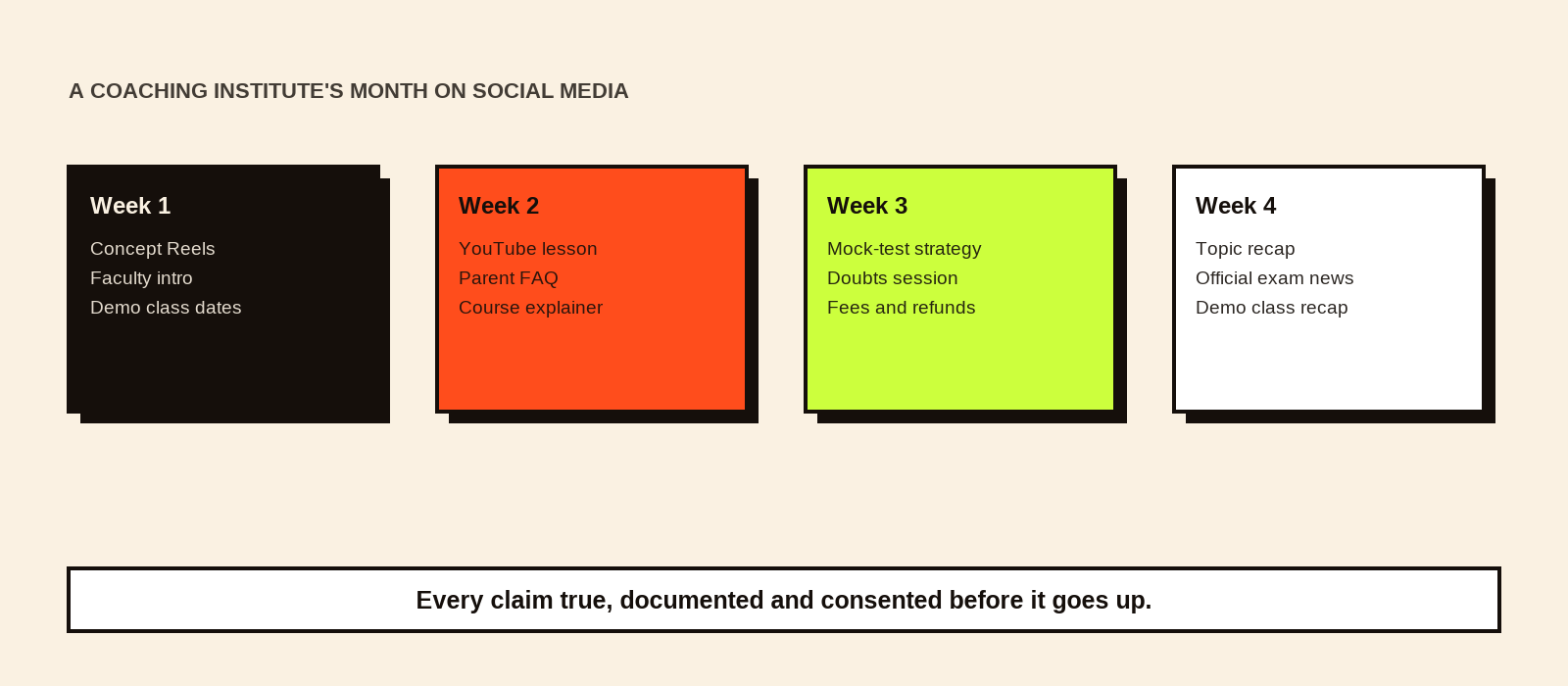
Here is a sample month for an institute posting four to five times a week on Instagram plus one longer YouTube lesson a week. Adjust the volume to what your faculty can review, and see our guide to building a monthly social media content calendar for the planning meeting and fields.
| Week | Teaching | People | Students and parents | Enquiry |
|---|---|---|---|---|
| 1 | Two concept Reels, one solved-problem carousel | Faculty introduction | Answers to last month's top doubts | Demo class dates for the month |
| 2 | Two concept Reels, one long YouTube lesson | A day in a classroom (consented students only) | Parent FAQ: how progress is shared | Course explainer: who the batch suits |
| 3 | Revision or mock-test strategy series | Faculty answers a common doubt | Student questions live session | Fee and refund policy explained plainly |
| 4 | Topic recap carousel | Support team: counsellors, doubt desk | Official exam update (if any), with source | Demo class recap and next dates |
Short-form video carries most of this plan. Our guide to an Instagram Reels strategy covers formats and hooks, and our guide to influencer marketing for education and EdTech brands covers working with educator creators, which is separate from running your own accounts.
Demo classes and the enquiry journey
Map what happens after someone engages, because a good post followed by a slow or pushy reply wastes the effort. A simple journey: a student sees a lesson, visits the profile, finds batch details and a booking link, messages a question, gets a reply from a named counsellor, attends a demo, and receives the course document with fees and refund policy in writing before paying. Keep the DM reply honest about fit; if a batch doesn't suit the student's level, say so. Never invent closing dates or seat counts to push a decision, because clause 3(e) treats false urgency as misleading.
Student stories, toppers and consent
Result posts are allowed when they are true, documented and consented. Clause 4(2) requires the successful candidate's written consent, taken after selection, before you use their name, photo, testimonial or video. Clause 4(1)(a) requires the rank secured, the name and duration of the course they took, and whether it was paid to be shown with the photograph. Never claim a student who only attended a test series or a free crash course as a full-course result, and never reuse another institute's toppers.
Many coaching students are minors. Under the Digital Personal Data Protection Act, 2023 a child is anyone under eighteen; section 9 requires verifiable consent of a parent before processing a child's personal data, and bars tracking, behavioural monitoring and targeted advertising directed at children. Rule 10 of the DPDP Rules, 2025 sets out how verifiable parental consent works, and comes into force eighteen months after the Rules were published in November 2025. For any student under eighteen, get the parent's written consent as well as the student's, and check your current obligations with counsel.
[Student name] secured [rank or result] in [exam, year].
Course taken with us: [course name], [duration]. [Paid / free] course.
Shared with [student's / student's and parent's] written consent, given after the result.
Past results are no guarantee of future results.
Claims compliance checklist
- Every number (selections, ranks, students, years) has a document behind it that you could show a regulator.
- No 'guaranteed', 'assured', 'sure-shot' or '100%' claims about selection, marks, admissions or jobs.
- Topper posts show rank, course name, duration and whether it was paid, in the same font size as the claim.
- Written consent from the candidate, taken after selection, is on file; parental consent too for under-18s.
- Faculty credentials and course details match the course document.
- Recognition or approval claims (AICTE, UGC or others) are true and current.
- No invented scarcity, countdowns or 'seats filling fast' lines.
- Exam dates and rules quote the official notice.
- Infrastructure shown actually exists today.
- Someone with authority to say no has approved the post.
Platforms and approvals
Instagram and YouTube carry most coaching content: Instagram for short lessons and community, YouTube for full-length lessons students search for and return to. A WhatsApp number handles enquiries, and a Facebook page often reaches parents. Whatever the mix, the institute's director or a named compliance owner approves claims, results and course posts, and subject faculty approve lessons. An agency can plan, script, edit and publish, but it does not replace your legal or compliance review.
Common mistakes
- Collecting blanket photo consent at admission and using it for result posts later.
- Claiming students who took a short test series as full-course results.
- Hiding 'paid course' or rank details in a caption that people won't expand.
- Posting unconfirmed exam dates from rumours or other channels.
- Running countdown offers that reset every week.
- Posting results only and no teaching, so the feed gives students no reason to trust you between result seasons.
Where to start
Audit your last three months of posts against the claims checklist, fix or remove anything that fails, and rebuild the calendar around lessons, faculty and honest course information. Put the consent process for result posts in place before the next results day. Schools and universities face different rules, covered in our guide to social media management for educational institutions.
If you want outside help with the calendar and production, our content planning and production scope covers content planning, scripting, Reels editing and publishing; claims approval stays with the institute.