Social Media Campaigns for Restaurants: How to Promote Seasonal Menus, Events and Limited-Time Offers
How restaurants can plan social media campaigns for seasonal menus, events and limited-time offers: lead times by campaign type, a campaign one-pager, a sample six-week timeline and honest offer terms.
The monsoon menu has been ready in the kitchen for a week, but the first post goes up the morning it launches, with a phone photo and the caption 'New menu now live!'. Two weeks later the team is planning a Friday jazz night and announces it on Wednesday. Neither campaign fails because the food or the band was wrong. They fail because social media was asked to start when the kitchen finished.
Quick answer
Social media marketing campaigns for restaurants work best when they start with the kitchen and the calendar together. Seasonal menus need about four to six weeks from planning to close, events need enough notice for people to book, and limited-time offers need clear terms and an honest end date. Write a one-page campaign brief, shoot before launch, tease without overpromising, then sustain and measure with your own sales and booking data.
Three campaign types, three different clocks
A seasonal menu, an event and a limited-time offer (LTO) all look like 'a promotion', but they ask different things of the audience and the kitchen. Planning them with the same timeline is where most problems start. The lead times below are practitioner guidance, not platform rules; adjust them to your kitchen and your guests.
| Seasonal menu | Event | Limited-time offer | |
|---|---|---|---|
| What you want people to do | Try new dishes over several weeks | Book or turn up on a specific date | Visit or order within a defined window |
| Suggested planning start | 4 to 6 weeks before launch | 3 to 4 weeks before the date | 2 to 3 weeks before it starts |
| Must-have information | Dishes, prices, how long the menu runs | Date, time, price or cover, booking method, capacity | Exact terms, dates, times, dine-in or delivery, exclusions |
| Content that carries it | Dish Reels, chef story, carousels | Performer or host intro, countdown Stories, recap | One clear offer post, Stories reminders, pinned post |
| Main risk | Dishes look different from the shoot | Overselling capacity | Unclear terms causing disputes at the bill |
Start with a campaign one-pager
Before any post is designed, put the campaign on one page that the owner, chef, floor manager and social team all agree. It prevents the most common last-minute changes: a price that changes after the post is live, a dish dropped because a supplier fell through, or an event that quietly becomes ticketed.
CAMPAIGN BRIEF

Campaign name: ____
Type: [seasonal menu | event | limited-time offer]
Runs from ____ to ____ (days and times: ____)
Outlets: ____ | Dine-in / delivery / takeaway: ____

GOAL
What success looks like, in our own numbers: [covers on event night | units of new dishes sold | bookings | enquiries]
How we will count it: [POS item report | booking system | 'how did you hear about us' at the table]

THE OFFER OR MENU (owner and chef to confirm)
Items and prices: ____ (taxes and service charge stated as they appear on the bill)
Conditions: ____ (minimum order, days excluded, not combinable with ____, while stocks last ONLY if stock is genuinely limited)
Capacity: ____ covers / ____ portions per day

CONTENT
Shoot date: ____ (must be before teaser week)
Key assets: ____ | Partners to tag or collaborate with: ____
Channels: Instagram feed, Reels, Stories, Google Business Profile, WhatsApp broadcast to opted-in customers, in-venue

OPERATIONS
Staff briefing date: ____ | Who answers DMs and calls about it: ____
What happens if it sells out early: ____

APPROVALS
Chef (dishes and descriptions): ____ | Owner (prices, terms): ____ | Social lead: ____
Sample timeline: a six-week seasonal menu campaign
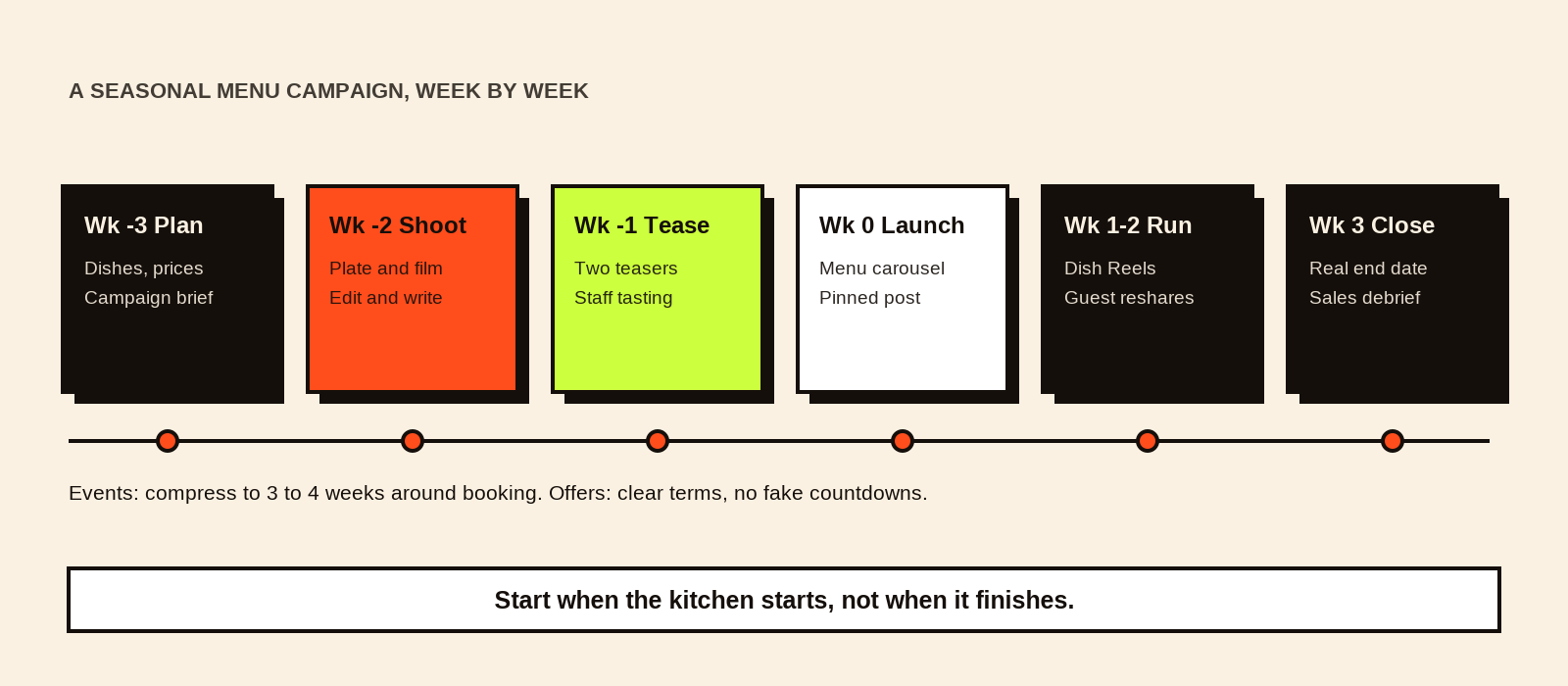
Here is a hypothetical example. Say a mid-sized restaurant is launching a four-week monsoon menu of six dishes and two drinks. Week 0 is launch week. The same structure works for a festive menu or a winter specials board.
| Week | Kitchen and operations | Social content | Other channels |
|---|---|---|---|
| Week -3: Plan | Chef finalises dishes, costing and portions; owner confirms prices | Campaign brief signed off; content plan and shot list written | Brief floor staff on dates |
| Week -2: Shoot | Test plating; shoot all dishes and the chef's prep | Edit Reels, carousels and Stories; write captions and dish descriptions | Update menu card proofs |
| Week -1: Tease | Staff tasting so servers can describe each dish | Two teasers (an ingredient close-up, the chef at the pass); Stories poll on which dish to reveal first | Google Business Profile update; WhatsApp note to opted-in regulars |
| Week 0: Launch | Menu live; track item sales daily | Launch carousel with prices; dish Reel; pinned post; Stories through the week | In-venue table cards; staff mention it at order |
| Weeks 1 to 2: Sustain | Drop or tweak any dish that isn't working | One dish Reel a week, reshared guest posts (with permission), 'what our team orders' Stories | Google post refreshed with a new photo |
| Week 3: Close | Plan which dishes, if any, stay on | 'Last week' reminder only if the end date is real; thank-you and recap | Debrief: sales, feedback, content learnings |
Adapting it for an event
Compress the plan to three or four weeks and build it around the booking. Announce with every detail people need to decide (date, time, price or cover charge, what is included, how to book), introduce the performer, chef or partner, and use Stories reminders as the date approaches. If you are co-hosting with a brewery, artist or neighbouring business, Instagram's collaborative posts let an invited account appear on the post and share it with its followers once they accept. Close the loop with a recap post the next day, using only guests who agreed to be shown.
Adapting it for a limited-time offer
An LTO needs less storytelling and more clarity. One well-written offer post, pinned for its duration, plus Stories reminders, usually does the job. The end date must be the real end date. If the offer is extended, say so plainly rather than restarting a countdown. India's Central Consumer Protection Authority issued Guidelines for Prevention and Regulation of Dark Patterns on 30 November 2023 that name false urgency among specified dark patterns, so avoid fake timers, invented 'only 5 left' claims and offers that 'end tonight' every night.
Writing offer terms that don't cause arguments
Most offer complaints at the table come from something the post left out. The ASCI Code expects claims about objectively ascertainable facts to be capable of substantiation, and food descriptions are covered by the FSSAI claims rules on truthful, non-misleading claims. In practice, check every offer post against this list before it goes live:
- The price matches the bill, and the post says whether taxes and any service charge are extra.
- Days and hours are stated (for example, weekdays 12 to 4 pm only).
- Dine-in, takeaway or delivery is stated; delivery app prices and offers may differ and are set on the app.
- Exclusions are listed: other offers, certain items, public holidays, group bookings.
- Words like 'unlimited', 'free' and 'buy one get one' mean exactly what they say, with any limits written next to them.
- 'While stocks last' appears only when stock is genuinely limited, and you update the post when it runs out.
- Dish descriptions avoid 'fresh', 'healthy', 'farm-to-table' or 'authentic' claims the kitchen can't support.
- Staff have seen the same terms, so the server and the post say the same thing.
Where each channel fits in a campaign
Instagram carries most of the storytelling, but nearby customers often check Google first. At the time of writing (November 2026), Google Business Profile Help says businesses can publish posts as updates, offers or events, which makes it a natural second home for the launch photo and the offer terms. Stories carry the reminders, and a WhatsApp broadcast reaches regulars who have opted in to hear from you. The Stories guide covers stickers and reminder formats in more depth.
If creators are part of the plan, keep their work on a separate track with its own brief and disclosure checks; our seasonal influencer marketing guide covers that side. Campaigns sit on top of your regular calendar rather than replacing it, so slot them into the monthly content calendar early.
Measuring whether the campaign worked
Reach and likes tell you whether people saw the campaign, not whether they came in. Agree the business measure in the brief and compare it with a similar period before the campaign.
| Campaign type | Business measure | Supporting social signals |
|---|---|---|
| Seasonal menu | Units of new dishes sold (POS item report), share of orders including them | Saves and shares on dish posts, DMs asking about dishes |
| Event | Bookings, covers on the night, repeat bookings for the next edition | Story replies, link taps, enquiries by DM or call |
| Limited-time offer | Offer redemptions recorded at billing, average bill during the window | Pinned post views, questions about terms |
Ask at the table how guests heard about it, and accept that some of the effect won't be attributable. For which social metrics matter by goal, see our social media KPIs guide.
Common mistakes
- Shooting the menu on launch day, so the first post is rushed and the teaser week is skipped.
- Announcing events with too little notice for people to plan or book.
- Leaving taxes, service charge or exclusions out of the offer post.
- Fake urgency: countdowns that restart, or 'last day' posts that aren't.
- Not briefing staff, so the server contradicts the post.
- Judging the campaign on likes instead of dish sales, bookings or redemptions.
Where to start
Pick your next seasonal menu, event or offer, fill in the campaign brief with your chef and floor manager, and count back six weeks. Book the shoot before the teaser week; our restaurant shoot brief covers that step.
Multi-week pushes that combine organic content, creators and offers are where social campaign planning helps. Ongoing posting, Stories and comment handling for those campaigns sit within a managed social media service, with campaign scope agreed separately.