Social Media Marketing for Financial Services: Building Credibility Without Making Risky Promises
How banks, NBFCs, fintechs, mutual funds, advisers, brokers and insurers can run their own social accounts in India: education, plain-language explainers, expert content, creators and a compliance sign-off that every post passes through.
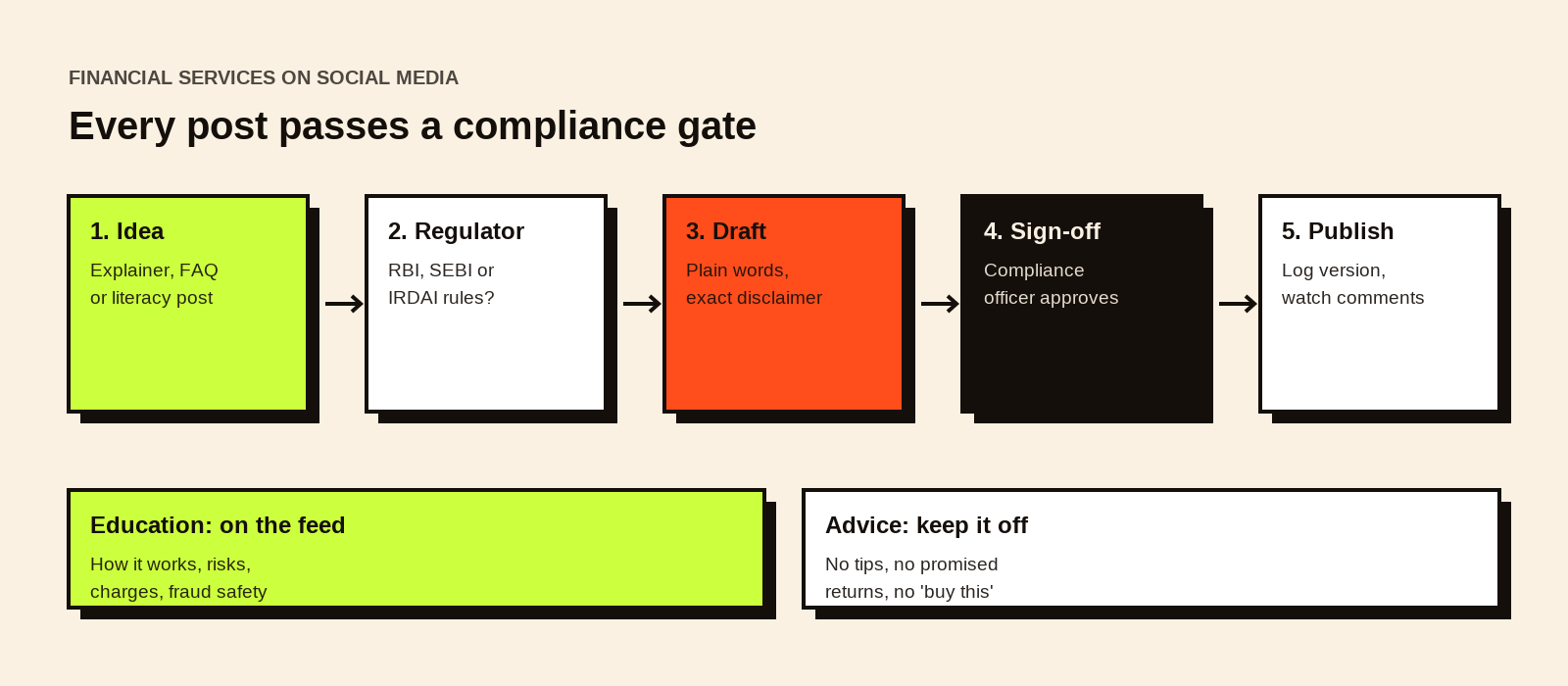
Your product team wants a Reel that says the new savings plan 'beats inflation'. A follower has asked in the comments which fund they should pick for their daughter's education. And a popular trading creator has offered to promote your app for a fee. Three ordinary social media moments, and each one can put a regulated financial brand in trouble if it is handled like a consumer brand would handle it.
Quick answer
Social media marketing for financial services works when the feed educates rather than predicts. Explain products in plain language, build financial literacy, show qualified experts with accurate credentials, and answer common questions. Never promise returns or give personal advice in public. Know which regulator covers each activity (RBI, SEBI or IRDAI), use the required disclaimers, check every creator you associate with, and route every post through your compliance officer before it goes live.
Start with who regulates what
'Financial services' covers businesses with very different rulebooks. A fintech app may distribute mutual funds, offer a loan through a partner NBFC and sell insurance as a corporate agent, and each activity falls under a different regulator. Map your activities before you plan content, because the rules follow the product being talked about, not the account posting it.
| Activity | Regulator | What to check before posting |
|---|---|---|
| Banking, lending, NBFC products, payments | RBI | The RBI directions for your category of entity, lending partner names and how loan terms are stated |
| Mutual funds and AMCs | SEBI (AMFI is the industry body) | The Advertisement Code in the SEBI (Mutual Funds) Regulations, 2026, including the standard warning |
| Investment advisers and research analysts | SEBI | Registration details, advertising approval through the supervisory body, no performance claims |
| Stockbrokers and depository participants | SEBI, with exchanges and depositories as supervisory bodies | Exchange advertising rules and SEBI's restrictions on associating with unregistered advisers |
| Insurance (insurers and distributors) | IRDAI | IRDAI's 2024 policyholder protection regulations and the insurer's written approval for distributor ads |
This table is a starting map, not legal advice. Your compliance officer decides which rules apply to your entity and product, and regulations in this sector change often. Several changed in 2026 alone.
Education versus advice
The safest and most useful content for a financial brand is education: explaining how something works so people can make their own decisions. Advice tells a specific person, or an audience, what to buy, sell or expect. The line matters legally as well as ethically. SEBI's circular of 22 October 2024 says that persons regulated by SEBI, and their agents, must not associate directly or indirectly with anyone who gives advice or recommendations on securities without being registered or permitted, or who makes express or implied claims of returns or performance without permission. The rules took effect on 29 August 2024.
SEBI's clarification circular of 29 January 2025, updated on 8 May 2026, adds detail. A person engaged solely in education must not use market price data of the preceding thirty days to name a security, or a code name for one, in a way that indicates future price, advice or a recommendation. Before the May 2026 update, the window was three months. Your own content team should hold itself to the same discipline.
| Education (usually suitable) | Advice or claims (keep off the feed) |
|---|---|
| How a SIP works and what rupee cost averaging means | 'Start a SIP in this fund today' |
| What an expense ratio is and where to find it | 'This fund will give you 15% a year' |
| How a term plan differs from a savings-linked plan | 'This plan is the best cover for your family' |
| What a credit score is and what affects it | 'Guaranteed approval in 10 minutes' |
| How to spot a phishing call claiming to be your bank | Comments recommending specific stocks or entry prices |
| Questions to ask before choosing any product | 'Our customers doubled their money' |
What to post: content that builds trust
Plain-language product explanations
Most financial confusion comes from jargon. A carousel that explains 'what lock-in actually means' or a 45-second video on 'what happens when you miss an EMI' does more for trust than a product announcement. Keep each post to one idea, define terms the first time you use them, and state charges, conditions and exclusions as clearly as features. If the explanation needs a long disclaimer to stay accurate, it probably needs to be two posts.
Financial literacy and safety
Literacy content earns its place because it is useful even to people who never buy from you: budgeting basics, how insurance claims work, how to read a loan offer, and above all fraud awareness. Posts that explain how your organisation will never ask for an OTP or PIN, and where to report fraud, protect customers and give you something to point to when impersonators appear.
Expert-led content, with credentials stated accurately
A fund manager explaining a market term, an actuary explaining why premiums differ by age or a credit officer explaining what lenders look at all add authority. State each expert's role and qualifications exactly as they hold them, and never let 'our expert' imply a registration the person doesn't have. If an employee speaks about securities, make sure what they say stays within your entity's permissions and is approved like any other post.
FAQs from your own inbox
Comments, DMs and branch queries show you what people misunderstand. Turn the repeat questions into short answers, as our guide to turning customer questions into content explains, but answer the general question, never the individual's situation. 'What documents do I need for a home loan?' is content. 'Should I take this loan?' is a conversation for a qualified person in a private channel.
Disclaimers and advertising codes
Mutual funds: the Advertisement Code in the Fifth Schedule of the SEBI (Mutual Funds) Regulations, 2026, in force from 1 April 2026, requires the standard warning 'Mutual Fund investments are subject to market risks, read all scheme related documents carefully.' in legible fonts, with no words added or removed. Vernacular ads carry it in the same language, and in audio-visual ads it must be shown and voiced clearly. The same code says advertisements shall not contain testimonials or rankings, and that no celebrities shall form part of the advertisement.
Change is coming. SEBI notified a Common Advertisement Code for stockbrokers, depository participants, online bond platforms, investment advisers, research analysts, mutual funds, AMCs and portfolio managers through the Intermediaries (Second Amendment) Regulations, 2026, published in the Gazette on 9 October 2026. It comes into force on the 180th day after publication, so in April 2027, and at the time of writing (November 2026) it is not yet in force. Among other things, it requires the entity's name and SEBI registration number in ads, bans promises of guaranteed or indicative returns and testimonials, and treats purely educational communication with minimal branding and no promotional call to action as outside the definition of an advertisement. Confirm the transition with your compliance officer.
Insurance: the IRDAI (Protection of Policyholders' Interests, Operations and Allied Matters of Insurers) Regulations, 2024 repealed the 2021 advertisement regulations. They require ads to be fair and true, reflect potential risks, show the insurer's registered name, and not hide exclusions or use illegible text. Regulation 27(6) applies them expressly to content insurers and distribution channels post on their social media pages, and regulation 28 says ads issued by a distribution channel need the insurer's written approval first.
Using creators responsibly
Creators can make financial topics approachable, but this is where the most serious risks sit. For SEBI-regulated entities, the association rules above apply to paid promotions, referrals and affiliate links, and SEBI's FAQ says advertising or lead generation through a marketing agency can also be a violation if it ends in an indirect association with a person engaged in prohibited activities. Check what a creator posts across all their channels, not only in your campaign.
ASCI's influencer guidelines add a qualification test. Addendum 2, dated 17 August 2023, says influencers giving stock or investment advice should be registered with SEBI and state their registration number with their name and qualifications, and that other financial advice needs suitable qualifications such as an IRDAI licence, CA or CS. These details must appear upfront, superimposed on the video or as the opening remark. Creators without qualifications can share generic information that isn't technical advice. For campaign planning, see influencer marketing for fintech brands and personal finance influencer marketing, which cover creator selection in depth.
Disclosures and compliance sign-off
Every post, Story, reply template and creator script should pass through a named compliance owner before publishing. That person, or your legal team, decides whether content is compliant. A social media agency can plan, write and design within agreed rules, flag risks and keep records, but it does not replace your compliance officer and should never be the final word. Build the approval stage into the calendar so nothing is posted under deadline pressure; our social media approval process guide covers turnaround times and tools.
Post ID / platform / planned date:
Product or topic, and which regulator covers it:
[ ] Education or advertisement? (if it promotes or solicits, treat as an ad)
[ ] Entity name, and registration number where required
[ ] Required standard warning or disclaimer, exact wording, legible
[ ] No promise or implication of returns, guaranteed outcomes or 'risk-free'
[ ] No past performance unless shown in the manner the regulator specifies
[ ] Charges, conditions and exclusions stated, not hidden
[ ] No testimonials where the applicable code prohibits them
[ ] Any statistic has a source and date shown next to it
[ ] Expert credentials stated exactly as held
[ ] Creator involved? Registration and qualification checked, disclosure label agreed
[ ] Comment and DM reply guidance attached
Approved by (compliance): __________  Date: ______
Version approved: ______
- Common mistake: approving the caption but not the on-screen text, voice-over or thumbnail.
- Common mistake: boosting an organic post into an ad without re-checking it against advertising rules.
- Common mistake: reusing an approved post months later after rates, charges or rules have changed.
- Common mistake: letting a festive or trending format push in words like 'guaranteed', 'best' or 'high returns'.
- Common mistake: no record of who approved what, when, and which version went live.
Platform communication: comments and DMs
Public replies need their own rules. Never ask for or confirm account numbers, policy numbers, PAN or OTPs in comments; move service issues to a verified private channel and say so publicly. Don't answer 'which fund should I buy?' with a recommendation. Explain that you can't advise in comments and point to a qualified route. Watch for impersonation pages and scam comments under your posts, hide or report them, and pin a fraud-awareness post. The split between community replies and service queries is covered in community management vs customer support.
Measurement and lead qualification
Financial brands often measure the wrong things. A Reel about quick returns may get huge reach and terrible leads. Judge content by whether it brings in people who understand the product and are eligible for it.
| Goal | Useful signals | Lead quality check |
|---|---|---|
| Understanding | Saves, shares, completion of explainer videos | Fewer basic questions in DMs over time |
| Trust | Positive comment themes, profile visits, follows after educational posts | Share of enquiries that mention a specific post or topic |
| Enquiries | Form starts and completions, calls, WhatsApp chats | Eligibility rate and sales-team rating of each lead |
| Safety | Fraud-awareness reach, impersonation reports resolved | Fewer fraud-related complaints reaching support |
Agree definitions of a qualified lead with your sales and compliance teams, and track leads by content theme rather than by individual post. Our guide to social media KPIs explains how to pick metrics by goal.
Where to start
Map your activities to regulators, write a one-page list of words and claims you will never use, and set up the approval checklist before you plan a single month. Then build the calendar around explainers, literacy, experts and real questions. Credibility in this sector comes from being clear and careful, consistently.
If you work with an agency, agree in writing that your compliance team approves every post. Kudozz's social media management works this way for regulated brands, with planning, writing and design inside our social media management scope and final sign-off staying with you.