Social Media Marketing for NGOs: How to Communicate Impact, Build Communities and Encourage Support
How NGOs and nonprofits can run their own social accounts with dignity and honesty: mission storytelling, programme education, volunteers, transparent donation appeals, real impact reporting, consent and community management.
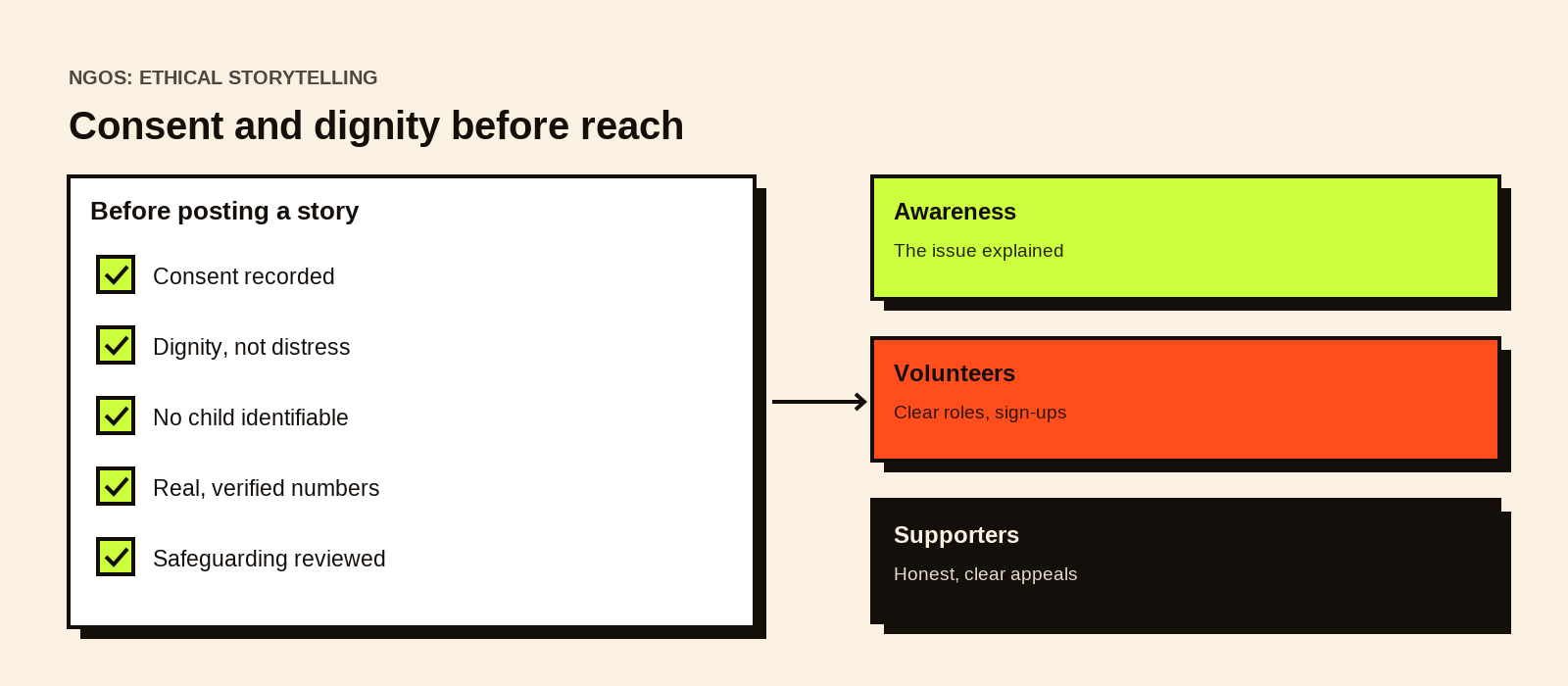
Your programme team sends a photo from a village school: a child in a torn uniform, looking straight into the camera. It would probably get more reactions than anything you've posted this year. But nobody asked the child's parents, the school is identifiable from the background, and the image says more about poverty than about the reading programme that is actually changing things. What you do with that photo says a lot about how your organisation uses social media.
Quick answer
Social media marketing for NGOs works when it tells true stories with dignity and consent, explains programmes clearly, invites people to take part and reports real impact. Build content around your mission, programmes, community voices, volunteers and transparent donation appeals. Never fabricate or inflate impact, protect children's identities, follow ASCI's guidelines for charitable causes, and check tax and foreign contribution questions with your accountant or legal adviser.
What social media can do for an NGO
For most NGOs, social media serves five goals: awareness of the issue, understanding of your approach, participation (volunteers, events, advocacy), funding (individual donors, CSR partners noticing your work) and accountability (showing supporters what happened). Each needs different content. A feed made only of appeals wears people out; a feed with no clear way to help wastes attention.
| Goal | Content that serves it | Signal to watch |
|---|---|---|
| Awareness | Explainers on the issue, facts from credible sources, myth-busting | Shares and saves |
| Understanding | How a programme works, a day with a field worker, before-and-after of a process | Comments asking real questions |
| Participation | Volunteer roles, event invitations, simple actions | Sign-ups and attendance |
| Funding | Specific, transparent appeals with clear use of funds | Donations attributed to social |
| Accountability | Updates, reports, what went wrong and what you changed | Repeat donors, trust in comments |
Ethical storytelling: dignity first
Stories move people, which is exactly why they need care. The people you work with are partners in your work, not illustrations of need. Show them as people with agency: the woman running the self-help group meeting, not only the hardship that brought her there. Let community members tell their own stories in their own words where they want to, and quote them accurately.
ASCI's Guidelines for Advertisements for Charitable Causes, dated 13 June 2023, say appeals must not disrespect the dignity of the people on whose behalf they are made, and give graphic images of victims in distress, especially children, as an example of what not to use. Advertisers must be able to show proof of consent for beneficiaries' images if asked. In digital ads, images that could cause unjustified distress to an ordinary viewer should be blurred and shown only to people who choose to click through. The guidelines also say an appeal must not suggest that people who don't donate are failing in their duty or should feel ashamed.
Children: consent, safeguarding and no identifying details
Content about children needs the strictest rules. Get informed consent from a parent or guardian, and the child's own agreement where they are old enough to understand. Don't publish a child's full name, school, village or anything that could locate them, and check backgrounds for signboards and uniforms. Prefer images of activities, hands at work or children from behind over identifiable faces, especially for sensitive issues such as abuse, health or trafficking, where children should never be identifiable. India's DPDP Rules require verifiable consent from a parent or guardian before a child's personal data is processed, according to the PIB backgrounder on the Rules, notified in November 2025 with phased compliance. Check how your consent records and safeguarding policy meet current obligations with counsel.
An ethical storytelling and consent checklist
Story / asset ID:
Person(s) featured:
[ ] Informed consent recorded, in a language the person understands
[ ] They know where it will appear (social, website, reports, ads) and for how long
[ ] They know they can withdraw consent, and who to contact
[ ] For a child: parent or guardian consent recorded, child's agreement sought
[ ] No full name, school, village, address or other locating details for children or vulnerable people
[ ] Background checked for signboards, uniforms, house numbers
[ ] Image shows dignity and agency, not distress for effect
[ ] Words checked: no pity language, no labels the person wouldn't use for themselves
[ ] Facts and numbers verified against programme records
[ ] Sensitive issue? Safeguarding lead has reviewed
[ ] Distressing image? Not used, or blurred behind a click in ads
Approved by: __________  Date: ______
Consent record stored at: __________
Programmes, community education and volunteers
Many supporters don't know what your organisation actually does day to day. Programme explainers fix that: a carousel on how a nutrition programme reaches a household, a short video of a field worker explaining a session, a map of where you work (without exact locations where safety matters). Community education posts, such as how to apply for a government scheme or recognise signs of a health issue, serve the people you work with directly. Keep these factual, cite official sources for any scheme details or health information, and update them when rules change.
Your programme staff and the communities you work with ask the same questions repeatedly. Collect them and answer them in posts, as our guide to turning questions into content explains.
Volunteer participation
Volunteers need specifics: what the role involves, time commitment, location, skills needed and how to sign up. Post roles as clearly as job listings, show what a volunteer day actually looks like, and thank volunteers publicly (with their permission). Keep a simple record of where sign-ups came from so you know which posts work. Volunteers who work with children should go through your safeguarding process before they meet any child, and your posts can say so; it reassures parents and partners.
Donation communication without pressure
Good donation appeals are specific and transparent. Say what the money is for, and if an appeal is for one person or case, say whether funds may be used for other beneficiaries or purposes. ASCI's charitable causes guidelines require this disclosure, and if a crowdfunding platform takes a fee or percentage, that must be stated clearly in the ad. Avoid urgency you can't justify and guilt-based messaging.
Tax benefits and foreign donations need expert checks. Donors often ask whether a donation qualifies for a tax deduction; under the Income-tax Act, 1961 this was section 80G, and the Income-tax Act, 2025 came into force on 1 April 2026, so confirm your current registration status, the applicable provision and receipt requirements with your accountant before you mention tax benefits in any post. If you accept donations from foreign sources, the Foreign Contribution (Regulation) Act, 2010 applies; the Ministry of Home Affairs' FCRA FAQ says foreign contribution can only be accepted with registration or prior permission. Check with your legal adviser before inviting overseas donations on social media.
Impact reporting: only real numbers
Impact posts build trust only if they are true. Use numbers from your own programme records or audited reports, say what period they cover and what exactly was counted ('children enrolled' is not 'children who learned to read'), and never round up, project or borrow figures from other organisations. Where results are mixed, say so: supporters respect an organisation that explains what it learned. If you don't yet have reliable data, tell a single verified story instead of making up a statistic.
- Every number traceable to a record, report or survey you can produce.
- The period and place the number covers stated in the post.
- Outputs (sessions held) kept separate from outcomes (changes measured).
- No before-and-after claims you can't evidence.
- Programme lead or M&E team signs off impact posts.
Community management: trolls, misinformation and criticism
NGOs working on contested issues attract hostile comments, misinformation and sometimes coordinated attacks. Write moderation rules before you need them: what you reply to, what you hide or report (abuse, threats, personal data, scams), and what you escalate. Correct misinformation once, calmly, with a source, and don't get pulled into long arguments. Genuine questions about your funding or work deserve a straight answer; that is part of accountability. Watch for scam accounts impersonating your NGO to collect donations, and tell supporters which payment routes are official. For serious incidents, follow a written plan such as the one in our social media crisis management guide, with legal and leadership involved; and see community management vs customer support for routine moderation boundaries.
Measuring meaningful engagement
Likes are a weak measure for an NGO. Track the actions that move your mission: volunteer sign-ups, event attendance, petition or pledge completions, newsletter subscriptions, donations attributed to social, repeat donors, and the quality of comments and questions. Review monthly, and compare content themes rather than single posts. A modest post that brought in twelve committed volunteers did more than a viral one that brought none.
If you work with creators on cause campaigns, the GCC-focused guide to creator partnerships for nonprofits covers that side, while this article covers your own channels.
Common mistakes
- Using distressing images of beneficiaries, especially children, to drive donations.
- Publishing photos without recorded consent or with identifying details visible.
- Inflating or estimating impact figures, or using another organisation's numbers.
- Mentioning tax benefits without checking current registration and rules.
- Posting only appeals, with no programme updates or thanks.
- Ignoring critical questions instead of answering them transparently.
Where to start
Before you plan content, put the consent checklist and a short safeguarding policy for images in place, and agree who signs off impact numbers. Then plan a month around one programme: explain it, introduce the people who run it, share one verified story with consent, and end with a specific way to help.
If your team is stretched, an agency can handle planning, design and community management within an agreed scope; at Kudozz, we keep consent, safeguarding and impact sign-off with the NGO's own team.