How to Decide Which Products to Prioritise for Influencer Marketing
Most brands send creators their newest or most important product. That's often the wrong choice. A scoring method for picking the products creators can actually sell: margin, demonstrability, stock, reviews and the job each product does for the business.
If your catalogue has more than a handful of products, the first influencer decision isn't which creators to hire. It's which products to put in their hands. Pick badly and even well-matched creators struggle: the product is hard to show on camera, the margin can't absorb the cost, or it sells out the week the posts go live.
Quick answer
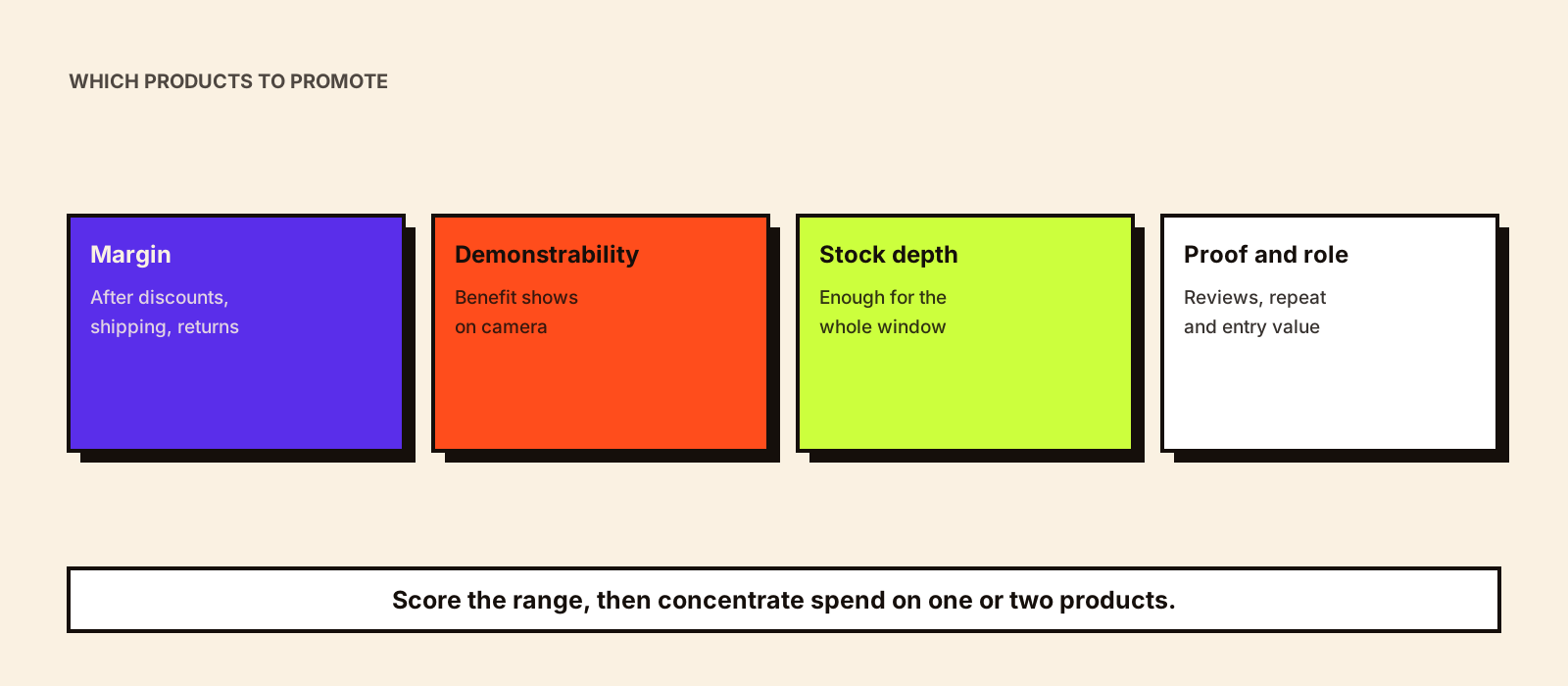
Prioritise products that score well on five things: contribution margin after discounts and returns, how easily the benefit shows on camera, stock depth for the campaign window, existing proof (reviews, repeat purchase, low return rate) and strategic role (does it bring in new customers who go on to buy more?). Score each candidate from 1 to 5 on each factor, weight the factors by your campaign objective, and give the top one or two products the bulk of creator spend. Keep a small test slot for a newer product rather than spreading the budget evenly across the range.
Why the obvious choice is often wrong
Brands usually default to one of three products: the newest launch, the best seller, or the item with the most stock to clear. Each can work, but none is a strategy on its own.
| Default choice | When it works | When it backfires |
|---|---|---|
| Newest launch | There's a real story, stock is ready and the product page has proof | No reviews yet, so creator traffic lands on a page that doesn't convert |
| Best seller | You want efficient first orders and a reliable test of creators | It already sells through search and repeat buyers, so creators add little that wasn't happening anyway |
| Excess stock | The product is good and simply under-discovered | It's slow because people don't want it; creators make that visible to a bigger audience |
| Highest price | The product needs explanation and has margin to fund it | Price is the main objection and creators can't answer it in a 30-second Reel |
The five factors to score
1. Contribution margin after the real costs
Use the margin left after product cost, shipping, payment fees, the creator discount and expected returns, not the gross margin on the price list. A product with a thin margin needs far more orders to recover a creator fee; how to calculate the break-even point of an influencer campaign shows the arithmetic.
2. Demonstrability
Ask whether a stranger could understand the benefit with the sound off in ten seconds. Visible change (a stain removed, a fit on a real body, a before-and-after room) scores high. Benefits that take weeks to appear, or that viewers have to take on trust, score low. Low doesn't mean impossible, but it means a longer format, a more expert creator and a bigger budget per conversion.
3. Stock depth and fulfilment
A product that might sell out in the posting window shouldn't be the lead, unless scarcity is the plan and you've prepared for it. Check stock across every channel the creators will send people to: your site, marketplaces, quick commerce and stores. If supply is tight, see how to plan influencer campaigns when stock is limited.
4. Existing proof
Creator traffic is sceptical traffic. People arrive, scroll to the reviews and check the return policy. Products with a healthy rating, a decent number of reviews, a low return rate and a high repeat-purchase rate convert that traffic better. If a promising product has a high return rate, fix the cause first; creator content can help, as how creator content can help reduce product returns explains, but it shouldn't be the first job you give a paid campaign.
5. Strategic role
Some products are entry points: cheap enough to try, and likely to lead to a second purchase. Others lift average order value, defend a category against a competitor, or establish the brand in a new segment. A product with a modest margin can still be the right lead if the customers it brings in are worth a lot over a year.
A product prioritisation scorecard
Score each candidate from 1 (weak) to 5 (strong), multiply by the weight for your objective, and add up. The weights below are a starting point; change them to suit your business, but agree them before scoring so the favourite product doesn't win by default.
| Factor | Weight: first orders | Weight: awareness or launch | Weight: repeat and loyalty |
|---|---|---|---|
| Contribution margin | 25% | 15% | 20% |
| Demonstrability | 25% | 30% | 15% |
| Stock depth | 15% | 20% | 15% |
| Existing proof | 20% | 10% | 20% |
| Strategic role | 15% | 25% | 30% |
| Product (hypothetical skincare brand) | Margin | Demo | Stock | Proof | Role | Score (first orders) |
|---|---|---|---|---|---|---|
| Sunscreen, 50 ml | 3 | 4 | 5 | 5 | 5 | 4.25 |
| New vitamin C serum | 4 | 2 | 3 | 1 | 4 | 2.75 |
| Gift set | 2 | 3 | 2 | 3 | 2 | 2.45 |
| Face wash | 2 | 3 | 5 | 4 | 3 | 3.25 |
Illustrative only. In this example the sunscreen leads the first-order campaign: it's easy to show, well reviewed and in stock, and it brings in customers who buy other products. The serum is the brand's priority launch, but it has no reviews yet and its benefit takes weeks to show, so it gets a smaller test with expert creators rather than the main budget.
Giving each product a role, not just a share
Once you've ranked the products, decide what each one is for in this campaign. That changes the creators, the format and the measure of success, so it's worth writing down.
| Role | Typical share of creator budget (illustrative) | Creators and format | Judge it on |
|---|---|---|---|
| Lead product | 60–70% | Creators whose audience matches your best customers; demos and honest reviews | Cost per new customer and their second purchase |
| Test product | 15–25% | A few specialist or expert creators; longer explainers | Whether proof builds: saves, questions, early reviews |
| Bundle or add-on | 10–15% | Mentioned alongside the lead product rather than on its own | Average order value on creator-attributed orders |
How you divide the creator budget once products are chosen is covered in how to allocate your influencer marketing budget across creators. Where a product sits in its life (launch, growth, maturity or decline) also shapes the plan; see planning influencer campaigns around your product's lifecycle.
Check the landing experience before you commit
- Does the product page show the product in use, from real people, not just studio shots?
- Are the questions people ask in comments answered on the page (size, shade, compatibility, how long until results)?
- Is the price the creator will mention the price the viewer will see, including on marketplaces?
- Is there enough stock in every size, shade or variant the creators will feature?
- Will the discount code work on this product, and is it excluded from other offers that would make it pointless?
If several answers are no, you can still run the campaign, but fix the page first or pick a product that is ready. Our creator content on product pages guide covers how to use creator videos on the page itself.
When to spread across many products
Concentration is the default, but there are exceptions. Fashion and home brands where the appeal is the whole range often do better with creators styling several pieces. Gifting periods suit curated edits. Marketplace sellers with dozens of near-identical variants may lead with the listing that has the most reviews and let the variants ride along. Even then, give creators a clear lead item so the content has a focus and the measurement has an anchor.
If you're unsure which products to lead with across a year of campaigns, Kudozz's influencer campaign strategy service starts with exactly this exercise before any creator is approached.
Common mistakes
- Choosing the product the founder is most excited about without scoring it against the others.
- Using list-price gross margin instead of margin after discounts, shipping and returns.
- Sending creators the whole range, so each product gets a few seconds and none gets a proper demonstration.
- Leading with a product that has no reviews and expecting creator traffic to convert anyway.
- Judging a test product by the same cost-per-order target as the lead product in its first campaign.
- Forgetting to check stock on marketplaces and quick commerce, where much creator-driven demand ends up.
Conclusion
Product choice quietly decides how well an influencer campaign can perform. Score your candidates on margin, demonstrability, stock, proof and role; weight the scores by what the campaign needs to achieve; and concentrate spend on one or two products while keeping a small, fairly judged test slot. Revisit the scores every quarter, because reviews, stock and margins change.