How to Choose Creator Content for Different Product Price Points
A ₹299 snack and a ₹12,000 air purifier need different creator content. What changes as price goes up: the proof shoppers need, the format, the creator tier, the channel, the offer and how long you wait before judging results. A practical framework for Indian D2C brands.
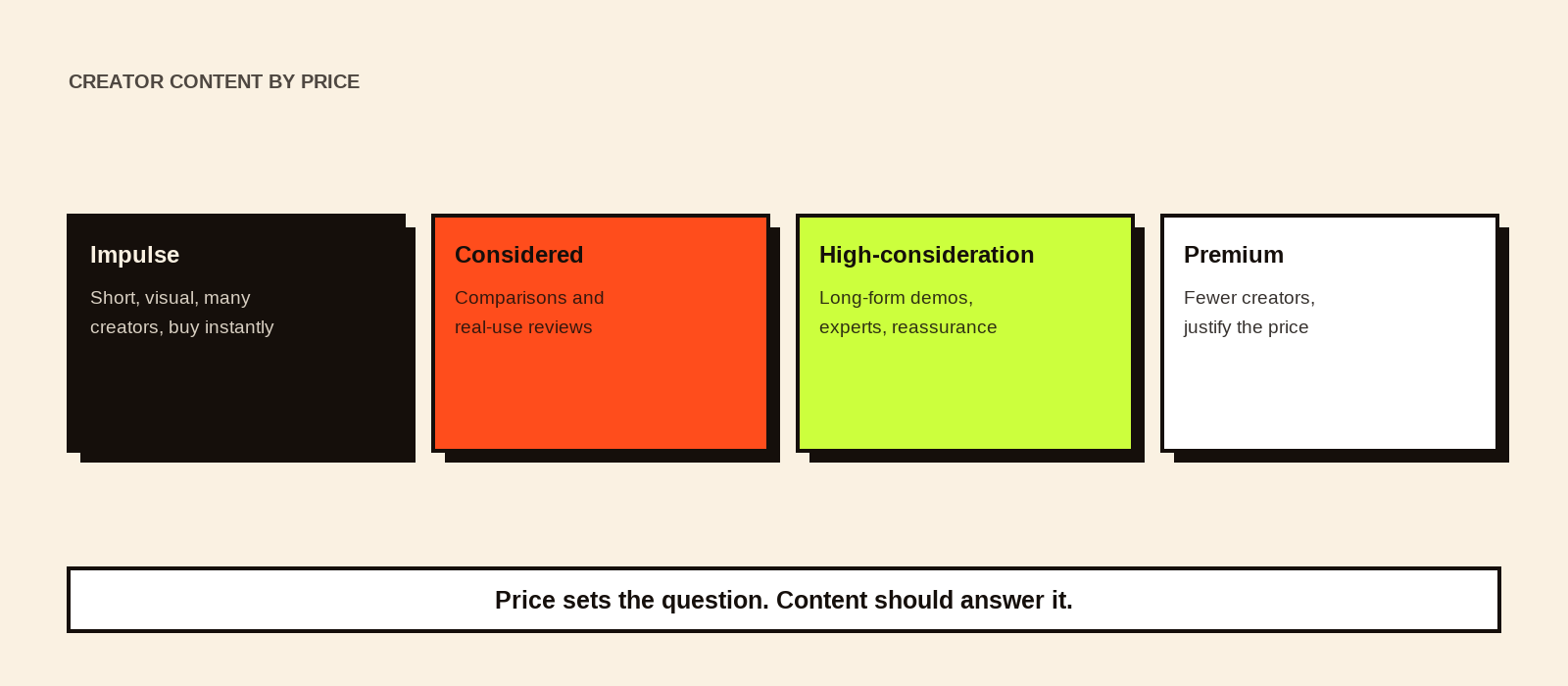
Brands often brief creators the same way for every product: show it, say what you like, add the code. That works reasonably for a ₹349 lip tint. It works badly for a ₹9,000 mattress topper, where a shopper wants to know how it feels after a month, whether it fits their bed and what happens if they don't like it. Price changes the questions people ask before buying, and creator content has to answer those questions.
Quick answer
Match creator content to the risk a shopper feels at your price. Low-priced impulse products need fast, visual, high-frequency content from many creators, sent to wherever people can buy instantly. Mid-priced products need comparisons and real-use reviews. High-consideration products need long-form demonstrations, expert or long-term-use creators, and answers on returns and after-sales service. Premium products need fewer, carefully chosen creators and content that justifies the price. Judge each band on its own timeline: days for impulse products, weeks or months for expensive ones.
Why price changes the job of creator content
At a low price, the main obstacle is attention: the shopper won't lose much if the product disappoints, so a quick, appealing demonstration and easy purchase are enough. As price rises, the obstacle becomes doubt. Shoppers compare more, read more reviews, watch longer videos and wait for a sale. Google's festive research in India shows both behaviours side by side. In a Google-commissioned Ipsos survey (n=2,450, late 2025), 61% of 'quick buyers' who purchased within about two days without prior research had used YouTube Shorts, while exploratory shopping journeys averaged more than eight searches and nearly eight videos.
Return and cash-on-delivery behaviour also changes with price and payment method. Unicommerce, analysing transactions on its platform in 2024, reported a 24% return rate for cash-on-delivery orders against 10% for prepaid orders, as reported by The Tribune. Content that sets accurate expectations matters more as the cost of each return rises.
The price-band framework
The bands below are illustrative, not industry standards. Where the lines fall depends on your category and customer: ₹2,500 is an impulse buy for some audiences and a careful decision for others. Use your own data on how long customers take to buy and how often they return products to place yourself.
| Impulse (roughly under ₹500) | Considered (roughly ₹500–3,000) | High-consideration (roughly ₹3,000+) | Premium (priced above category norms) | |
|---|---|---|---|---|
| Shopper's main question | Does it look good or fun? | Is it better than the alternative? | Will it work for me, and what if it doesn't? | Is it worth paying more? |
| Proof needed | Visual appeal, quick result | Comparison, real-use review | Long-term use, expert view, warranty and returns | Craft, materials, story, quality in detail |
| Best formats | Short Reels and Shorts, unboxings, taste tests | Side-by-side comparisons, 'two weeks in' reviews | Long-form YouTube demos, Q&A, setup walkthroughs | Considered long-form, behind-the-scenes, styling |
| Creator tier | Many nano and micro creators | Micro creators with relevant niches | Fewer specialists and experts; long-term users | Few, selective creators whose taste fits the brand |
| Where to send traffic | Quick-commerce apps or marketplaces where buying is instant | Marketplace or your site, with reviews visible | Your site or a detailed listing; consider WhatsApp for questions | Your site or flagship listing; a controlled experience |
| Offer approach | Small discounts, bundles, launch price | Code-based discount or bundle | EMI, warranty, trial or easy returns rather than deep discounts | Rarely discount; offer access, service or limited editions |
| Judge results over | Days to two weeks | Two to six weeks | One to three months | Months; brand search and enquiry quality |
Impulse products: volume, speed and availability
Snacks, beverages, basic personal care, phone accessories and small gifts live or die on being seen often and bought easily. The best content is short, visual and repeatable: a taste reaction, a before-and-after, a 'what I use every morning'. You need many pieces from many creators, because each one reaches a small audience and wears out quickly. Nano and micro creators usually give the most content per rupee here; building a scalable micro-influencer network explains how to run them in batches.
Availability matters as much as the content. If a shopper sees a ₹199 snack in a Reel and can't find it on the app they use, the moment is gone. Brief creators to name the exact product and where to buy it, and check stock in the cities they reach. The quick-commerce influencer marketing guide covers availability by city and timing creator posts with stock going live.
Considered products: comparison and real use
Skincare, clothing, kitchen appliances and mid-range gadgets sit here. The shopper has heard of alternatives and wants to know why yours. The most useful content compares fairly and shows real use: 'I switched from X to this, here's what changed after two weeks', a texture swatch on different skin tones, a fit try-on with the creator's size stated. Honest limitations help: a creator who says the product isn't ideal for very oily skin makes the rest of the review more believable. How to brief creators for honest product comparisons covers what you can and can't ask for.
This band is also where returns start to hurt. Size, shade and fit content prevents the most avoidable ones; creator content that helps reduce product returns lists the formats that work.
High-consideration products: depth, experts and reassurance
Air purifiers, mattresses, water purifiers, premium appliances, fitness equipment and expensive skincare devices take longer to sell. Shoppers watch long videos, read comparisons and often wait for a sale or EMI offer. Short Reels still help with awareness, but the content that closes the sale is detailed: a full setup walkthrough, a month-in review, a comparison against the two competitors shoppers are actually considering, and plain answers on installation, warranty, service and returns.
- Use fewer creators for longer: one or two long-form YouTube reviews from trusted specialists, plus a handful of micro creators showing everyday use.
- Add an expert where the product makes technical or health-related claims, and check every claim before it goes live; expert creator marketing covers how to work with qualified professionals.
- Plan follow-up content: 'three months later' videos answer the question shoppers care about most.
- Give creators enough time with the product. A week isn't long enough to judge a mattress.
- Route questions somewhere they'll be answered quickly, such as WhatsApp or a detailed listing Q&A.
Products that are hard to show in a short video, because the benefit is invisible or takes weeks, need their own approach; see how to create creator content for products that are hard to demonstrate.
Premium products: justify the price, protect the brand
Premium means priced above what most of the category charges, whether that's a ₹1,800 face serum or a ₹40,000 handbag. The content has to show why the difference is worth it: materials, craft, how it ages, how it feels to own. Discount codes undermine that story, so premium brands usually offer access (early drops, events, personal service) instead. Creator choice is narrower, since a creator whose usual content is coupon deals sends the wrong signal. Influencer marketing for premium and luxury brands goes deeper on creator selection and measuring beyond clicks.
When one brand sells at several price points
Many D2C brands sell an entry product and a hero product at very different prices: a ₹299 travel-size and a ₹1,499 full-size, or a ₹999 accessory and a ₹14,999 device. Don't brief them as one campaign. A common pattern is to use creators to drive trial of the entry product through quick commerce or marketplaces, then use longer-form content and email or WhatsApp follow-up to move those customers to the higher-priced product. Measure the two separately, and track how many entry-product buyers later buy the hero product.
Illustrative figures: a home-appliance brand spends ₹2 lakh on twenty micro creators promoting a ₹799 accessory on marketplaces, judged on orders within ten days, and ₹2 lakh on two long-form YouTube reviews of its ₹11,999 flagship, judged on site enquiries, branded search and sales over the following two months. Putting both into one campaign report would make the accessory look brilliant and the flagship look like a failure in week one. These numbers are hypothetical.
Measurement windows by price
The most common mistake with expensive products is judging them on impulse-product timelines. A creator review of a ₹15,000 product may drive few sales in its first week and steady sales for months, especially around sale events. Set the window before launch and stick to it.
| Band | Primary metric | Supporting signals | Window |
|---|---|---|---|
| Impulse | Orders and cost per order | Code use, quick-commerce sales in creator cities | Days to two weeks |
| Considered | New customers and cost per new customer | Saves, comparison-video watch time, returns rate | Two to six weeks |
| High-consideration | Qualified enquiries and sales | Long-form watch time, branded search, WhatsApp questions, sale-period lift | One to three months |
| Premium | Brand search and quality of enquiries | Average order value, full-price share, repeat customers | Quarter or longer |
For all bands, calculate break-even on contribution margin after returns, not on revenue. A high-priced product with a high return rate can look profitable on ROAS and lose money once returns are counted; how to calculate the break-even point of an influencer campaign shows the method.
Common mistakes
- Briefing a ₹10,000 product with the same 30-second Reel format used for a ₹300 product.
- Judging high-consideration products on first-week code sales.
- Discounting premium products through creator codes and eroding the price position.
- Sending impulse-product traffic to a slow site checkout instead of where people can buy instantly.
- Booking big creators for low-priced products when many small creators would produce more usable content.
- Giving creators too little time with a product that takes weeks to show results.
Conclusion
Price sets the question a shopper needs answered before buying, and creator content should answer that question. Cheap products need reach, frequency and instant availability. Mid-priced products need comparisons and honest use. Expensive products need depth, expertise and reassurance on returns and service. Premium products need fewer, carefully chosen voices that justify the price. Brief, place and measure each band on its own terms.