Is Influencer Marketing Worth It for a Small Business or Startup?
When influencer marketing pays off for a small business or startup, when it doesn't yet, a break-even check you can run on your own numbers, and the smallest test that will tell you something.
Most founders ask this question after seeing a competitor's creator videos everywhere, or after a creator offers to post about the product. Both are reasons to look, not reasons to spend. Influencer marketing can be one of the more efficient ways for a small brand to reach a specific audience, and it can also be an expensive way to buy views from people who will never buy. The difference is usually decided before the first creator is contacted.
Quick answer
Influencer marketing is usually worth it for a small business or startup when four things are true: the product is easy to show and already satisfies customers, your buyers follow creators in your category, you can track what creator traffic does on your site, store or marketplace, and you can afford a test large enough to compare several creators. It is usually not worth it yet when the product, offer or checkout still needs fixing, when one order is worth too little to cover the cost of reaching a buyer, or when the budget only stretches to one creator. Start with a small, tracked test and let your own cost per customer decide the next rupee.
What 'worth it' should mean for a small business
A large brand can justify creator spend on awareness alone. A small business usually needs the money to come back, or at least to buy something it couldn't get more cheaply elsewhere. Judge a creator test on three things, in this order:
| Test | The question | How to answer it |
|---|---|---|
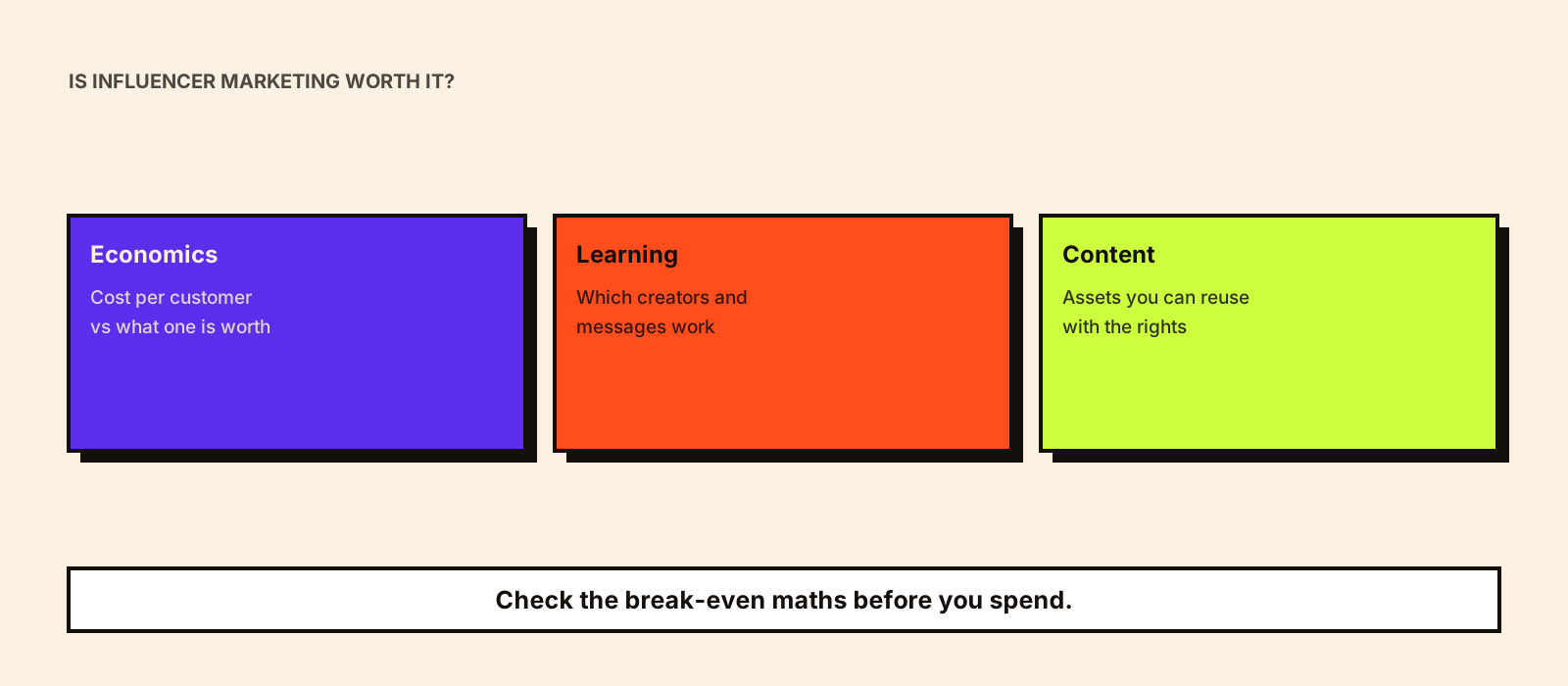
| Economics | Did creators bring customers at a cost the business can live with? | Total test cost divided by tracked customers, compared with what a customer is worth to you |
| Learning | Do we now know which creators, messages and formats work for us? | A short written debrief: what to repeat, what to drop, what to test next |
| Content | Did we get content we can reuse in ads, on product pages or in email? | Number of usable assets with the rights to use them, valued at what you'd otherwise pay for them |
A test that loses money on the first order can still be worth running if it teaches you something specific and leaves you with content you can use. A test that does none of the three was not worth it, however many views it got.
When it tends to pay off, and when it doesn't yet
| Usually worth testing when | Usually not worth it yet when |
|---|---|
| The product looks or works better on camera than in a description (food, beauty, apparel, gadgets, apps, home) | The product's benefit is invisible or takes months to show, and you have no reviews or proof to point to |
| Your customers already follow creators for advice in your category | Your buyers rarely use the platforms where creators in your category publish |
| Customers who try the product come back or recommend it | Returns, complaints or poor reviews are still common |
| An order or customer is worth enough to cover the cost of reaching them | Margins are so thin that only very cheap traffic could pay back |
| Your site, app or listing converts visitors you already get | Checkout, delivery or the landing page is still being fixed |
| You can fund several creators on one platform and track each one | The budget covers one creator, so a single post decides the verdict |
If several items in the right-hand column describe your business, the better first step is the readiness work, not a campaign. Our influencer marketing readiness checklist covers what to fix first.
Run a break-even check before you spend
You don't need industry benchmarks to decide whether a test is sensible. You need two numbers from your own business and one from the quotes you receive.
- Contribution margin per order: the selling price minus product cost, shipping, payment fees, expected returns and any discount you'll give through creator codes.
- What a customer is worth: the contribution margin from the first order alone if cash is tight, or across the orders a typical customer places in a year if you know your repeat rate.
- Total test cost: creator fees, product and shipping, any usage rights, tracking, and the hours your team or an agency will spend.
- Break-even customers = total test cost ÷ what a customer is worth.
| Line (hypothetical numbers) | Amount |
|---|---|
| Creator fees for six micro-creators, one Reel each | ₹48,000 |
| Product, shipping and a small reserve | ₹7,000 |
| Team time on sourcing, briefs and payments, costed | ₹10,000 |
| Total test cost | ₹65,000 |
| Contribution margin on a first order | ₹450 |
| Break-even on first orders alone | About 145 customers |
| If a customer typically orders twice a year | About 73 customers |
These are made-up numbers to show the arithmetic, not typical rates or results. The useful question is whether the break-even count is plausible for the creators you're considering. If six creators would each need to drive dozens of tracked orders from one post, and their audiences are mostly outside your delivery area or price range, judge the test on learning and content, or redesign it. Influencer marketing ROI forecasting shows how to build low, expected and high scenarios, and influencer CPM, CPE, CPC and CPA has the formulas for comparing creators afterwards.
Remember that codes and links undercount. People see a creator's video, then search for you later, buy on a marketplace, or order cash on delivery after a friend forwards the post on WhatsApp. Compare sales and branded search in the test weeks with the weeks before, not just code redemptions.
What the evidence says, and what it doesn't
Creator marketing is now a mainstream budget line rather than an experiment. In the US, IAB's November 2025 survey of advertisers found 48% regarded creators as a 'must buy', and projected US creator ad spend of $37 billion for 2025. In India, the WPP Media and Kantar India Influencer Marketing Report (June 2025) put the industry at ₹3,600 crore in 2024 and reported that 63% of Indian internet users turn to influencers for product discovery and 69% for information.
Those figures show that audiences pay attention to creators and that large advertisers keep spending. They don't show that a small brand will earn its money back. Treat the widely shared 'every rupee returns several rupees' figures with caution: most come from vendor surveys that don't publish their methods, and averages hide the many campaigns that lose money. Your own break-even check is a better guide than any industry average.
Small business or startup: different reasons to do it
| Established small business | Venture-funded or early startup | |
|---|---|---|
| Main reason | More customers in a defined area or niche at a sustainable cost | Learning fast: which audience, message and format work, before scaling spend |
| Good first objective | Bookings, store visits or orders you can count | Tracked sign-ups or first orders, plus message and audience learning |
| Creators to start with | Local or niche creators whose followers can actually buy from you | Specialist creators in the exact niche; founder-friendly creators who'll give feedback |
| Watch for | Spending on reach outside your service area | Mistaking a one-off spike for repeatable demand |
Startups trying to stand out against bigger competitors have a separate set of advantages to use, covered in how startups compete with larger brands through creator marketing.
The smallest test that tells you something
- One objective and one platform. Don't split a small budget across Instagram, YouTube and a marketplace.
- Enough creators to compare. Five to ten well-matched nano or micro creators usually tell you more than one bigger name, because one unusual post can't decide the result.
- A unique link and code per creator, with your analytics checked before anything goes live.
- A short written agreement for each creator: deliverables, dates, payment, disclosure and whether you may reuse the content.
- Clear disclosure on every post. India's ASCI guidelines treat free products, discounts and perks as a material connection, so gifted posts need a label too.
- A review date four to six weeks after the last post, with the break-even check repeated on real numbers.
A week-by-week version of this plan is in influencer marketing for startups. Gifting isn't free either: products a creator keeps can carry tax obligations for the business, so ask your accountant how your gifts and fees should be handled. The ASCI influencer guidelines set out the disclosure labels and placement.
After the test: stop, fix or scale
| What you see | Likely meaning | Next step |
|---|---|---|
| Two or three creators beat break-even; others didn't | Creator fit matters more than the channel | Rebook the winners, find more creators like them |
| Plenty of clicks, few orders | The offer, price or landing page is the bottleneck | Fix the destination before spending more on creators |
| Good engagement, almost no traffic | Content entertained but didn't give a reason to act | Rebrief with a clearer offer and call to action |
| Poor results across every creator | Audience, product or platform mismatch | Revisit the audience and platform, or pause the channel |
| Best content beats your existing ads | Creator content is worth more as advertising | Secure usage rights and test it in paid social |
Judge the channel over two or three rounds, not one. How long results take to show up is covered in how long influencer marketing takes to work.
The same logic at a larger scale, including decisions for individual creators and whole programs, is set out in how to decide whether to scale, pause or stop an influencer campaign.
Selling outside India
The economics work the same way everywhere, but the rules and costs don't. Creators advertising in the UAE need an advertiser permit, now issued by the National Media Authority, the UK's ASA recommends a clear 'Ad' label, and Australian small businesses face the same disclosure expectations as national brands. See the GCC influencer marketing playbook and influencer marketing for small businesses in Australia for market-specific detail.
Do you need an agency for a first test?
Not necessarily. A founder or marketer with a few spare hours a week can run a small test, and doing it once teaches you what to ask for later. An agency earns its fee when you need many creators quickly, several cities or languages, a fixed launch date, a regulated category, or simply don't have the hours. Influencer marketing agency vs in-house compares the options honestly.
Conclusion
For a small business or startup, influencer marketing is worth it when it brings customers at a cost you can live with, teaches you something you can act on, or produces content you'd otherwise pay for. Check the break-even maths before you spend, run a test big enough to compare creators, count more than codes, and let your own numbers decide whether to scale.