Social Media Management for Travel Companies: Building Destination Interest and Generating Enquiries
How travel agencies and tour operators can run their own social accounts: destination storytelling, itineraries turned into content, a seasonal calendar, short-form video, traveller stories, UGC and creators, and a fast enquiry journey.
Someone saves your Reel of a misty tea estate in July. They don't message you until October, and when they do, it's to ask whether the trip works for a family with a five-year-old and what the hotels are like. By then they have also saved posts from four other operators. The company that answers fastest and most clearly, with content that already showed the trip in detail, usually gets the booking conversation.
Quick answer
Social media management for travel companies works when content helps people imagine and plan a trip. Tell destination stories, turn each itinerary into a series of posts, plan around seasons and booking windows, use short-form video with properly licensed music, share traveller stories with consent, and add creator and UGC content. Never invent prices or inclusions, point to official sources for visas and safety, and reply to enquiries quickly.
What travellers need from your feed
Travel decisions move through inspiration, research, comparison and booking, often over weeks or months. Your feed needs content for each: beautiful destination posts to get saved, practical posts that answer 'what is this trip actually like', and proof that real people have taken it with you. A feed of only sunsets and offers covers the first and last stages and leaves the middle to competitors.
It also needs to sound like you. Two operators can sell the same Kerala circuit. What sets you apart is how you design days, the stays you choose, how your guides behave and how you handle problems. Show that.
Turn every itinerary into a content series
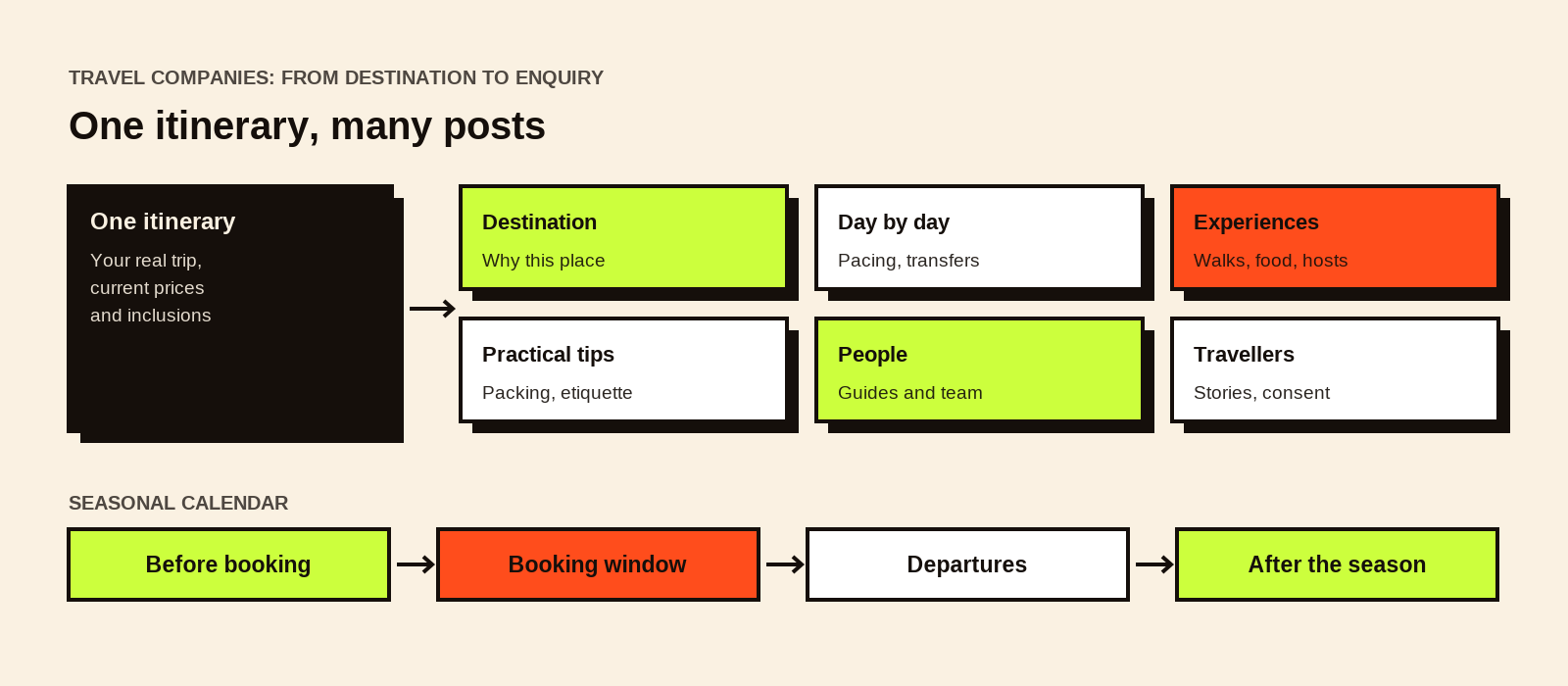
Your itineraries are already content plans. Each one holds a destination story, a day-by-day structure, experiences, practical details and the people who travel it. Break one itinerary down like this and you have weeks of posts without repeating yourself.
| Itinerary element | Post ideas | Format |
|---|---|---|
| Destination | Why this place, what it feels like, best-known and lesser-known spots | Reel, carousel |
| Day-by-day plan | 'Day 3 of our Spiti trip', pacing, travel times between stops | Carousel, Stories series |
| Experiences | A cooking class, a guided walk, a homestay dinner | Short video, photo post |
| Stays and transport | What rooms look like, how transfers work (only what is actually included) | Carousel, Story highlight |
| Practical tips | What to pack, how to prepare for altitude or heat, local etiquette | Carousel, short video |
| People | Guides, drivers, hosts, your planning team | Short interviews, photo posts |
| Travellers | Stories and photos from past guests, with consent | Reposts, quotes, reviews |
| FAQs | Who the trip suits, fitness level, what is and isn't included | Story Q&A, pinned post |
Before any post mentions prices, inclusions, hotel names or dates, check them against the current itinerary document. Packages change, and a saved post from six months ago is still a promise in the traveller's eyes. Add 'prices and inclusions as on [date]' to anything with specifics, and archive outdated posts.
Plan around seasons and booking windows
Travel content works best when it runs ahead of the trip season, because people plan before they travel. A practical rule of thumb: start inspiration content several weeks before booking typically begins for a season, shift to practical planning content as departures approach, and use traveller stories during and after the season. Your own enquiry data is the best guide to timing, so check when enquiries for each destination actually arrive.
| Phase | Content focus | Example for a monsoon-season destination |
|---|---|---|
| Before booking opens | Inspiration, destination stories, 'why go in this season' | Reels of green landscapes, what the season is like |
| Booking window | Itinerary breakdowns, FAQs, who the trip suits, how to enquire | Day-by-day carousel, packing list |
| Departures | Live Stories from trips (with consent), guide introductions | Behind-the-scenes from the group |
| After the season | Traveller stories, reviews, photo recaps, lessons learned | Guest quotes, UGC reposts |
| Off-season | Planning guides for the next season, evergreen tips | 'How to plan your first trip to...' series |
Layer festivals, long weekends and school holidays on top for domestic travel, and the departure seasons of your source markets for international travellers. Our guide to building a monthly social media content calendar covers the planning format.
Short-form destination video
Short video suits travel because it shows motion, sound and atmosphere that photos can't. The strongest travel Reels are specific: the first ten seconds of arriving at a viewpoint, a guide explaining a local custom, the actual room at the actual homestay. Avoid stock footage presented as your trip, and don't use drone shots where drones aren't permitted. Our Instagram Reels strategy guide covers hooks and series planning.
Music needs care. Instagram's help page says certain business accounts and certain types of posts don't have access to the music library, and describes Meta's Sound Collection as over 14,000 royalty-free songs and sounds that can be used for commercial purposes such as ads. At the time of writing (November 2026), check which tracks your account can use, prefer original sound or Sound Collection audio, and keep a record of any music you license separately.
Travel FAQs and official information
FAQ content is valuable, but some questions aren't yours to answer on social media. Visa rules, entry requirements, permits and safety conditions change and depend on the traveller's nationality and situation. Don't state them as facts in posts. Instead, explain that requirements vary, link to official sources such as the destination's embassy or immigration website and the Ministry of External Affairs, and offer to help travellers find the right information. The same applies to health requirements: point to official guidance and suggest people check with a doctor.
Respect local and safety guidance in your own content too. Don't film or encourage behaviour that ignores signage, closures or local customs, and avoid geotagging fragile or private locations that can't handle crowds.
Traveller stories, UGC and creators
Past travellers are your most credible voices. Ask for permission before reposting their photos or quotes, credit them, and never edit a review to sound better. If a group photo includes people who didn't agree to it, don't post it. Children in group trips need a parent's consent. If you collect traveller content systematically, our guide to customer testimonials and UGC covers permission and evidence.
Creators can bring a destination to new audiences, and creator-made trip content can be reused on your feed with the right rights agreed. Paid or hosted trips must be disclosed. Planning destination campaigns with creators is covered in influencer marketing for travel brands, and if you need a steady flow of traveller-style videos for your own channels, that is what UGC content production is for.
Regional and international audiences
Travel companies often serve several audiences at once: domestic travellers from different states, NRIs planning trips home, and international visitors. They differ in language, planning time and questions. A Gujarati-speaking family planning a pilgrimage circuit and a European couple planning a Rajasthan trip need different captions, different FAQs and often different platforms. Decide which audiences matter most, consider regional-language captions or separate posts where you have the team to reply in that language, and avoid mixing currencies or audiences in a single offer post.
The enquiry journey
Travel enquiries usually start in DMs or on WhatsApp, and they are easily lost. Set up the journey before you increase content:
- One clear route in the bio and on posts: WhatsApp, a short form, or both.
- A first reply that asks for dates, number of travellers, departure city and the trip they saw.
- A target response time during working hours, and an away message for nights and holidays (the WhatsApp Business app supports away messages and quick replies).
- Saved replies for common questions, checked regularly against current itineraries.
- A shared log of every enquiry, with the post or trip that prompted it.
- A follow-up rule, for example one reminder after a few days if a quote goes unanswered.
Your profile should make this easy too; our guide to turning Instagram profile visitors into enquiries covers bios, highlights and links.
Common mistakes
- Showing prices or inclusions that are out of date or apply only to some departures.
- Using stock or other companies' footage as if it were your trip.
- Stating visa or safety rules as facts instead of pointing to official sources.
- Reposting traveller photos without permission.
- Running inspiration content only in the travel season, when bookings are already made.
- Collecting enquiries in DMs with no owner or response time.
Where to start
Pick your three best itineraries and break each one down using the framework above. That gives you a first month of content rooted in trips you actually sell. Then map those trips onto a seasonal calendar, fix your enquiry journey, and start asking past travellers for permission to share their stories.
If you want help with content planning, editing and publishing, Kudozz can run your travel company's social calendar while your planners handle enquiries and bookings.