Social Media Marketing for Coaching Businesses: Turning Expertise Into Consistent Enquiries
A practical guide for independent business, career and leadership coaches: defining a niche, explaining the discovery call, using LinkedIn and Instagram for different jobs, sharing client stories responsibly and a 30-day calendar.
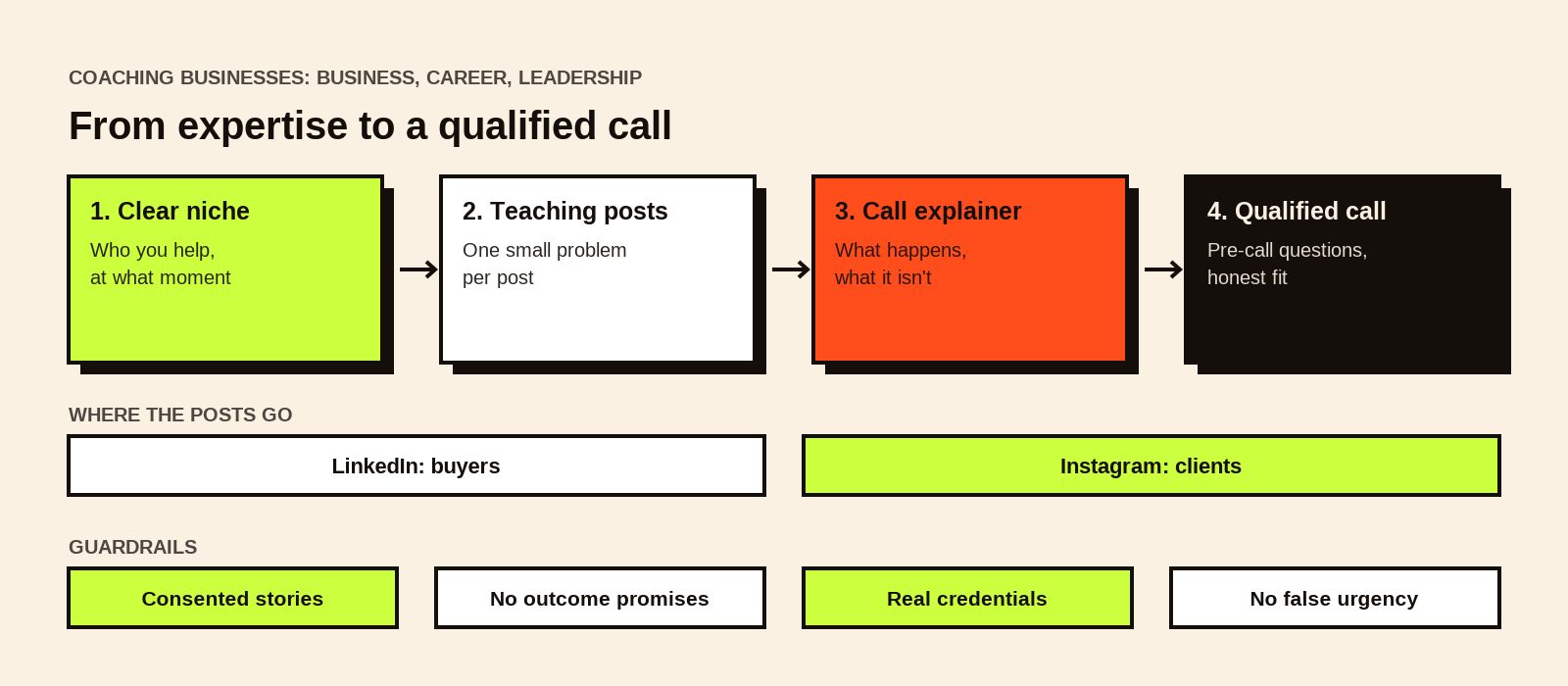
Picture a leadership coach with fifteen years in HR, a coaching certification and a handful of clients who all came through referrals. She posts a quote card every few days on LinkedIn and Instagram. Former colleagues like them politely. Nobody books a discovery call, and the two messages she got last month were from students asking for free career advice. Her expertise is real; her feed just doesn't show it, or say who it's for.
Quick answer
Social media marketing for coaching businesses works when your content shows how you think, who you help and what working with you involves. Pick a niche people can repeat, publish posts that each solve one small problem, explain your discovery call plainly, and use LinkedIn for professional buyers and Instagram for personal clients. Share client stories only with consent and without promising promotions, income or life changes. Count qualified discovery calls, not followers.
Who this guide is for, and the rules worth checking
This guide is for independent business, career, leadership and executive coaches, working solo or in a small firm, who sell one-to-one or small-group coaching. It isn't about exam-preparation institutes, which our guide to social media marketing for coaching institutes covers, or about creators packaging an audience into a course, which our guide to building a creator coaching business covers.
The CCPA's Guidelines for Prevention of Misleading Advertisement in Coaching Sector, 2024 define coaching to include academic support, imparting education, guidance, instructions, study programmes, tuition or similar activity, and exclude counselling, sports, dance, theatre and other creative activities. They were written with coaching centres in mind. Whether one-to-one business or leadership coaching falls inside that definition isn't settled by the text, so check with your legal adviser rather than assume either way.
Two things apply regardless. Section 2(28) of the Consumer Protection Act, 2019 defines a misleading advertisement to include one that falsely describes a service, gives a false guarantee or deliberately conceals important information. Chapter I of the ASCI Code says factual claims must be capable of substantiation and that ads shouldn't refer to a person without their permission. Life and wellbeing coaches have one more line to hold: coaching isn't therapy. Don't describe your work as treating anxiety, depression or any health condition, and point anyone who describes a crisis to a qualified professional.
Define a niche people can repeat
A niche isn't a label for your bio. It's a sentence a former client could repeat to a friend. If nobody can repeat it, referrals stall and your posts try to speak to everyone. Write it in this shape, and describe the change you work on rather than a result you promise.
I help [specific person, by role or situation]
who are [specific moment or problem]
to work on [the change you coach towards, not a guaranteed result]
through [format: 1:1 sessions / small group / workshop, and length].

Hypothetical example: I help first-time managers in tech companies, in their first year of leading a team, work on one-on-ones, feedback and difficult conversations through a six-session programme.
| Too broad | Narrower and repeatable | Content it makes easy |
|---|---|---|
| Life and career coach | Career coach for mid-career professionals moving from IT services to product roles | Role-switch questions, CV and interview stories, decision frameworks |
| Leadership coach | Coach for founders managing their first leadership team of five to ten people | Delegation, hiring first managers, running leadership meetings |
| Business coach | Coach for owners of small service firms who want to step out of daily delivery | Pricing conversations, building a second line of managers, owner time audits |
Explain the discovery call before anyone books it
Most coaches ask people to 'book a free call' without saying what happens on it. Busy professionals hesitate because they expect a sales pitch. A pinned post, a profile section and a short video that explain the call remove that doubt and also put off people who aren't a fit, which saves you time.
WHAT HAPPENS ON A DISCOVERY CALL

Who it's for: [your niche in one line]
Length: [__ minutes], on [video / phone]
Cost: [free / paid, and the amount if paid]

We'll talk about:
1. What's prompting you to look for a coach now
2. What you've already tried
3. How I work: [format, number of sessions, gap between sessions]
4. Whether I'm the right fit, or who might suit you better

What it isn't: a coaching session, or a pressure sale.
After the call: I'll send [a written proposal / my fee and terms] within [__] working days. You decide in your own time.

Book through: [link]
Keep the explainer honest. If places in a group programme are genuinely limited, state the real number and the real start date. Don't invent 'only two spots left' lines; the CCPA's November 2023 guidelines on dark patterns name false urgency among the practices they cover.
LinkedIn and Instagram do different jobs
Coaches who sell to companies or senior professionals usually find buyers on LinkedIn. Coaches whose clients pay personally, such as career changers, often find Instagram useful too. Choose by where your buyer already reads, not by habit, and post from your personal profile on LinkedIn, because people hire a coach, not a logo.
| Job | ||
|---|---|---|
| Who you reach | HR and L&D heads, founders, managers, your former colleagues | Individuals paying for themselves, younger professionals |
| Formats that suit coaching | Text posts with a point of view, carousels, longer articles | Short talking-head Reels, carousels, Stories with question boxes |
| What proves expertise | Frameworks, lessons from real situations (anonymised), workshops you ran | Quick tips, myths in your niche, behind-the-scenes of how you prepare |
| Where enquiries arrive | Messages, comments, profile link to your booking page | DMs, link in bio, Story replies |
| A realistic cadence for one person | Three posts a week, plus time to comment on others' posts | Two or three posts a week, Stories on most days |
Our guide to how professional services firms use LinkedIn goes deeper on profile and firm-page choices, and our guide to choosing social media platforms by business model helps if you're unsure whether a third platform is worth it.
Client stories without outcome promises
Client stories persuade, and they're also where coaches most often overclaim. 'My client got promoted in three months' implies the coaching caused the promotion and that others can expect the same. You can't substantiate either. Tell stories about the work instead: what the client was facing, what you worked on together and what they said about the process, in their words and with their permission.
- Written consent for each story, naming where it will appear (LinkedIn, Instagram, website) and whether the client is named.
- The client approves the final wording before it goes live.
- Quotes are real and unedited in meaning. No AI-written or composite testimonials presented as one person's words.
- No promotions, salary rises, revenue or 'life-changing' outcomes presented as caused by coaching.
- Anonymised stories really are anonymous. Company, role and city together can identify someone.
- Corporate clients: check whether the employer's contract restricts what you can share about the engagement.
- Stories are removed promptly if the client withdraws consent.
Our guide to using customer testimonials and UGC covers permission records in more detail.
Better enquiries, not more of them
A coach with ten hours a week for clients doesn't need forty discovery calls a month. Add a short form before the booking link so you can prepare, and so people see early whether you're a fit.
1. What's your current role, and how long have you been in it?
2. What made you look for a coach now?
3. What would you like to be different in six months? (Your goal, not a promise from me.)
4. Is this self-funded or funded by your employer?
5. When would you want to start?

Note on the form: I'll reply within [__] working days. If I'm not the right fit, I'll say so and suggest where to look.
Mistakes that attract the wrong enquiries
- Motivational quote cards with no point of view, which attract likes from peers rather than enquiries from buyers.
- A bio that lists every coaching type you've trained in.
- Hiding the fee structure entirely, so every call starts with a mismatch. You don't have to post prices, but say how fees work.
- Answering every DM with a booking link before answering the question.
- Claiming credentials loosely. Name the certifying body and the exact certification, and don't present a private certification as a licence.
- Copying another coach's framework without credit.
A 30-day content calendar for coaches
This calendar assumes a solo coach posting on LinkedIn three times a week and Instagram twice a week, with one rest day for commenting and replies. Replace the hypothetical topics with your niche, and batch-write a week at a time. Our guide to a monthly social media content calendar explains the planning fields if you want a fuller tracker.
| Day | Platform | Format | Post |
|---|---|---|---|
| 1 | Text post | Who I coach and the one problem I see most often in that group | |
| 2 | Reel | 60-second intro: who you are, who you help, how to book | |
| 3 | Carousel | A simple framework you use in sessions, step by step | |
| 4 | Both | Engage | Comment thoughtfully on ten posts in your niche |
| 5 | Text post | A mistake you made as a manager and what you'd do now | |
| 6 | Carousel | Five questions to ask yourself before a career switch | |
| 7 | Both | Rest | Reply to comments and messages |
| 8 | Text post | A common belief in your field you disagree with, and why | |
| 9 | Stories | Question box: what's your hardest work conversation this month? | |
| 10 | Pinned post | The discovery call explainer | |
| 11 | Reel | Answer one question from the Day 9 box | |
| 12 | Carousel | How a typical coaching engagement runs, session by session | |
| 13 | Both | Engage | Comment on posts by HR or L&D leaders |
| 14 | Both | Rest | Review which posts drew messages |
| 15 | Text post | A consented client story about the process, not the outcome | |
| 16 | Carousel | Myth vs reality of what coaching is and isn't | |
| 17 | Article | Longer piece expanding your Day 3 framework | |
| 18 | Reel | Behind the scenes: how you prepare for a first session | |
| 19 | Text post | Coaching vs mentoring vs therapy: when each fits | |
| 20 | Both | Engage | Reply to every comment from the week; thank people who shared |
| 21 | Both | Rest | Batch-write next week |
| 22 | Text post | What you learned from a workshop or talk you gave | |
| 23 | Stories | Poll on a niche dilemma, with your view the next day | |
| 24 | Carousel | A checklist people can save, such as a first-90-days plan for new managers | |
| 25 | Reel | Answer a question you get on every discovery call | |
| 26 | Text post | How fees and formats work, without hard selling | |
| 27 | Both | Engage | Comment on posts from people in your target roles |
| 28 | Both | Rest | Note the month's best questions |
| 29 | Text post | Recap: the three ideas readers responded to most | |
| 30 | Both | Stories and post | Next month's dates for calls or a workshop, with real availability |
What to track each month
- Discovery calls booked, and how many fitted your niche.
- Where each call came from: ask on the form and again on the call.
- Messages that asked a real question, not just 'interested'.
- Saves and shares on teaching posts, which show content people want to keep.
- Profile visits in the week after a strong post.
- Calls that became paid engagements, tracked over a quarter because coaching decisions take time.
Follower counts tell you little here. Our guide to whether social media is generating sales for a small business shows how to keep a simple monthly record of enquiries by source.
Your first 30 days
Write your niche sentence and test it on two former clients. Publish and pin the discovery call explainer, add the pre-call questions, then run the calendar for a month and compare enquiries against the month before. Keep every story consented and every claim provable.
If you'd rather keep your hours for clients, Kudozz's social media management can cover planning, design, copywriting and publishing within an agreed scope, while your point of view, client approvals and coaching itself stay with you.