Social Media Marketing for Diagnostic Centres: Communicating Services, Processes and Patient Information
How pathology labs and imaging centres in India can use social media to explain tests, preparation, sample collection and report timelines honestly, keep reports confidential, handle packages and accreditation claims, and plan a month of content.
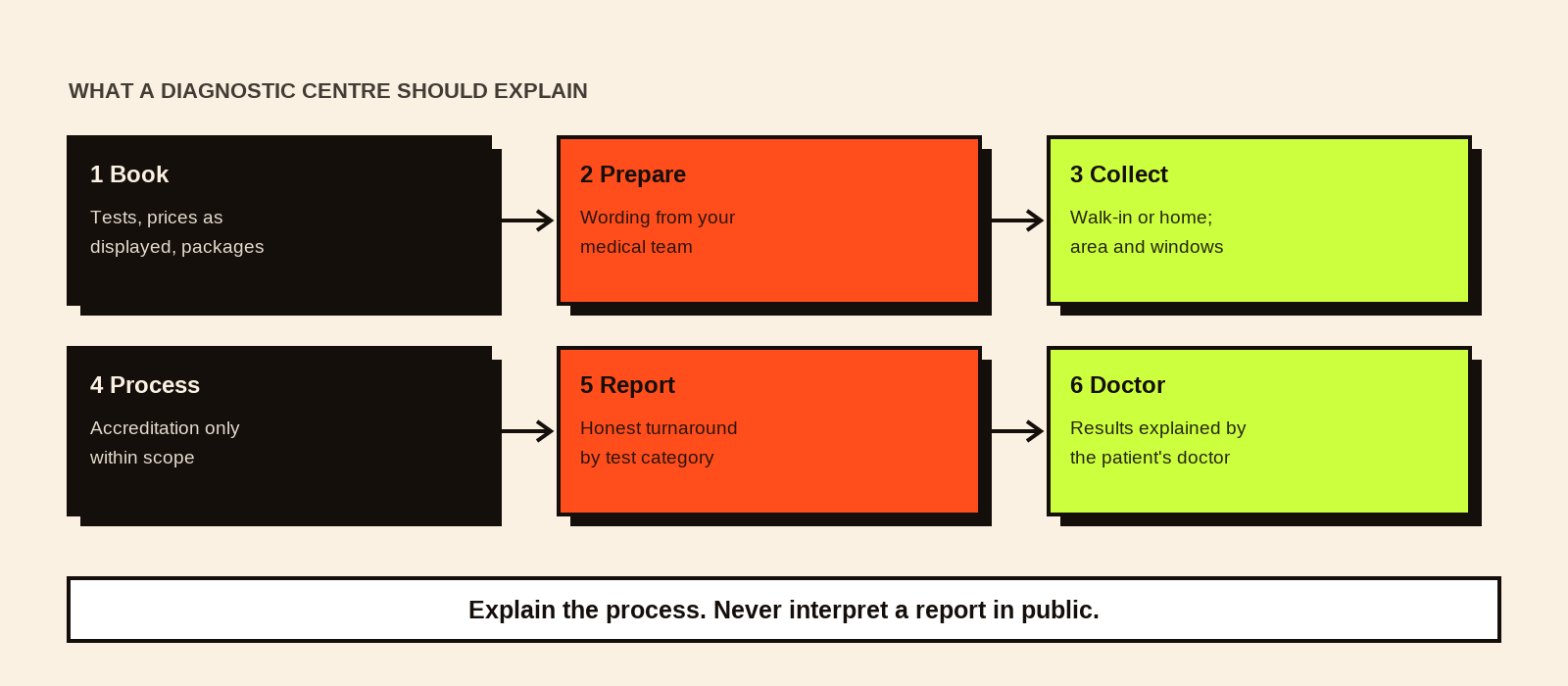
At 6.45 am a patient messages your lab's Instagram: 'I'm fasting for the lipid test, can I have black tea?' By noon someone has commented that her report is a day late and 'the sugar value looks wrong'. Meanwhile marketing has drafted a 'Full body check-up, 70% off, today only' creative. A diagnostic centre's social media is mostly about these moments: clear process information, honest timelines and careful handling of anything to do with a result.
Quick answer
Diagnostic centres should use social media to explain which tests they offer, how to prepare, how sample collection and home collection work, and when reports are realistically ready, with preparation advice written by the centre's own medical team. Never interpret a result publicly, keep reports confidential, state package contents and prices plainly without countdown offers, and claim accreditation only for the tests and location it actually covers.
The rules that apply to a diagnostic centre
Diagnostic centres sit under several overlapping rules. This is orientation, not legal advice; your legal adviser should confirm which apply to your set-up and state.
| Rule or body | What we verified (November 2026) | What it means for your posts |
|---|---|---|
| Clinical Establishments (Registration and Regulation) Act, 2010 | Applies to therapeutic and diagnostic establishments in the states and UTs where it has taken effect or been adopted; other states have their own laws | Registration status is a state matter; check with your state authority |
| Clinical Establishments (Central Government) Rules, 2012, rule 9(i) | Registered establishments must display the rates charged for each type of service at a conspicuous place, in the local language and English | Online prices should match the displayed rates exactly |
| NMC Guidelines on Ethical Advertising (6 October 2026) | Apply to registered medical practitioners and to hospitals and medical institutions. Explanation II allows factual information on diagnostic facilities and equipment without claims of superiority, guaranteed accuracy or guaranteed outcomes | Pathologists and radiologists who report are RMPs; whether a standalone lab counts as a 'medical institution' is for your legal adviser |
| NMC clauses 8.1(i), 8.1(vii) and 8.1(x) | No promoting unnecessary diagnostics or fear-based marketing; no referral or lead-generation fees connected with procuring patients or specimens; no inducements likely to encourage unnecessary diagnostic investigation | No scare hooks, no per-sample commissions, no 'today only' test offers |
| NABL accreditation | Voluntary; capabilities not listed in a lab's scope are not covered; use of the NABL symbol is governed by NABL 133 | Claim accreditation only for the tests and location in your scope |
Sources: the Clinical Establishments portal, the Central Government Rules, 2012, the NMC guidelines of 6 October 2026 and NABL's FAQ. Clause 6.4.2 of the IMC Regulations, 2002 also extends the ban on commissions to the referral of specimens for diagnosis. We found no social-media-specific advertising rule for laboratories in the Central Act's portal or the 2012 Rules; your state law may say more.
Test preparation posts come from your medical team
Preparation instructions are the most saved and shared posts a lab can publish, and the most dangerous if wrong. Fasting rules, medication questions and timing vary by test and by patient, so every preparation post must be written or approved by your centre's pathologist or medical director, using the same wording as your printed instructions. Never borrow preparation advice from another lab's feed or a general website.
Test name (as on your test menu):
Who should read this:
Preparation steps (from our standard instructions, version/date):
What not to change without asking your doctor (for example, regular medicines):
What to bring:
When to arrive / collection window:
Approved by (name, qualification, registration no.):
Caption ends with: 'Your doctor's instructions come first. If unsure, call us on [number] before your test.'
Reply to the 6.45 am 'can I have black tea?' message with your approved standard answer for that test if one exists, or a call-back from the lab if it doesn't. Don't improvise, and don't advise on medicines; that is for the patient's doctor.
Sample collection and home collection
People booking home collection want to know who is coming, when, and how they'll know it's genuine. Content that answers those questions reduces missed slots and anxious calls:
- The service area by locality or PIN code, kept current, and what happens if an address is outside it.
- Collection windows as they actually run, including Sundays and holidays, and how rescheduling works.
- How to recognise your collector: uniform, ID card, the confirmation message they'll receive. Never post staff phone numbers.
- What the collector will do: confirm identity, label in front of you, handle the sample as your protocol requires, give a receipt.
- Charges for home collection stated plainly, including any minimum order.
- A walk-through Reel of your walk-in collection area: queue, token system, accessibility, a private space if available.
Report turnaround: promise only what your process delivers
'Reports in 6 hours' is a claim. If your own data shows some tests take longer, or that samples arriving after a cut-off go into the next run, say so. Explanation II to clause 3.2 of the NMC guidelines bars guaranteed accuracy and other unverifiable representations about diagnostic facilities, and the same logic applies to timelines. Publish turnaround by test category, with the cut-off times and what can delay a report, and review it whenever your process changes.
When will my report be ready?
Routine blood tests: usually [time] after collection, for samples received by [cut-off].
[Category]: usually [time].
Some tests are sent to a partner lab or need repeat checks, which takes longer; we'll tell you at booking.
Reports are shared by [WhatsApp / email / app / collection counter] only to the registered number or email.
Never interpret a report in public
Your social team will see people post screenshots of reports and ask 'is this normal?'. The answer is always the same: the lab does not interpret results on social media, and the patient's doctor is the right person to explain them. Hide or remove comments that expose someone's report where your moderation policy allows, and contact the person privately to explain why. Health information is personal data under the Digital Personal Data Protection Act, 2023; its Rules were notified on 14 November 2025 with phased compliance (PIB, 17 November 2025), and clause 7.4 of the NMC guidelines bars sharing patient data that could identify someone publicly.
Thanks for asking. We can't interpret reports on social media, and we've hidden your comment to protect your privacy. Please discuss the result with the doctor who ordered the test. If you think there's a problem with the report itself, call our lab on [number] and quote your booking ID, and our team will check it with you.
We're sorry for the trouble. To protect your privacy we can't discuss reports here. Please call [number] or email [address] with your booking ID so our team can look into it today.
Our guide to community management vs customer support explains how to split routine replies from issues that need the lab team, which for a diagnostic centre should include any comment alleging a wrong result.
Packages and prices
Health check-up packages are a staple of diagnostic marketing, and the area most likely to cross a line. Clause 8.1(x) bars discounts, limited-period offers, coupons, cashbacks, referral benefits and similar inducements used in a way likely to encourage unnecessary diagnostic investigation, and says any lawful disclosure of charges, packages or fees must be factual, transparent and not misleading.
- List every test in a package by name and count, not 'over 80 parameters'.
- Show the price that will actually be charged, the same as your displayed rate list, with any home collection charge.
- Say who a package is not meant to replace: a doctor's advice on which tests a person needs.
- No countdowns, 'today only', 'last few slots' or false comparisons with a made-up 'original' price.
- No fear-based hooks ('Is a silent disease growing inside you?'); clause 8.1(i) bars fear-based marketing.
- Run package posts past your legal adviser and medical director before publishing.
Accreditation claims
NABL describes its accreditation as voluntary and says capabilities not listed in a lab's scope are not covered by its accreditation. That shapes how you talk about it. Say which location is accredited and which tests or departments are in scope, and avoid 'fully accredited lab' if only some tests are covered. Use of the NABL symbol is governed by NABL's own policy document, NABL 133, which you'll find in its published documents; follow its current issue exactly and check whether it allows the symbol in social media creatives before using it. NABL also publishes lists of labs facing action for misuse of the symbol.
- Name the accreditation body, the accredited location and the scope; link to the public directory where patients can verify it.
- Update or remove posts promptly if scope changes, accreditation is suspended or a branch isn't covered.
- Don't imply accreditation guarantees accuracy or makes you better than other labs (Explanation II and clause 8.1(ix)).
Sample content calendar
A diagnostic centre's calendar is mostly evergreen process content, refreshed and reposted, plus a few dated items. Here is a four-week sample with three posts a week; adapt it to what your team can produce and the medical team can approve. Our guide to a monthly social media content calendar covers fields and planning meetings.
| Week | Post 1 | Post 2 | Post 3 |
|---|---|---|---|
| 1 | Preparation explainer for one commonly booked test (medical team's wording) | Home collection: service area and collection windows | Turnaround by test category, with cut-offs |
| 2 | Walk-through Reel of the walk-in collection area | 'How to recognise our collector' carousel | Health awareness post tied to a national health day, sourced from MoHFW or WHO |
| 3 | Package explainer: every test listed, price as displayed, who should ask their doctor first | 'How you'll receive your report and who can access it' | Meet the team: the reporting doctors with qualifications and registration numbers |
| 4 | Accreditation post with location, scope and how to verify it | FAQ round-up: parking, timings, payment, insurance paperwork | Preparation explainer for a second test |
Health awareness posts should take their facts from primary sources such as the Ministry of Health and Family Welfare or the World Health Organization, never suggest that viewers need a test, and be checked by your medical director. If you run several branches, our guide to managing social media for multiple locations covers branch pages and local information.
Common mistakes
- Copying preparation instructions from another lab's Reel.
- Advertising 'reports in 4 hours' because it is true for the fastest test.
- Replying 'looks normal' to a report screenshot to be helpful.
- Putting the NABL symbol on a creative for a branch or test outside the scope.
- Paying a partner, doctor or app per sample or per booking.
Getting started
Start by getting your medical team to sign off standard preparation wording for your ten most booked tests, publish honest turnaround and home collection posts, and agree the reply templates for results and complaints. Check package posts against your displayed rate list and your accreditation scope before anything goes live. For measuring whether the posts lead to bookings, our guide to measuring social media sales for small businesses covers calls, WhatsApp enquiries and 'how did you hear about us'.
Kudozz's publishing and scheduling support can keep a calendar like this running within an agreed scope. Where the centre's doctors are registered medical practitioners, ask your State Medical Council how clauses 8.1(ii) and 8.1(viii) apply before engaging any agency, and never tie an agency's fee to bookings, patients or samples.