How Skin and Aesthetic Clinics Can Use Educational Social Media Content to Build Trust
How dermatology and aesthetic clinics in India can explain procedures, set honest expectations, show who treats patients and handle 'will this work for me?' comments under the NMC's October 2026 guidelines, with a skin-clinic approval checklist.
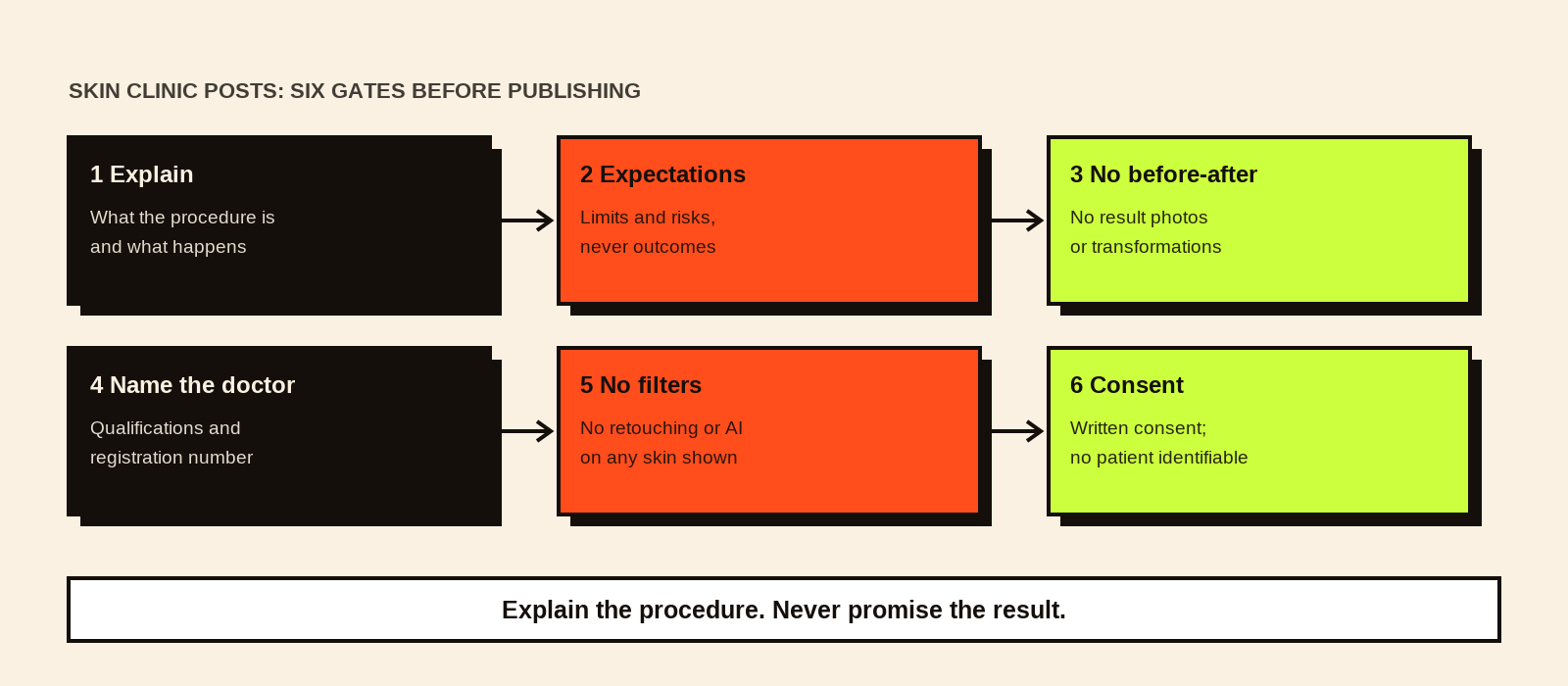
A follower comments under your clinic's Reel: 'How much for laser on my pigmentation, and will it go in three sittings?' The same week, a team member asks whether they can post a patient's peel results, and a sunscreen brand offers free stock if the dermatologist mentions it in a Story. Skin and aesthetic clinics get these requests more than most practices, because the thing patients most want to see, results, is exactly what the rules restrict.
Quick answer
Skin and aesthetic clinics build trust on social media by explaining conditions and procedures in plain language, describing what a procedure involves rather than what it will achieve, and showing who treats patients with their real qualifications and registration details. Under the NMC's guidelines of 6 October 2026, doctors must not display before-and-after photographs or advertise results for promotion, so the feed runs on education and process, approved by the treating doctor before anything is published.
Explain what the clinic does, in plain words
Many patients can't tell a dermatology consultation from a salon facial, or a medical laser from a beauty-parlour device. Clear, factual descriptions of what you offer are the most useful content a skin clinic can publish, and they are where trust starts. Describe only services the clinic actually provides, and keep the medical and the elective sides distinct:
| Service type | How to describe it on social media | What to leave out |
|---|---|---|
| Medical dermatology (skin, hair and nail conditions) | That the doctor examines, diagnoses and treats these conditions; general education on when to see a dermatologist; what a consultation involves | Named cures, timelines, 'permanent' results, anything that reads as a diagnosis for the viewer |
| Cosmetic and aesthetic procedures (only those you offer) | What the procedure is, what happens in a session, preparation and aftercare the doctor wants patients to know, and that suitability is decided at consultation | 'Painless', 'guaranteed', 'miracle', 'glowing skin in one session', and any promise about how a person will look |
| Products the clinic stocks or uses | Generic, doctor-approved ingredient education ('what a broad-spectrum sunscreen means') | A doctor recommending or endorsing a named product (clause 8.1(iv)) |
One thing a clinic's feed should never try to settle is who is allowed to perform which procedure. That is a question for regulators and your legal adviser, not a caption. What the feed can do is state plainly who performs each procedure at your clinic and what that person's actual qualifications are, so patients can judge for themselves.
The clauses that shape a skin clinic feed
Our guide to social media management for clinics sets out the general framework (the National Medical Commission's Guidelines on Ethical Advertising and Public Communication, No. R-13014/01/2024-Ethics, dated 6 October 2026, read with the Indian Medical Council (Professional Conduct, Etiquette and Ethics) Regulations, 2002) and a general approval checklist. Read that first. These are the clauses that matter most for skin and aesthetic work:
- Clause 8.1(iii): no advertising of success rates or numbers of patients treated, with 'painless treatment', 'Miracle treatment', '100% success' and 'Guaranteed cures' given as examples of barred claims.
- Clause 8.1(v): no publishing cases for promotional purposes, advertising surgical results, displaying 'before and after' photographs, publicising celebrity patients or promoting personal success stories, unless published strictly for scientific or educational purposes with anonymised patient consent.
- Clause 8.1(vi): no statement that creates unrealistic expectations, misrepresents treatment outcomes or conceals risks.
- Clause 8.1(iv): no approval, recommendation or endorsement of any drug, health product or commercial product for advertising in connection with the doctor's name, photograph or professional status.
- Clause 8.1(x): no discounts, limited-period offers, contests, coupons, gifts, cashbacks, referral benefits or free procedures used in a way likely to encourage unnecessary treatment; any lawful disclosure of charges must be factual and transparent.
- Clause 7.2(b): AI must not be used to create or manipulate a patient's image, testimonial or clinical outcome.
Sources: the NMC guidelines of 6 October 2026 and the IMC Regulations, 2002. The NMC text applies to registered medical practitioners and to hospitals and medical institutions. If treatments at your clinic are delivered by people registered with another council, their own regulator's rules also apply; check them rather than assuming the NMC text covers everything.
Before-and-after photos: what clause 8.1(v) means for you
Before-and-after images are the default format in aesthetic marketing worldwide, which is why this needs to be precise. Clause 8.1(v) lists displaying 'before and after' photographs among the things a registered medical practitioner shall not do, alongside advertising surgical results and promoting success stories. The only carve-out is material 'published strictly for scientific or educational purposes with anonymized patient consent'. Clause 6.2 adds that patient consent does not, by itself, make a before-and-after depiction acceptable, and Explanation V to clause 3.2 bars doctors from requesting or sharing patient testimonials for promotion on social media.
A clinic's Instagram exists to build interest in the clinic, so it is hard to see how a results post there would count as strictly scientific or educational. The safe policy is no before-and-after images, result reels or 'transformation' carousels on the clinic's or the doctor's accounts. If you believe a specific educational use falls within the exception, get the State Medical Council's view in writing first. Separately, clause 7.17 of the 2002 Regulations already barred publishing patients' photographs in an identifiable way without their permission.
What to show instead
- A labelled diagram of what a procedure does to the skin layers, drawn rather than photographed.
- A session walk-through filmed with a staff volunteer or in an empty room: arrival, consent conversation, preparation, the procedure room, aftercare briefing.
- Aftercare instructions as a save-worthy carousel, written by the doctor.
- 'What this procedure can't do': the doctor explains its limits and who it may not suit.
- Questions worth asking at any consultation: qualifications, risks, number of sessions, total cost, what happens if you're unhappy.
- Factual equipment posts (what the device is and what it's used for) without superiority, accuracy or outcome claims (Explanation II to clause 3.2).
Show who treats patients, accurately
Under Explanation III to clause 3.2, a doctor's electronic media posts should disclose their name, qualifications, registration status and SMR or NMR registration number; under Explanation IV, a clinical establishment's posts should name the doctors involved with the same details. Clause 1.4.2 of the 2002 Regulations allows only recognised medical degrees and qualifying certificates as suffixes, and clause 7.20 says a physician shall not claim to be a specialist without a special qualification in that branch. Copy every credential from the registration certificate and degree, never from a bio or a visiting card.
This procedure is performed at [clinic name] by [full name], [recognised qualifications exactly as registered], registered with [State Medical Council / NMC], Reg. No. [number]. Suitability is decided only after an in-person consultation.
Keep the doctor's photograph directory-style rather than promotional. Clause 9.2 says use of a practitioner's photograph is not permitted where it amounts to self-advertisement, solicitation or promotional publicity, so a 'meet the doctor' post should read like a profile, not a celebrity feature.
Filters, retouching and body image
On a skin clinic's feed, a beauty filter is a misleading claim about skin. Make it a written rule that no filter, smoothing, reshaping or AI enhancement is applied to any skin shown in clinic content, including staff and models, and that lighting stays consistent. Altered skin in a post about a procedure risks the unrealistic expectations clause 8.1(vi) forbids, and AI-made or AI-altered faces risk clause 7.2.
- Don't frame normal features (pores, texture, fine lines, darker skin tones, body hair) as problems that need fixing.
- Avoid language that ranks skin tones or links appearance to worth, success or marriage prospects.
- Avoid fear-based hooks ('your skin is ageing faster than you think'); clause 8.1(i) bars fear-based marketing and creating unnecessary demand for procedures.
- Use a range of real skin types in illustrations and staff volunteers in demos, with consent.
Products on the feed
Skin clinics often stock products, and brands often approach dermatologists. Clause 8.1(iv) of the 2026 guidelines and clause 6.1.1 of the 2002 Regulations both bar a doctor from giving an endorsement or recommendation of a product for use in advertising with their name or photograph. Keep product content generic and educational (ingredient categories, how to read a label, why patch-testing instructions on the pack matter) and leave specific product choices to the consultation. Turn down paid or gifted mentions for the doctor's account. If you also run a separate retail skincare brand, our guide to social media for beauty and skincare brands covers product marketing, which follows different rules from a doctor's feed.
Replying to 'will this work for me?'
Comments asking about suitability, results and price are the most common inbound on a skin clinic account. The person managing the inbox should never assess a photo, suggest a treatment or predict a result. Agree these replies with the doctor once, then use them consistently. Our guide to community management vs customer support explains how to route the questions that need the clinic team.
Thanks for asking. Whether a treatment suits you, and what it can realistically do, depends on an examination by the doctor, so we can't advise here or from a photo. You can book a consultation on [number / link]. Please don't share photos of your skin or medical details in comments.
Our consultation fee is [amount]. Procedure fees depend on what the doctor recommends after examining you; the current fee list is at [link / on request at the front desk]. We'll always give you the full cost before any treatment starts.
We're sorry to hear this. To protect your privacy we can't discuss anyone's treatment here. Please call [number] or email [address] so the doctor can speak with you directly.
Skin clinic content approval checklist
Use this in addition to the general clinic checklist, before any post, Story, Reel or reply template goes live. The treating doctor signs off; our guide to the social media approval process covers stages and turnaround.
- The procedure or condition is described factually, in plain language, and only if the clinic offers it.
- No outcome promised: no 'results', timelines, 'permanent', 'painless', 'guaranteed', 'miracle' or '100%'.
- Risks, limits and the need for a consultation are mentioned where a procedure is discussed.
- No before-and-after images, result reels, transformation carousels, celebrity patients or patient stories.
- No filter, retouching or AI alteration on any skin shown; no AI-generated faces.
- The treating practitioner is named with recognised qualifications, registration status and registration number.
- No named-product endorsement by a doctor; no gifted or paid product mentions.
- No discounts, packages with countdowns, contests, referral rewards or free procedures.
- Everyone shown has given written consent; no patient is identifiable.
- Normal skin features are not framed as defects; no fear-based hooks.
- Reply templates for suitability, price and complaints are approved and ready.
Common mistakes the checklist catches
- Copying aesthetic marketing from other countries, where before-and-after content is routine, into an Indian doctor's feed.
- Captioning a procedure post with what the patient 'will get' instead of what the procedure involves.
- Letting a receptionist or agency answer 'is this acne or pigmentation?' from a photo in DMs.
- Using a smoothing filter on a model in a laser explainer.
- Running festive offers on peels or laser packages.
Where to begin
Start with three things: a correct practitioner line on every post, a short series explaining each procedure you offer and its limits, and approved replies for suitability and price questions. Run every draft through the checklist above. If the dermatologist also wants a personal professional profile, our guide to social media management for doctors covers that separately.
Outside help such as Kudozz's copywriting and publishing support can draft explainers and keep the calendar running, but for a doctor-led clinic, clause 8.1(ii) lists engaging 'any third party for marketing medical services' among practices to avoid while clause 8.1(viii) addresses how agencies are paid, so ask your State Medical Council how those apply before engaging anyone, and never tie any fee to patients or bookings.