Building a Professional Creator Career in India Beyond Being an Influencer
Creator careers in India go well beyond influencing. Explore 14 creator-economy roles, the skills that transfer between them, how to run it as a business, and a 12-month career plan.
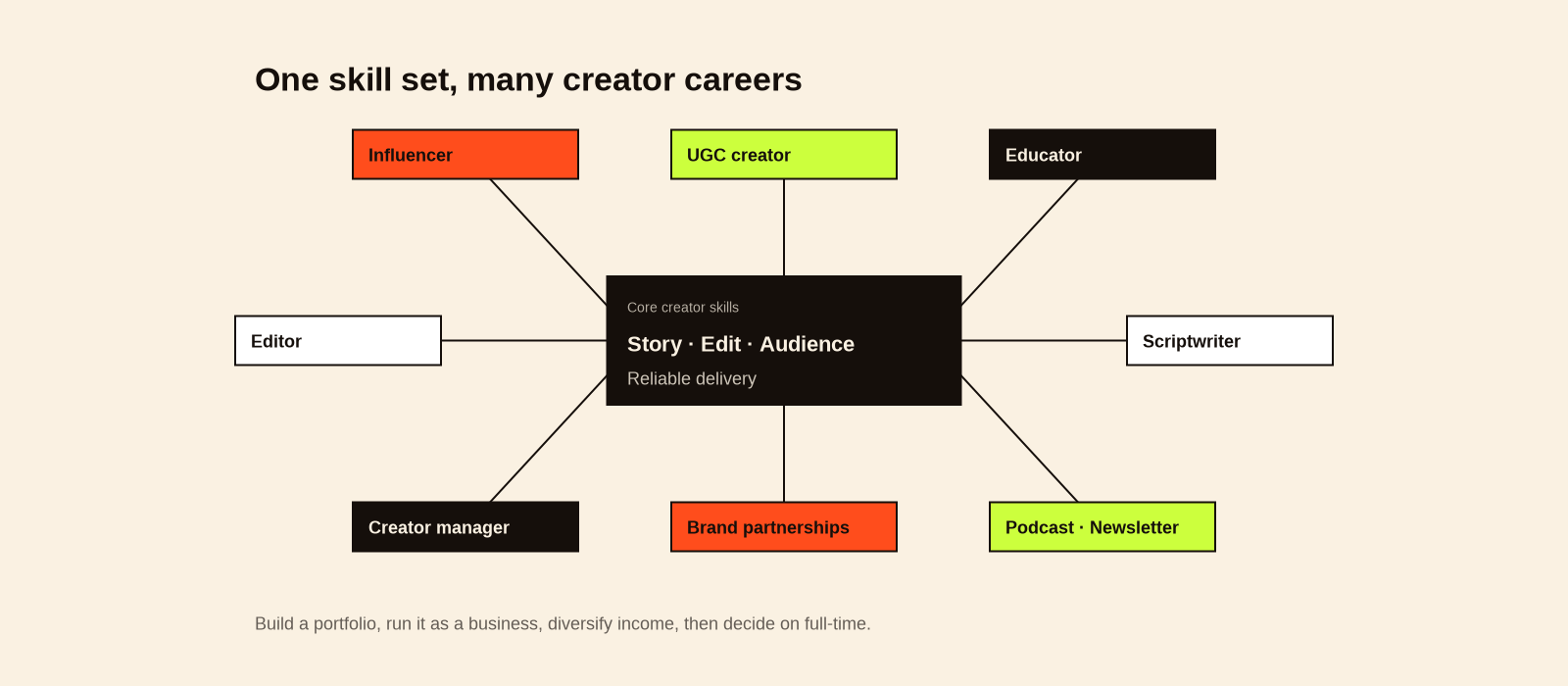
If you've been making content for a while, you've probably wondered whether it can become a real career, and whether that career has to mean chasing followers forever. It doesn't. The skills you've built writing hooks, editing Reels, talking to a camera or running a community are the same skills a whole set of creator-economy roles need. This guide maps those roles, shows which skills carry across, and gives you a practical 12-month plan for building a career you can sustain.
Quick answer
A professional creator career in India can mean being an influencer, but it can also mean working as a UGC creator, editor, scriptwriter, thumbnail designer, educator, podcaster, newsletter writer, community builder, creator manager, brand-side partnerships executive or social media manager. Most of these share core skills: storytelling, editing, audience understanding and reliable delivery. Build a portfolio that proves those skills, run your work like a small business with invoices and contracts, spread income across more than one source, and go full-time only once you have several months of expenses saved.
Why 'creator' is now a set of careers, not one job
Being an influencer is the most visible creator role, but it depends heavily on audience growth and platform changes you don't control. Around every influencer sits a team of people doing creator work without being the face: someone editing, someone scripting, someone negotiating with brands. Brands also hire people who understand creators. If you treat your experience as a bundle of skills rather than a follower count, you have more doors open, and more stability when one platform or format slows down.
Creator-economy roles and what each involves
Here's an overview of the main paths. Some are freelance, some are in-house jobs, and many people combine two. We've deliberately left out pay figures because they vary too widely by city, client and experience to be useful as a single number.
| Role | What the work involves | Who it suits |
|---|---|---|
| Influencer | Building an audience and partnering with brands that fit it | People comfortable on camera who enjoy audience interaction |
| UGC creator | Making product videos brands use on their own channels and ads | Strong on-camera demonstrators, even with a small following |
| Educator or course creator | Teaching a skill through courses, workshops or cohorts | People with deep, provable expertise |
| Video editor | Cutting long and short videos, captions, pacing, sound | Detail-focused people who like the craft more than the spotlight |
| Scriptwriter | Writing hooks, scripts and series formats for creators or brands | Writers who understand spoken rhythm and retention |
| Thumbnail designer | Designing YouTube thumbnails and title concepts | Visual thinkers who can test and iterate |
| Creator or talent manager | Handling a creator's brand deals, schedules and negotiations | Organised communicators who like deal-making |
| Social media manager (brand side) | Running a brand's accounts, content calendar and reporting | People who enjoy planning and consistency |
| Creator partnerships executive | Finding, briefing and managing creators for a brand | People who know creators and can speak brand language |
| Agency roles | Campaign management, creator sourcing, strategy, account management | People who like variety and fast-moving teams |
| Podcaster | Hosting, producing and distributing audio or video shows | Good conversationalists and researchers |
| Newsletter writer | Writing a regular email publication for a defined audience | Writers who enjoy depth and owning their audience |
| Community builder | Running and moderating WhatsApp, Discord or paid communities | People who are patient, fair and good at structure |
| B2B or LinkedIn creator | Building professional credibility in an industry through posts and video | Working professionals with niche knowledge |
A few of these have their own deep guides. If UGC appeals to you, start with how to become a UGC creator in India. If teaching suits you, our guide to building a creator course business covers validation and launch, and if writing is your strength, see how to start a creator newsletter in India. For the manager and agency side, how to start a creator management agency in India explains how that business works.
Skills that transfer between roles
Look at what you already do each week and map it to roles. The table below shows which core skills feed which paths, so you can see where you're closer than you think.
| Skill you build as a creator | Roles that use it most | Proof you can show |
|---|---|---|
| Hook and script writing | Scriptwriter, UGC creator, social media manager | Scripts with before-and-after retention notes |
| Video editing | Editor, UGC creator, agency production | Before-and-after edits, reels you cut for others |
| Visual design | Thumbnail designer, social media manager | Thumbnail sets and the titles they went with |
| On-camera presence | Influencer, UGC creator, educator, podcaster | Short showreel of different formats |
| Audience research | Partnerships executive, strategist, newsletter writer | A written content audit of your own channel |
| Negotiation and briefs | Creator manager, agency roles, partnerships | Anonymised brief and deliverables summary |
| Community moderation | Community builder, social media manager | Rules, onboarding message, event formats you ran |
| Analytics | Strategist, agency roles, social media manager | A monthly report you wrote for your own account |
| Teaching and explaining | Educator, B2B creator, podcaster | A workshop recording or tutorial series |
| Regional language fluency | Scriptwriter, UGC creator, localisation, partnerships | The same script written in two languages |
Build a professional portfolio, not just a profile
Your Instagram grid shows your content, but it doesn't show how you think. A portfolio does. Whatever role you're aiming for, keep a simple page or document with three to six case studies. Each should explain the goal, what you did, the constraints you worked within and what you learned. Use your own numbers only if they're real and you're comfortable sharing them. Our guide to building a creator portfolio covers format and what brands look for.
Project: [e.g. Diwali gifting Reel series for my own channel]
Role: [what you personally did: script, shoot, edit, thumbnail]
Goal: [what success meant]
Constraints: [budget, deadline, language, tools]
What I did: [3 to 5 steps]
Result: [honest outcome, or what you learned if it didn't work]
Links: [video, script doc, before-and-after]
Treat it as a business from the start
Whether you're freelancing as an editor or taking brand deals, you're running a small business. That means a few basic systems, set up before the money becomes complicated.
- Write a one-page plan: what you offer, who pays for it, and how you'll find them. Our creator business plan template keeps this simple.
- Send proper invoices with your PAN, bank or UPI details and payment terms for every job.
- Use written agreements for scope, deadlines, revisions, usage and payment, even for small clients.
- Keep a separate bank account or at least a separate record for creator income and expenses.
- Understand GST and TDS early so a brand's deduction or a registration requirement doesn't surprise you.
- Back up your files and secure your accounts, because your work and your access are your assets.
Our guides on how to invoice brands as a creator in India, creator contracts and GST for influencers walk through each of these in detail.
Diversify your income sources
A career that relies on a single income source is fragile. If brand deals pause during a slow quarter, or a platform changes how content is shown, you want other sources still coming in. Combine client work (editing, scripting, UGC) with your own products (courses, templates, a paid community) and platform income where you're eligible. Our guide to creator monetization in India lists 12 options so you can pick two or three that suit your skills.
| Income type | Examples | Trade-off |
|---|---|---|
| Client services | Editing, scripting, UGC, social media management | Steadier, but tied to your hours |
| Brand partnerships | Sponsored posts, integrations, ambassadorships | Can be lumpy and seasonal |
| Own products | Courses, templates, presets, workshops | Slow to build, scalable later |
| Platform income | Ad revenue, subscriptions, affiliate | Depends on eligibility and platform rules |
| Employment | In-house roles at brands or agencies | Stable, with less control over what you make |
A 12-month creator career plan
Use this as a template, not a promise. Adjust each quarter based on what's actually working for you.
MONTHS 1-3: CHOOSE AND PROVE
- Pick 1 primary role and 1 backup role from the roles table
- Close 2 skill gaps (e.g. sound mixing, thumbnail testing)
- Build 3 portfolio case studies
- Set up invoicing, a contract template and an income tracker

MONTHS 4-6: FIRST PAID WORK
- Pitch or apply to [X] clients or roles every week
- Deliver 2 to 3 paid projects and ask for written feedback
- Add each finished project to the portfolio
- Review: which work did you enjoy and get repeat interest in?

MONTHS 7-9: SYSTEMS AND SECOND INCOME
- Write simple SOPs for your most repeated tasks
- Add one second income source (a template, workshop or retainer client)
- Raise prices for new clients if your calendar is consistently full
- Start a savings buffer measured in months of expenses

MONTHS 10-12: DECIDE THE NEXT STEP
- Compare runway, pipeline and energy against the full-time checklist
- Decide: stay part-time, go full-time, or move into an in-house role
- Plan the next year's skills and portfolio pieces
When to go full-time, and when to keep your job
There's no right moment that works for everyone, but you can make the decision less emotional. Measure your readiness in months of expenses covered, not in how much one good month paid. Our guide to creator financial planning explains how to budget around uneven income.
| Signal | Leaning towards full-time | Leaning towards keeping your job |
|---|---|---|
| Savings runway | Several months of personal and business expenses saved | Less than a few months saved |
| Income sources | Two or more sources, none more than about half of the total | One client or one platform pays most of it |
| Pipeline | Repeat clients and enquiries you didn't chase | Every project needs cold outreach |
| Time pressure | Turning down good work because of your job | Creator work fits comfortably around your job |
| Dependants and EMIs | Family has agreed and fixed costs are covered | Fixed obligations you can't defer |
| Energy | You still enjoy the work after a busy month | You're already exhausted part-time |
Keeping a job isn't failure. Many people build creator skills on evenings and weekends for a long time, or move into an in-house partnerships or social media role that uses those same skills with a steady salary.
Protect your wellbeing
Creator careers blur the line between work and life. Your phone is your office, comments arrive at midnight, and every holiday feels like content. Set working hours, batch your production, take real breaks around festivals and family events, and notice early signs of fatigue. Our guide to creator burnout in India covers how to stay consistent without posting every day. If podcasting is the path that interests you, start with our podcast starter guide. For professional opportunities, it's worth building a presence on LinkedIn as a creator.
Conclusion
Being an influencer is one path in the creator economy, not the only one. The skills you've built as a creator, from scripting and editing to understanding audiences, are useful across many roles, both freelance and in-house. Pick a direction, prove your skills with a real portfolio, run your work like a small business, spread your income, and make the full-time decision with savings and data rather than hope.