Social Media Management for Franchise Businesses: A Practical Operating Model
An operating model for franchise social media: who does what between franchisor and franchisee, what the agreement or brand manual should address, local approvals, admin access, reviews, onboarding and exits, and how funding is usually framed.
A franchisee in Indore runs a '50% off everything' weekend on a Facebook Page she created herself, using a logo she downloaded from Google. The franchisor finds out when customers in Bhopal start asking for the same deal. She wasn't acting in bad faith. Nobody had told her what she could post, where, or who had to approve it.
Quick answer
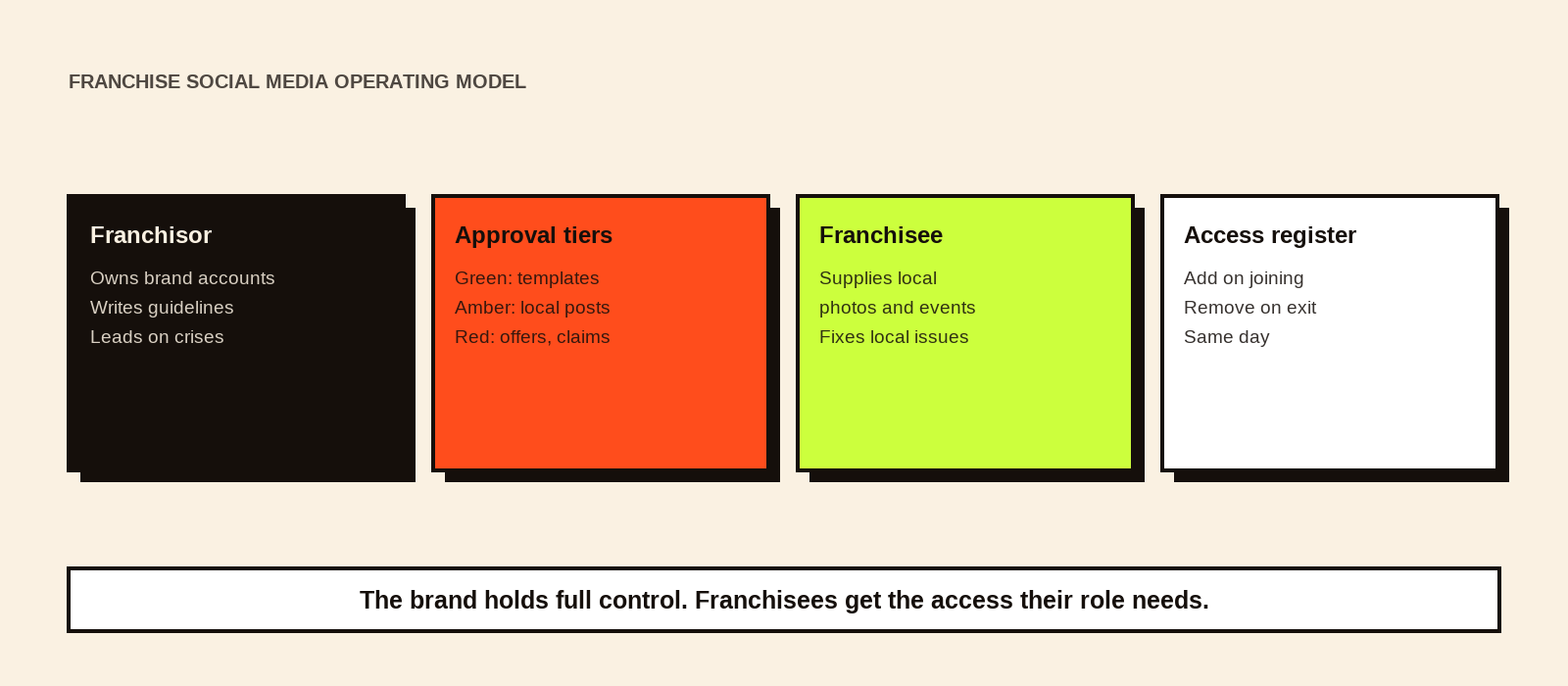
Franchise social media works when the franchisor owns the brand accounts, the guidelines and the template library, and franchisees contribute local content and local responses inside those rules. Write down who owns which accounts, who holds admin access, how local posts and offers get approved, how reviews and complaints are handled, and what happens to access when a franchisee joins or leaves. Check how all of this fits your franchise agreement with a lawyer.
In a company-owned chain, the head office can simply decide. In a franchise, the person running the outlet owns a business of their own, often pays into marketing, and wants local visibility. The brand, meanwhile, belongs to the franchisor and has to look the same in every city. Social media sits right on that line, which is why it needs explicit rules rather than goodwill.
If your outlets are all company-owned, the simpler model in how to manage social media for multiple locations will fit better.
Franchisor versus franchisee responsibilities
This is a starting split. Your agreement may already set some of it, and some networks give franchisees more freedom.
| Area | Franchisor | Franchisee |
|---|---|---|
| Brand accounts (national) | Owns, runs and publishes | Shares posts, suggests local stories |
| Local Pages or accounts | Owns or co-owns; holds full admin control | Posts within guidelines, with partial access if allowed |
| Guidelines and templates | Writes, updates and trains | Uses them; flags gaps |
| National campaigns and offers | Plans and publishes | Implements in store; doesn't change terms |
| Local offers and events | Approves and sets limits | Proposes, runs and reports results |
| Local photos and video | Sets quality and consent rules | Supplies material from the outlet |
| Comments and reviews | Sets response rules, handles escalations | Answers local factual questions; fixes local issues |
| Serious complaints and crises | Leads the response | Reports immediately; doesn't comment publicly |
| Reporting | Network-level and per-outlet reports | Shares local sales or bookings data where agreed |
What the agreement or brand manual should address
This isn't legal advice, and franchise agreements vary. Use these as questions to raise with your lawyer when drafting or renewing agreements, or when updating the brand manual that the agreement refers to.
- Who owns social media accounts, handles and Pages that use the brand name, including ones a franchisee creates?
- Can a franchisee create their own accounts at all, and if so, under what naming rules?
- Who must hold admin rights, and does the franchisor keep full control of every branded account?
- What content needs approval before posting, and what can a franchisee post freely?
- Who owns photos, videos and customer content created at the outlet, and can the franchisor reuse them network-wide?
- What consent is needed before posting staff or customers, especially children?
- Can franchisees run paid ads or work with influencers locally, and with whose approval?
- What happens to accounts, followers and content when the agreement ends, is transferred or is terminated?
- How are marketing contributions collected, spent and reported?
Centralised content guidelines
Franchisees aren't marketers by trade. The guidelines need to be short, visual and specific, with examples of good and bad posts. A useful pack includes:
- A one-page voice guide with saved replies.
- Editable templates for the posts franchisees make most: new staff, local events, timings, festive greetings, store milestones.
- Photo rules: lighting, angles, what must never be in frame (competitor products, untidy kitchens, customers who haven't agreed).
- A list of claims and words that always need approval, such as health, price comparisons and 'best in town'.
- Disclosure rules if franchisees host local creators, in line with ASCI's influencer advertising guidelines.
- A short 'do not post' list: politics, religion-related debate, competitor criticism, internal disputes.
The brand voice template is in how to create a social media brand voice, and ASCI's guidance is on its own site.
A local content approval workflow
Approval should be fast for low-risk posts and careful for anything involving price, claims or people. Three tiers usually cover it.
| Tier | Examples | Approval | Suggested turnaround |
|---|---|---|---|
| Green: template posts | Staff welcome, timings, event using an approved template | None, or a spot check after posting | Same day |
| Amber: local content | Original local photos, community events, local creator visit | Central marketing approves | One to two working days |
| Red: offers and claims | Discounts, contests, health or performance claims, anything with prices | Central marketing plus whoever owns pricing | Agreed in advance; plan a week ahead |
Use one shared request form or tracker so nothing gets approved over a WhatsApp voice note that nobody can find later. The social media approval process covers sign-off stages and tools in more detail.
Page ownership and admin access
Most franchise social media problems come back to access. The safest principle is that the brand holds full control of every branded asset, and franchisees get only the access their role needs. At the time of writing (November 2026), the platforms support this:
- Meta: in a business portfolio, a person can be given full control of a Page or partial, task-based access (for example, creating content or responding to messages). Meta notes that a Page must have at least one person with full control, and people with full control can remove anyone else.
- Google Business Profile: profiles have owners and managers. Both can reply to reviews, but only owners can add or remove users, and the primary owner can't be removed until ownership is transferred.
Meta explains access levels in its Page access help article, and Google covers profile roles in its owners and managers page. Keep an access register: every account, every person with access, their role, and the date it was granted.
Local offers, reviews and complaints
Local offers
Local offers are where franchisees most want freedom and where the network gets hurt most when they clash. Set a menu of pre-approved offer types and limits, and require that every offer post states which outlet it applies to and when it ends. Never let a local offer use national wording that suggests it's available everywhere.
Reviews
Decide whether the central team or the franchisee replies to reviews on local Pages and profiles, and give whoever replies a bank of saved responses. Franchisees should not ask staff, friends or family to post reviews, and nobody should offer incentives in exchange for positive ones only.
Complaints
A complaint about one outlet becomes a complaint about the brand within hours. Franchisees should fix the local issue, but public replies to serious complaints (food safety, injury, discrimination, legal threats) should come from the franchisor. For incidents that escalate, how to build a social media crisis response plan sets out severity levels; serious cases need legal and PR advice too.
Onboarding and exiting franchisees
When a franchisee joins
- Create or claim the outlet's location Page and Google Business Profile under the brand's business accounts.
- Grant the franchisee's named staff the agreed access level, never full control by default.
- Run a short training session on templates, approvals and escalation.
- Add the outlet to the content planning grid and reporting.
- Check for any accounts the franchisee already created under the brand name and agree what happens to them.
When a franchisee leaves or an outlet changes hands
- Remove the departing franchisee and their staff from every account on the access register, the same day the exit takes effect.
- Change any shared passwords and recovery emails or phone numbers.
- Update location details, hours or closure notices on Facebook and Google.
- Archive or hand over content as the agreement says.
- Search for unofficial accounts using the brand name for that city and report or reclaim them.
Funding: central fund or local spend
How social media is paid for is a commercial decision for each network, and the agreement usually decides it. These are the common approaches and the questions each raises.
| Approach | What it covers | Questions to settle |
|---|---|---|
| Central marketing fund | Brand accounts, templates, national content, agency fees | How contributions are set, how spend is reported to franchisees, whether local content is included |
| Local spend by franchisee | Local events, outlet shoots, local creators or ads | Minimum or maximum spend, approval rules, whether the franchisor provides suppliers |
| Mixed | Central for brand-level work, local for outlet-level activity | Where the line sits, and who pays for local content the central team produces |
Whichever you choose, share a simple report of what the fund paid for. Franchisees who can see the work are much more willing to follow the rules that come with it.
Common mistakes
- Letting franchisees create accounts in their own names, then discovering the brand can't access them.
- A brand manual with no social media section, or one written before Reels existed.
- Approval rules so slow that franchisees stop asking and post anyway.
- No exit checklist, so former franchisees keep posting under the brand name.
- Treating every franchisee post as a risk instead of giving them safe templates.
- Funding arguments that drag on because nobody reports what central money was spent on.
Where to start
Build the access register first: every branded account in the network, who owns it and who can log in. Then write the three-tier approval rules and a starter template pack, and review the agreement questions with your lawyer before the next renewal or new signing.
Social media management from Kudozz can run the central accounts, templates and calendar for a franchise network; franchise influencer marketing in the GCC covers the creator side for multi-location brands in that region.