Influencer Marketing Data: What Brand Teams Should Collect and Analyze
The nine categories of creator and campaign data brand teams should collect, when to collect each, who owns it, how reliable each source is, and the minimum dataset to start with.
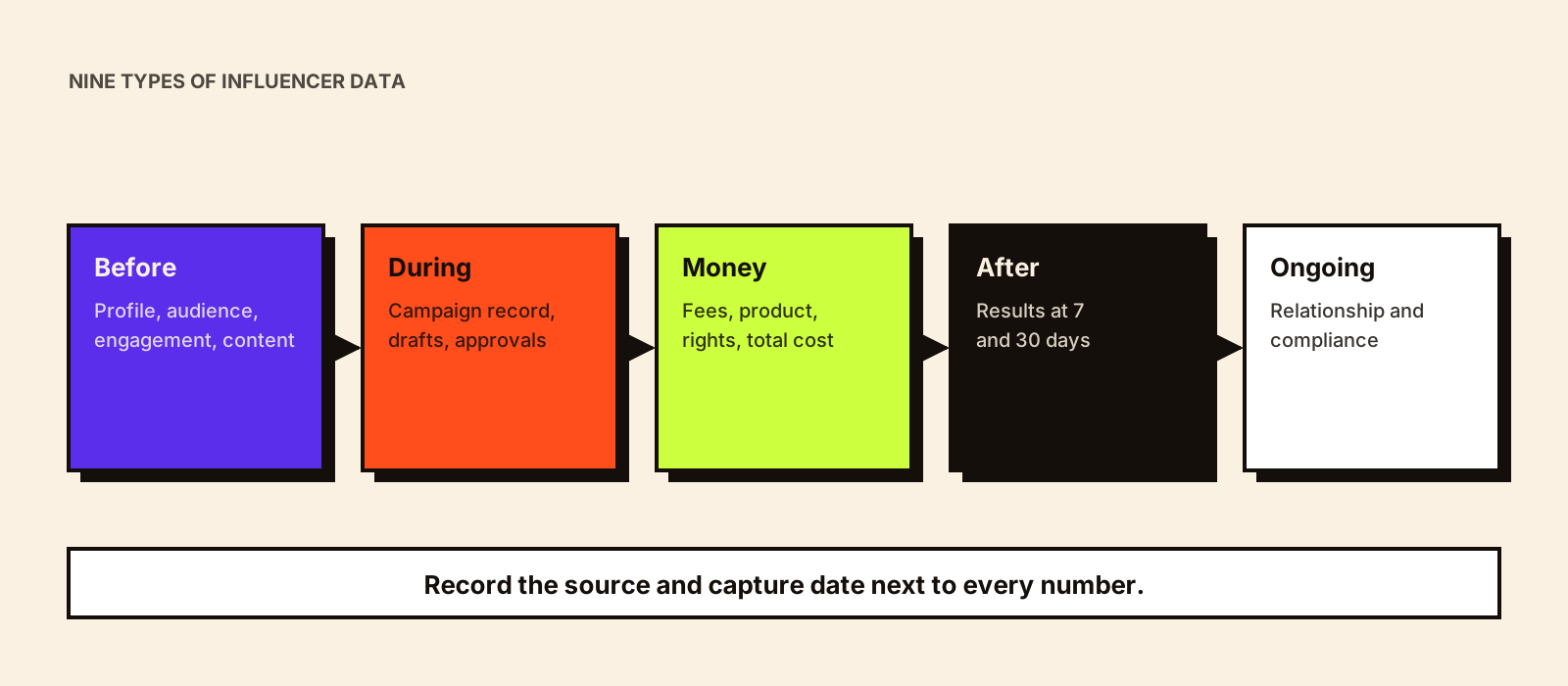
Most brands have plenty of influencer data and very little they can use. It sits in insight screenshots on WhatsApp, rate cards in someone's inbox, UTM reports nobody joined to creator names and approval comments in email threads. The problem isn't collecting more. It's deciding which data matters, collecting it the same way every time and keeping it attached to the creator and campaign it describes.
Quick answer
Brand teams should collect nine kinds of influencer data: creator profile data, audience data, engagement data, content data, campaign data, commercial data, historical performance, relationship data and compliance data. Collect each at a fixed point in the campaign (discovery, vetting, contracting, posting, 7 and 30 days after posting, close), record its source and date, and store it against both the creator and the campaign. A small, consistent dataset beats a large, patchy one.
The nine categories of influencer data
| Category | What it includes | Main source | Collected when |
|---|---|---|---|
| 1. Creator profile | Handles and URLs per platform, languages, location, niche, formats, posting frequency, tier, manager | Public profile, creator | Discovery |
| 2. Audience | Top cities and states, age, gender, language, returning viewers, audience growth | Creator insights (screenshots or connected accounts); tools for estimates | Vetting, refreshed before each booking |
| 3. Engagement | Views, reach, likes, comments, saves, shares, watch time, comment substance | Creator insights, public data | Vetting and after posting |
| 4. Content | Recent posts reviewed, themes, production quality, hooks, past sponsored content, disclosure habits | Human review | Vetting |
| 5. Campaign | Objective, brief version, deliverables, dates, links, codes, drafts, approvals, live URLs | Your campaign tracker | Throughout the campaign |
| 6. Commercial | Quoted and paid fees, product cost, usage rights fees, payment terms, total cost | Contracts, finance | Negotiation and close |
| 7. Historical performance | Results per post and campaign: views, engagements, clicks, conversions, cost metrics | Insights, analytics, store data | 7 and 30 days after posting |
| 8. Relationship | Stage, owner, interactions, reliability, revision rounds, communication notes, rebook decision | Your team | During and after each campaign |
| 9. Compliance | Disclosure check, claims approval record, usage rights and expiry, exclusivity, brand-safety notes | Your team, contracts | Before and after go-live |
Categories 1–4 describe the creator before you work with them. Categories 5–9 are created by working with them, and only your brand has them. That second group is what makes your data more valuable over time than any third-party database. Influencer database covers the discovery-side fields in more detail; influencer marketing CRM covers relationship records.
How reliable is each source?
| Source | Reliability | Use it for | Don't use it for |
|---|---|---|---|
| Creator-connected account data | High | Reporting, payment on results, audience fit | Creators who haven't connected |
| Creator insights screenshots | High if recent and complete | Audience fit, delivered reach and views | Undated or cropped images |
| Your analytics and store data | High for what it tracks | Clicks, sessions, orders by link or code | Sales it can't see (marketplaces, later purchases) |
| Public profile data | Accurate for what's public | Content review, public engagement, posting history | Reach, audience demographics |
| Third-party estimates | Varies | Scanning many creators quickly | Reporting delivered results or paying creators |
| Team judgment | As good as the reviewer | Content quality, brand fit, reliability | Anything that should be measured |
The single most useful habit is recording source and date next to every number. 'Audience 42% Maharashtra' means little without 'creator insights, 2026-08-14'.
When to collect what
DISCOVERY → profile, public engagement, content themes (provisional)
VETTING → audience insights from creator, authenticity check, content review, past sponsored work
NEGOTIATION → quoted rates by deliverable (dated), usage and exclusivity terms
CONTRACT → final fee, deliverables, dates, rights and expiry, payment terms
BRIEF → brief version, mandatory messages, approved claims
DRAFTS → submission dates, revision rounds, approval record
GO-LIVE → live URL, disclosure check, tracking link and code
+7 DAYS → views, reach, engagements, saves, shares, link clicks (same day for every creator)
+30 DAYS → same metrics again, conversions, comment themes
CLOSE → total cost, cost metrics, reliability rating, rebook decision and reason
Fixed capture days matter more than most teams realise. Comparing a post at day 3 with another at day 25 makes the newer one look worse for no reason. Influencer campaign automation shows how to trigger these requests automatically.
The minimum dataset to start with
If you collect nothing consistently today, start with twelve fields per creator per campaign. They're enough to compare creators fairly and decide who to rebook:
- Creator profile URL and primary language
- Audience top states or cities (with source and date)
- Deliverable type and platform
- Go-live date
- Total cost (fee plus product, shipping, rights and production)
- Views at 7 days
- Saves plus shares at 7 days
- Link clicks or sessions from the creator's UTM link
- Orders or leads from the creator's link or code
- On-time delivery (yes/no) and revision rounds
- Disclosure correct (yes/no)
- Rebook decision and one-line reason
Data to stop collecting
- Follower counts as a performance measure. They describe a creator; they don't measure a campaign.
- Total likes without views or reach. They're hard to interpret and easy to inflate.
- Personal details you don't need: home addresses after delivery, identity documents outside finance, personal opinions about creators.
- Screenshots without dates.
- Metrics nobody has defined. If two people calculate engagement rate differently, the number is noise.
Data ownership and privacy
Creator data is personal data. India's DPDP Rules, notified in November 2025, phase in most business obligations by May 2027: purpose limitation, security safeguards, breach handling and rights to correction and erasure. In practice that means collecting what you need for a defined purpose, restricting access to payment and identity data, keeping notes factual and agreeing with any agency who owns the data it collects on your behalf.
Who owns each kind of data
| Data | Collected by | Owned and maintained by | Used by |
|---|---|---|---|
| Creator profile and audience | Discovery / campaign manager | Influencer lead | Shortlisting, planning |
| Campaign record | Campaign manager | Campaign manager | Operations, reporting |
| Commercial | Campaign manager, finance | Finance (payment details), influencer lead (fees) | Budgeting, cost metrics |
| Performance | Campaign manager, analyst | Analyst | Reporting, rebooking, benchmarks |
| Relationship | Whole team | Influencer lead | Rebooking, programmes |
| Compliance | Campaign manager, legal | Legal or brand lead | Risk, rights, audits |
If an agency runs campaigns for you, agree in the contract which data it collects on your behalf, in what format you receive it and when. Otherwise your creator history leaves with the agency.
Write a data dictionary
Two people calculating 'engagement rate' differently produce two numbers that look comparable and aren't. A one-page data dictionary prevents that:
VIEWS: platform-reported views from creator insights, captured 7 days after posting
QUALITY ENGAGEMENTS: saves + shares + comments coded as question, intent or experience
ENGAGEMENT RATE: (likes + comments + saves + shares) ÷ views, recent 10 posts, median
TOTAL COST: fee + product at cost + shipping + usage-rights fee + production + paid boost on that post
CLICKS: sessions in web analytics with utm_source = creator handle
CONVERSIONS: delivered orders attributed by creator link or code within 14 days
RELIABILITY: 1–5, based on on-time drafts and revision rounds
India-specific data points
- Language and script of the content, and of the audience's comments.
- Audience state and city tier, not just country.
- Cash-on-delivery share and return-to-origin rate for creator-driven orders, since placed orders overstate results in COD-heavy categories.
- Marketplace sales during campaign windows, which creator links often can't track directly.
- Manager or agency representing the creator, and who invoices.
- GST and TDS details, held by finance rather than the marketing team.
These fields are what make regional and D2C comparisons possible later. Influencer analytics tools covers where each data type comes from, and measuring influencer campaign ROI covers attribution gaps for marketplace sellers.
Check data quality before you report
- Every creator has figures from the same capture day.
- Every audience figure has a source and date.
- Costs include everything in the total-cost definition.
- No duplicate creators (match on profile URL).
- Outliers have a note (viral post, boosted post, sale day).
Common mistakes
- Collecting campaign results but not costs, so efficiency can't be calculated.
- Storing results only in campaign reports, so creator history has to be reassembled each time.
- Mixing estimated and creator-provided figures without labels.
- Different capture days for different creators.
- No record of why creators were chosen, so nobody can learn from the outcome.
Conclusion
Good influencer marketing data is defined, dated, sourced and attached to the right creator and campaign. Collect the nine categories at fixed points, start with a minimum dataset you can maintain, and let your own campaign, commercial and relationship data accumulate. That history is the foundation of creator intelligence: using data to decide who to work with and why. For turning the data into decisions, see influencer data analytics.