Creator Intelligence: How Brands Can Use Data to Make Better Influencer Decisions
Creator intelligence is the decision layer on top of influencer data. How it answers who to work with, why, for which campaign, audience and stage, with what role, and a framework brands can run without special software.
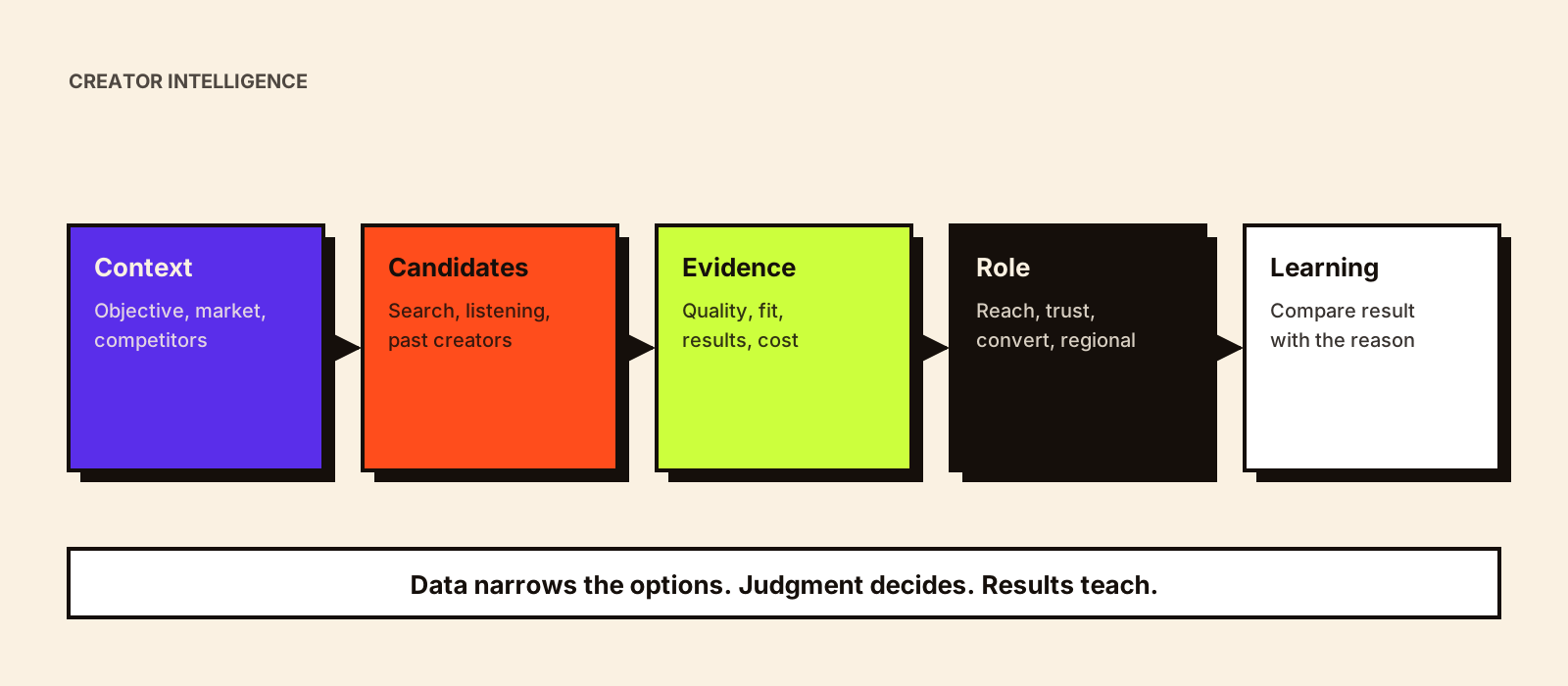
A creator database tells you that a Kannada home-cooking creator exists, has 80,000 followers and posts four Reels a week. It doesn't tell you whether she should be in your next campaign, what she should do in it, or whether she'll do it better than the three other creators you're considering. That gap, between knowing about creators and deciding about them, is what creator intelligence is meant to close.
Quick answer
Creator intelligence is the practice of turning creator, audience, campaign and market data into decisions about which creators to work with, why, for which campaign and audience, at which funnel stage and in what role. It combines data you collect (performance, costs, reliability), data you observe (content, audience, competitors, trends) and human judgment (fit, credibility, creative quality). It is a decision layer, not a database or a tool, and it gets better as your own campaign history grows.
Database vs analytics vs intelligence
| Creator database | Influencer analytics | Creator intelligence | |
|---|---|---|---|
| Question | Who exists? | What happened? | What should we do next, and why? |
| Output | Lists and profiles | Metrics and reports | Decisions with reasons |
| Time focus | Present | Past | Next campaign |
| Inputs | Profiles, audience data | Campaign results | Both, plus costs, reliability, market and competitor context, judgment |
| Owner | Discovery | Analyst | Whoever decides the creator mix |
The six questions creator intelligence answers
| Question | Data that informs it | What judgment adds |
|---|---|---|
| Who should we work with? | Audience fit, quality score, past performance, cost | Credibility, creative strength, brand fit |
| Why this creator? | Evidence: audience match, results, content consistency | A one-line reason anyone can check |
| For which campaign? | Past results by objective and format | Whether their style suits this idea |
| For which audience? | Audience location, language, age, interests | Whether their audience trusts them on this topic |
| At what stage of the funnel? | Reach and views (awareness), saves and comments (consideration), clicks and orders (conversion) | Whether they persuade or only entertain |
| With what role? | Format strengths, reliability, rights availability | Hero creator, regional voice, UGC producer, ambassador, seeding |
The creator intelligence framework
1. CONTEXT: What's the objective, audience, market, budget and timing? What are competitors doing?
2. CANDIDATES: Who could fit? (discovery, listening, brand mentions, past creators)
3. EVIDENCE: For each: audience quality and fit, engagement quality, content quality, past results, cost, reliability, risk
4. ROLE: What job would this creator do? (reach, trust, conversion, regional coverage, content for ads)
5. DECISION: Rank, shortlist and choose, with a written reason per creator
6. LEARNING: After the campaign, compare results with the reason. Update scores, notes and rebook decisions.
Step 6 is the one most brands skip and the one that makes the system intelligent. Without it, every campaign starts from the same assumptions.
Creator roles: the most underused decision
Most creator selection asks 'is this creator good?' The better question is 'good for what?' Assigning roles turns a list of creators into a plan:
| Role | What the creator is for | Evidence to look for |
|---|---|---|
| Reach driver | Getting the product in front of many relevant people | Consistent views in target markets; low cost per thousand views |
| Trust builder | Persuading an audience that already believes them | Comments asking questions, saves, past sponsored posts with real discussion |
| Converter | Driving clicks and orders | Past link clicks and code use; audience that buys in the category |
| Regional voice | Making the brand local in a language or city | Audience concentrated in the market; native-language content |
| Content producer | Making assets for ads and owned channels | Production quality, hooks, on-camera presence; rights available |
| Ambassador | Repeated presence over months | Reliability, brand affinity, stable audience |
A creator can be weak in one role and excellent in another. A micro creator with modest reach may be the strongest converter you have. Influencer ranking explains how to prioritise creators within each role.
Decision examples
Hypothetical example 1: a D2C haircare brand has budget for one macro creator or six micro creators for a Hindi-belt launch. Intelligence from two past campaigns shows micro creators in its category drove most code redemptions while macro posts drove reach and search interest. The decision: one macro creator for launch-week reach, budget for four micro creators chosen for audience concentration in Uttar Pradesh and Madhya Pradesh, and two reserved slots to rebook whichever converts best.
Hypothetical example 2: a fintech app sees a competitor working heavily with English-language finance creators. Market mapping shows few brands working with Hindi and Marathi personal-finance educators whose audiences are first-time investors. The brand tests three such creators on an education-led brief before committing a larger budget.
Neither decision is proven by the data. In both, data narrowed the options and set up a test that produces better data next time. Competitor and market context of this kind is covered in competitor influencer research and influencer market mapping.
What creator intelligence can't do
- Predict a single post's performance reliably. Creative execution, timing and platform distribution vary too much.
- Replace watching the content. Credibility and tone are judged by people.
- Work without your own history. Third-party data describes creators; only your results describe how they perform for you.
- Compensate for a weak product, offer or landing page.
- Remove risk. It reduces avoidable mistakes; it doesn't guarantee results.
How to build it without special software
- Keep one creator record with linked campaign history (a structured tracker is enough to start).
- Collect the same metrics at the same capture days for every creator.
- Write a one-line reason for every booking and every rejection.
- After each campaign, compare result with reason and update the creator's notes and scores.
- Review competitor and category creator activity quarterly.
- Add a dedicated platform only when manual upkeep becomes the bottleneck; see creator intelligence platform.
Influencer marketing data lists what to collect, and creator intelligence platform covers what to expect from software built for this.
Questions different teams bring
| Team | Their question | What intelligence gives them |
|---|---|---|
| Founder or CMO | Is creator marketing working, and where should we put more money? | Results by role, segment and market against baselines |
| Brand manager | Which creators should front the next launch? | Ranked shortlist with reasons and roles |
| Performance marketing | Which creator content should we run as ads? | Assets with strong engagement quality and rights available |
| Regional or sales teams | Who can we use in our markets? | Market map by language and region |
| Finance | Are we paying fair rates? | Fee history and cost metrics against peer cohorts |
Answering these from one consistent record is what separates intelligence from a set of disconnected reports. Influencer market mapping and the creator performance scorecard are the two tools teams most often lack.
Signals that should change a decision
| Signal | Possible decision |
|---|---|
| A creator's sponsored posts consistently outperform their organic median | Rebook; consider ambassador role |
| Strong engagement quality but weak conversions | Keep for consideration, not sales |
| Audience shifted away from your markets between screenshots | Pause until explained |
| Competitors now book the same creator monthly | Check exclusivity; look for lookalikes |
| A segment beats baseline across several creators | Shift budget to that segment |
| Comments show recurring objections | Change the brief before changing creators |
Maturity levels
| Level | What it looks like | Next step |
|---|---|---|
| 1. Ad hoc | Creators chosen by followers and familiarity; results in screenshots | Standard data fields and capture days |
| 2. Recorded | Consistent tracker; results per creator | Written reasons for each booking; scorecards |
| 3. Compared | Indexes, cohorts and baselines; scorecards drive rebooking | Competitor and market context |
| 4. Strategic | Market map, trend analysis and history inform annual plans | Regular test slots; feedback loop on every decision |
Most brands sit between levels 1 and 2. Moving up a level rarely needs new software; it needs consistent data and the habit of writing down why. Influencer data analytics covers the comparison work at level 3.
Where intelligence meets regional India
National averages hide most of the useful intelligence in Indian creator marketing. A creator type that underperforms nationally may be the strongest option in one state; a format that works for Hindi audiences may need adapting for Tamil or Bengali ones. Keep results tagged by language, state and city tier so the intelligence stays local enough to act on. Regional influencer marketing in India covers language planning.
Common mistakes
- Calling a creator database 'intelligence' when it can't explain any decision.
- Choosing creators for the brand's most visible campaign without any history from smaller tests.
- Assigning every creator the same role and judging them on the same metric.
- Never writing down why a creator was chosen.
- Treating scores as answers rather than as structured questions.
Conclusion
Creator intelligence is what happens when influencer data is used to make and explain decisions: who, why, for which campaign, audience, stage and role. Build it from consistent data, explicit reasons and a learning loop after every campaign, and keep judgment in the room. The brands that get better at creator marketing year after year are usually the ones that remember why they chose each creator and what happened next.