How to Turn Instagram Followers Into Customers for Your D2C Brand
A five-stage journey from discovery to product page for D2C brands on Instagram, with the content each stage needs, the signal to watch, and a checklist for fixing the leaks between a follow and an order.
Your D2C brand's Instagram has grown steadily. Reels get decent views, follower count is up, and comments say 'love this'. But when you check the store analytics, Instagram sends a trickle of visits and even fewer orders. Somewhere between 'love this' and the checkout page, people are dropping out.
Quick answer
To turn Instagram followers into customers, plan content for each step of the buying journey rather than for reach alone. Followers need to discover you, understand exactly what the product does, see believable proof, find a working link, and land on a product page that matches what they saw. Fix the weakest step first. Measure clicks and orders from Instagram, not just followers, because audience size and sales are different outcomes.
Followers and customers are different outcomes
A follow means someone found you interesting once. It doesn't mean they know what you sell, believe it works, or remember where to buy it. Content that grows followers (trends, relatable humour, broad lifestyle) often doesn't sell, and content that sells (demos, sizing, honest comparisons) may get fewer views. Both have a place. The mistake is reporting one and expecting the other.
| If your goal is | Watch | Typical content |
|---|---|---|
| Audience growth | Reach, views, follows from content, shares | Trend-aware Reels, entertaining or relatable posts, collaborations |
| Product consideration | Saves, profile visits, replies to product Stories, DMs asking about a product | Demos, explainers, comparisons, customer questions answered |
| Sales from Instagram | Link clicks, sessions and orders tagged with UTM parameters, discount code redemptions | Product pages linked clearly, offers with honest terms, reorder prompts |
Instagram's own insights report views, reach, interactions and profile activity for professional accounts. Orders live in your store analytics. You need both views side by side, which is why tagged links matter later in this guide. For which metrics to report against which goal, see our guide to social media KPIs.
The follower-to-customer journey
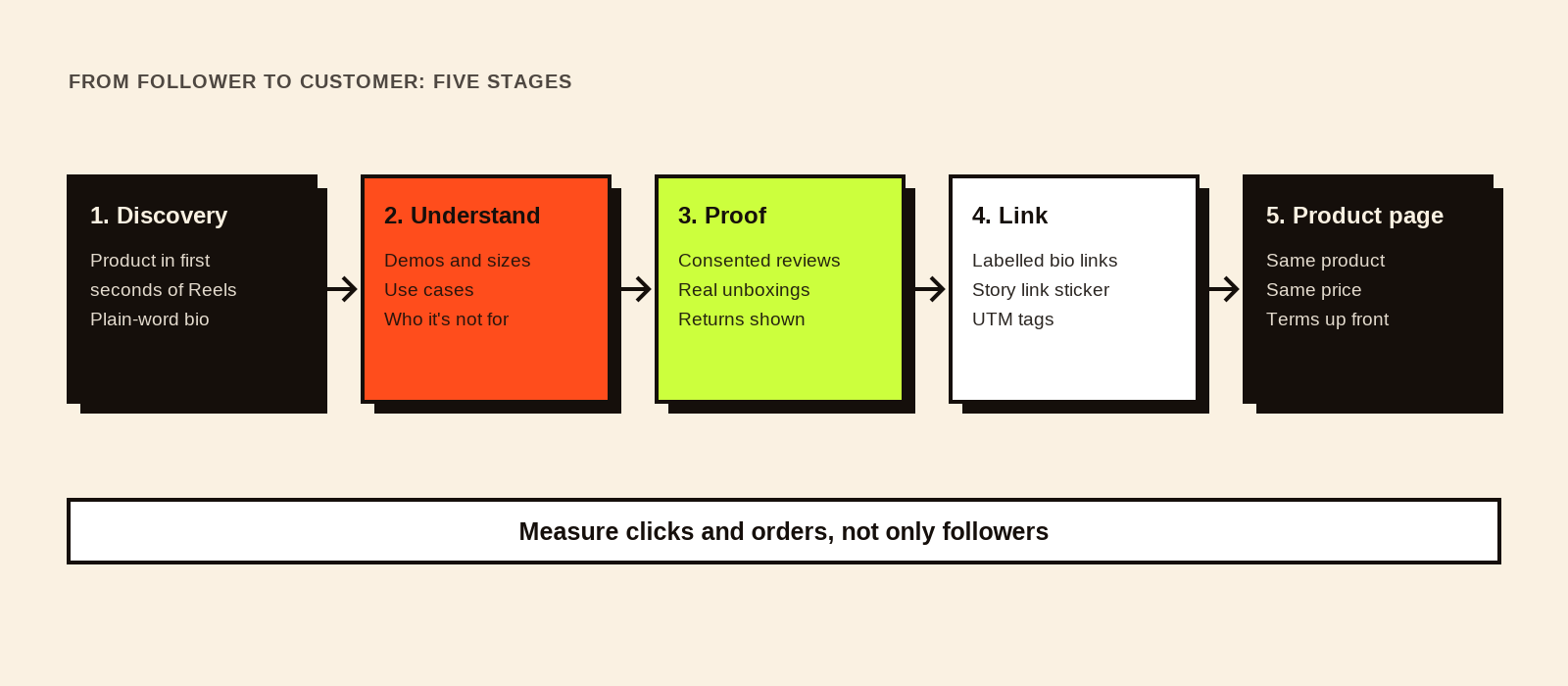
Here's the journey as five stages. Each has a question the follower is silently asking, the content that answers it, and a signal that tells you whether it's working. Use it to audit your last 30 posts: you'll usually find most of them sit in stage one.
| Stage | Follower's question | Content that answers it | Signal to watch |
|---|---|---|---|
| 1. Discovery | What is this brand? | Clear hook Reels, collaborations, posts that show the product in the first seconds | Reach to non-followers, profile visits |
| 2. Product understanding | What exactly does it do, and is it for me? | Demos, use cases, size and fit, ingredients or materials, 'who it's not for' | Saves, shares, product DMs |
| 3. Proof | Does it actually work for people like me? | Consented customer reviews, unboxings, before-and-after only where honest and allowed, returns policy shown | Comments asking 'where to buy', replies to proof Stories |
| 4. Link | Where do I buy it? | Labelled links in bio, Stories link stickers, pinned 'shop' post, product named in caption | Link clicks, UTM sessions |
| 5. Product page | Is this the same thing, at a fair price, and can I trust the checkout? | A page matching the post: same product, same price, offer terms, delivery and returns | Add to cart, orders, drop-off point |
Stage 1 and 2: get found, then get understood
Discovery content has one job: make the product visible and memorable fast. Show the product early in a Reel, name the problem it solves, and avoid openings that could belong to any brand. Instagram's published explanation of how search works (2021) says the text people type is matched against usernames, bios, captions, hashtags and places, so plain product words in your bio and captions help people who search, not just people who scroll.
Understanding is where most D2C feeds are thin. A follower who likes the look of your product still needs to know the size, how it's used, what it's made of, and whether it suits them. A carousel that answers 'which one should I buy?' or a 40-second demo often does more for sales than a beautiful shoot. Our guide to product explainer content maps each customer question to a format.
Stage 3: proof that a stranger will believe
A newer brand has to prove itself to people who've never heard of it. Good proof is specific and verifiable: a real customer's unedited review shared with permission, an unboxing that shows the actual packaging, a clear returns policy, the team answering a tough question in the comments. Weak proof is generic: stock 'happy customer' images, vague claims like 'loved by thousands', or reviews you can't trace.
Under the ASCI Code, claims about objectively ascertainable facts should be capable of substantiation, so 'bestseller', 'clinically tested' or 'number one' need evidence you can produce. For customer reviews, follow the consent and evidence rules in our guide to customer testimonials and UGC.
Stage 4: the link nobody should have to hunt for
Many sales are lost simply because buying takes too many taps. At the time of writing (November 2026), Instagram lets you add and reorder more than one link in your bio, and Instagram announced in October 2021 that the Stories link sticker was expanding to all accounts (with exceptions such as new accounts and repeat Community Guidelines violators). Use both. Label links by intent ('Shop bestsellers', 'Find your size'), not just 'Website'.
Link to the product page the post is about, not the homepage. Add UTM parameters so your analytics can separate bio clicks, Story clicks and DM links. If people prefer to ask before buying, a WhatsApp button on the profile can help, provided someone actually replies. Our guide to Instagram profile optimisation covers the profile itself; that article focuses on service enquiries, while this one stays on the product purchase.
What about Instagram Shopping and product tags?
Shopping features such as product tags depend on Meta's commerce eligibility requirements and on which markets are supported, and availability for Indian businesses has changed over the years. At the time of writing we could not confirm from Meta's official pages that these features are generally available to Indian D2C brands, so we don't build this plan around them. If your account shows the option, check Meta's commerce eligibility requirements and treat tags as an extra route, not a replacement for clear links.
Stage 5: a product page that keeps the promise
The post made a promise. The product page has to keep it. If the Reel showed a blue variant at one price and the page opens on grey at another, or the offer in the caption needs a code nobody mentioned, the follower leaves. Check that the product, variant, price and offer match what was posted; delivery time, shipping charges and returns are visible before checkout; and the page answers the same questions your comments ask.
Offers must state their terms honestly: the end date, minimum order and exclusions. The CCPA's Dark Patterns Guidelines (November 2023) name practices such as false urgency and drip pricing, where costs appear late in checkout. A countdown that resets or a 'last few left' banner on a well-stocked item breaks trust and the rules.
Follower-to-customer checklist
- Bio says what you sell in plain words a customer would search.
- Links in bio are labelled by intent and point to product or collection pages, with UTM tags.
- Highlights cover: start here, sizes or shades, reviews (with consent), delivery and returns.
- At least a third of monthly posts answer product questions rather than chase reach.
- Every product Reel shows the product within the first few seconds and names it in the caption.
- Proof posts use real, permissioned customer content, and every factual claim has evidence on file.
- Product pages match posts on product, variant, price and offer terms.
- Delivery charges, timelines and returns are visible before checkout.
- DMs and comments asking 'price?' or 'where to buy?' get a reply with a link, the same day where possible.
- Monthly report shows clicks, sessions and orders from Instagram next to reach and followers.
Common mistakes
- Chasing follower growth and assuming sales will follow.
- Posting mood shots that never show the product clearly or say what it does.
- Linking everything to the homepage.
- Answering 'price?' comments with 'DM us' and then not replying to the DM.
- Running offers whose terms appear only at checkout.
- Buying followers or joining engagement pods, which distort your data and break platform rules.
Where to start
Audit your last 30 posts against the five stages and count how many sit in each. Then fix the cheapest leak first, which is usually the link and product page, before making more content. Next month, shift part of the calendar from discovery to understanding and proof, and report orders from Instagram alongside reach.
For brands that want help planning and producing this journey every month, our social media management strategy work maps content to these stages and reports against them. Paid ads are scoped separately; if you're weighing them, see organic vs paid social media.