What Should You Expect in the First 90 Days of Hiring a Social Media Management Agency?
The first three months with a social media agency are about audit, strategy, the first calendars and the first honest review. What should happen in days 1 to 30, 31 to 60 and 61 to 90, who does what, and the warning signs to watch.
The contract is signed, the first invoice is paid, and the founder asks in the Monday meeting why the Instagram feed still looks the same. The agency, meanwhile, is waiting for logo files, login access and someone to approve a content calendar. Most disappointment in the first months of a social media agency relationship comes from this gap: each side expected the other to move first, and nobody agreed what 'progress' would look like in the first 90 days.
Quick answer
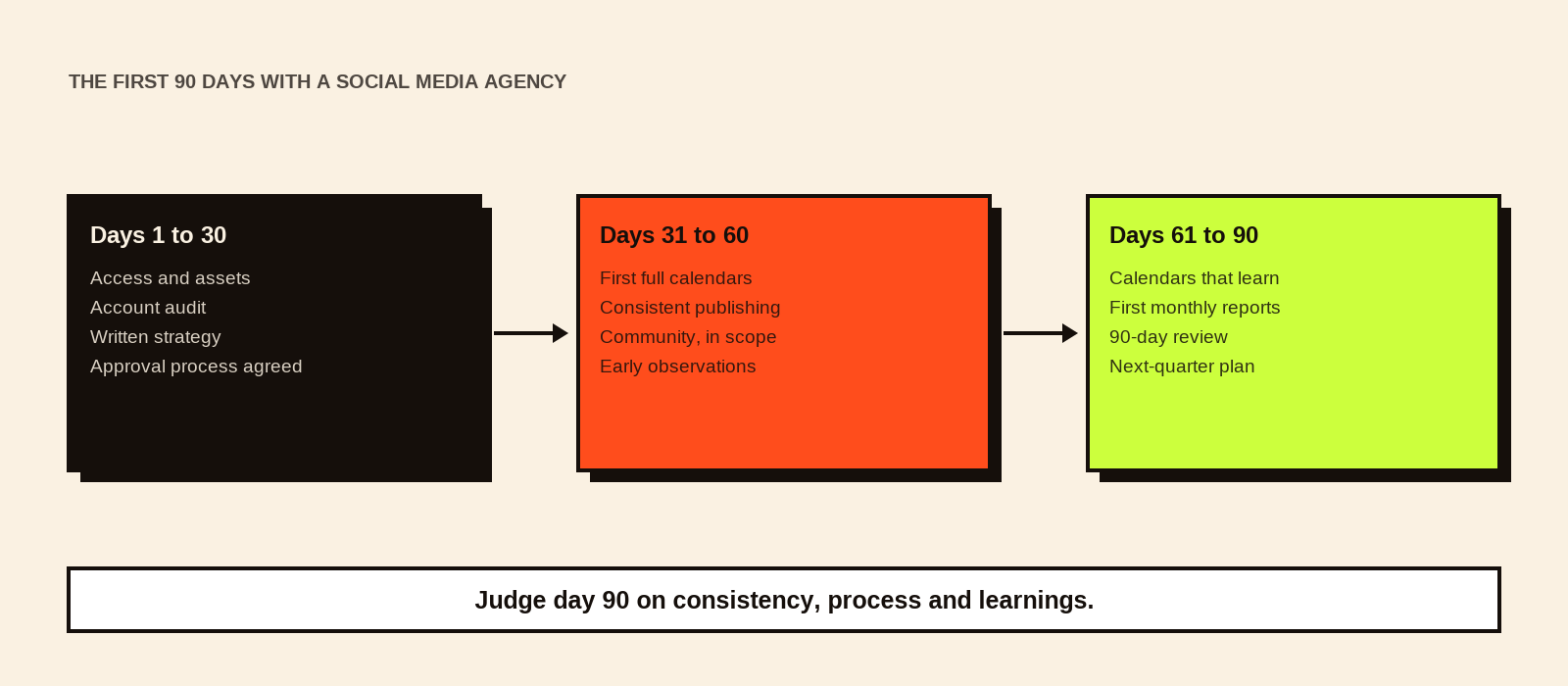
In the first 90 days, expect process before results. Days 1 to 30 cover onboarding, access, an audit of your accounts and a written strategy. Days 31 to 60 bring the first full content calendars, consistent publishing and early observations. Days 61 to 90 should end with a proper review: what was tested, what you learned and what changes next quarter. Growth numbers are not a fair test this early; consistency, approvals that run on time and clear learnings are.
Why the first 90 days are mostly about setup
A social media agency starts with almost nothing it can use straight away. It needs to understand your products, customers, tone, past content and the people who approve things. It needs access to accounts and assets. Then it needs a few weeks of published content before there is anything worth learning from. That's why the first quarter is a foundation quarter, not a growth quarter.
The work you do before kickoff shortens this a lot. If your brand assets, access and approvers are ready on day one, the agency spends its first month thinking rather than chasing files. Preparing your business before outsourcing social media management covers that groundwork in detail.
Days 1 to 30: onboarding, audit and strategy
The first month should feel busy on the agency's side and fairly demanding on yours. You'll be asked for information, access and time with the people who know the business.
What should happen
- A kickoff meeting that confirms scope, platforms, the posting rhythm, approvers and how you'll communicate.
- Access set up through each platform's role or partner system, not shared passwords.
- Brand assets collected: logos, fonts, colours, product images, past creatives and any brand guidelines.
- An audit of your current accounts: what you've posted, what got a response, profile basics, gaps and inconsistencies.
- A look at competitors and the category, so the strategy isn't written in a vacuum.
- A strategy document: objectives per platform, content pillars, formats, tone, posting rhythm and what will be measured.
- Agreement on the approval process and turnaround times.
Some agencies publish a few holding posts in the first month so the account doesn't go quiet, which is sensible. What you shouldn't see is a full calendar of finished posts in week one, before anyone has looked at your audience or past content. If you want to understand what a thorough account review covers, see how to conduct a social media audit.
Days 31 to 60: first calendars and consistent publishing
The second month is when you should see the strategy turn into a working rhythm. The agency shares a monthly calendar for approval, produces the creatives and captions, and publishes on schedule.
- The first full monthly calendar shared in advance, with dates, formats, captions and the purpose of each post.
- Creatives that follow the agreed pillars and brand guidelines, with one or two rounds of feedback rather than five.
- Short-form video edited from footage you or creators supply. Shoots, if needed, are planned and scoped separately.
- Publishing that happens on the agreed days without reminders from your side.
- Community management starting within the agreed scope, with sensitive queries passed to your team.
- Early notes on what's getting a response: a format, a hook, a topic. These are observations, not conclusions yet.
The friction in this phase is usually approvals. If posts sit with a founder for a week, the calendar slips and the agency starts publishing late or in bursts. Our guide to a social media content approval process sets out stages and turnaround times that keep the calendar moving.
Days 61 to 90: first learnings and a proper review
By the third month, there should be about eight weeks of consistent content to look at. That isn't enough to judge long-term growth, but it is enough to see patterns and make decisions.
- A second and third calendar that reflect what was learned, not a copy of the first.
- A monthly report that explains what happened and what will change, not just a set of screenshots.
- A 90-day review meeting covering what was tested, which content pillars and formats are earning attention, what isn't working and the plan for the next quarter.
- A frank conversation about the process: approval speed, asset supply, communication and anything in scope that isn't being delivered.
- Agreement on which metrics matter for the next quarter, tied to the business goal rather than vanity numbers.
For choosing those metrics, social media KPIs by business goal is a useful starting point. Pick a handful that connect to what the business is trying to grow, and agree them before the next quarter starts.
Milestones and who owns what
Onboarding milestones
The timings below are what we'd consider a reasonable plan for a brand on two or three platforms. Treat them as a template to agree at kickoff, not as an industry standard.
| Milestone | Suggested timing | Who signs it off |
|---|---|---|
| Kickoff meeting held, scope and approvers confirmed | Week 1 | Brand marketing lead |
| Platform access granted through roles or partner access | Week 1 | Account owner on the brand side |
| Brand assets and product information shared | Weeks 1 to 2 | Brand marketing lead |
| Account audit and competitor review shared | Weeks 2 to 3 | Brand marketing lead |
| Strategy document approved | Weeks 3 to 4 | Marketing head or founder |
| First monthly calendar approved | Weeks 4 to 5 | Named approver |
| Consistent publishing on the agreed rhythm | From week 5 or 6 | Agency, reviewed weekly |
| First monthly report | End of month 2 | Brand marketing lead |
| 90-day review and next-quarter plan | Weeks 12 to 13 | Marketing head or founder |
Client and agency responsibilities
Many slow starts come from tasks nobody owned. Agree this split in the first week and write it down.
| Area | Brand (client) | Agency |
|---|---|---|
| Access | Grants roles and partner access; keeps ownership of accounts | Requests the right roles; never asks for passwords |
| Brand inputs | Shares guidelines, assets, product details and claims you can make | Organises assets into a usable library; flags gaps |
| Strategy | Explains business goals, priorities and constraints | Writes the strategy and content pillars; explains trade-offs |
| Calendar and content | Approves on time; supplies footage and product samples | Plans, designs, edits, writes and schedules |
| Legal and claims | Confirms what can be said, especially in regulated categories | Follows the agreed claims list; flags anything uncertain |
| Community | Handles complaints, refunds and support queries | Responds within agreed scope; escalates sensitive messages |
| Reporting | Shares sales or enquiry data where relevant; attends reviews | Reports, interprets and recommends next steps |
The detailed version of this split for a managed service is in the process section of our social media management page, which sets out what happens at each stage of a typical month.
What good looks like at day 90
Organic growth depends on your category, product, budget, content supply and many things outside the agency's control, so we don't think a 90-day follower or sales target is a fair test. These are better signs that the relationship is working:
- Consistency: posts went out on the agreed days for at least two months, with no long gaps.
- Process: calendars arrive on time, approvals take days not weeks, and both sides know who decides what.
- Quality: the content looks and sounds like your brand without you rewriting every caption.
- Learnings: the agency can name two or three specific things it learned about your audience and how they changed the plan.
- Honesty: the report includes what didn't work, not only the best-performing post.
- A next-quarter plan you understand and agree with.
Where creator campaigns fit in
Many brands want to add influencer activity quickly. It usually works better once your own accounts are consistent, because people who discover you through a creator tend to check your profile next. A sensible point to start planning creator campaigns is around the 60 to 90 day review, when the content rhythm is stable. Campaign strategy is where that planning sits, and if you do run one, what to expect in the first 90 days of an influencer campaign covers the creator side separately.
Common mistakes and warning signs
Mistakes brands make
- Judging the agency on follower growth in month one.
- Adding new approvers halfway through the first calendar.
- Holding back product information, then asking why the content feels generic.
- Asking for extra platforms, shoots or paid ads that were never in scope, and treating them as missed deliverables.
- Skipping the 90-day review because things seem fine.
Warning signs on the agency side
- Asking for your passwords instead of role-based or partner access.
- No audit or strategy, just a calendar of generic posts in the first week.
- Missed publishing dates with no explanation.
- Reports that list numbers but never say what will change.
- Promises of guaranteed followers, reach or sales.
- Unclear about who is working on your account, or a different contact every month.
Practical recommendations
- Agree the milestones table above, with dates, in the kickoff meeting.
- Name one approver and one backup before the first calendar is shared.
- Book the 30-, 60- and 90-day check-ins at the start so they don't get skipped.
- Keep a shared log of decisions, feedback and learnings from day one.
- Ask at day 30 for the strategy in writing, and at day 90 for the three biggest learnings in writing.
Where to start
Treat the first 90 days as setup and calibration. Get access, assets and approvers ready, expect an audit and strategy in month one, consistent publishing in month two and an honest review in month three. Judge the agency on consistency, process and what it has learned about your audience, not on growth figures that need more time.
If you're still choosing a partner, it helps to know what a managed service usually includes before the 90 days begin; our social media management scope lays out what's covered and what is scoped separately.