How to Localize UGC and Influencer Campaigns Across Markets
How to localize UGC across India, the UAE and Saudi Arabia, the UK, Australia and Singapore: when to re-cast rather than translate, language and dialect, settings and seasons, product and pricing details, disclosure rules and reviewing content with local eyes.
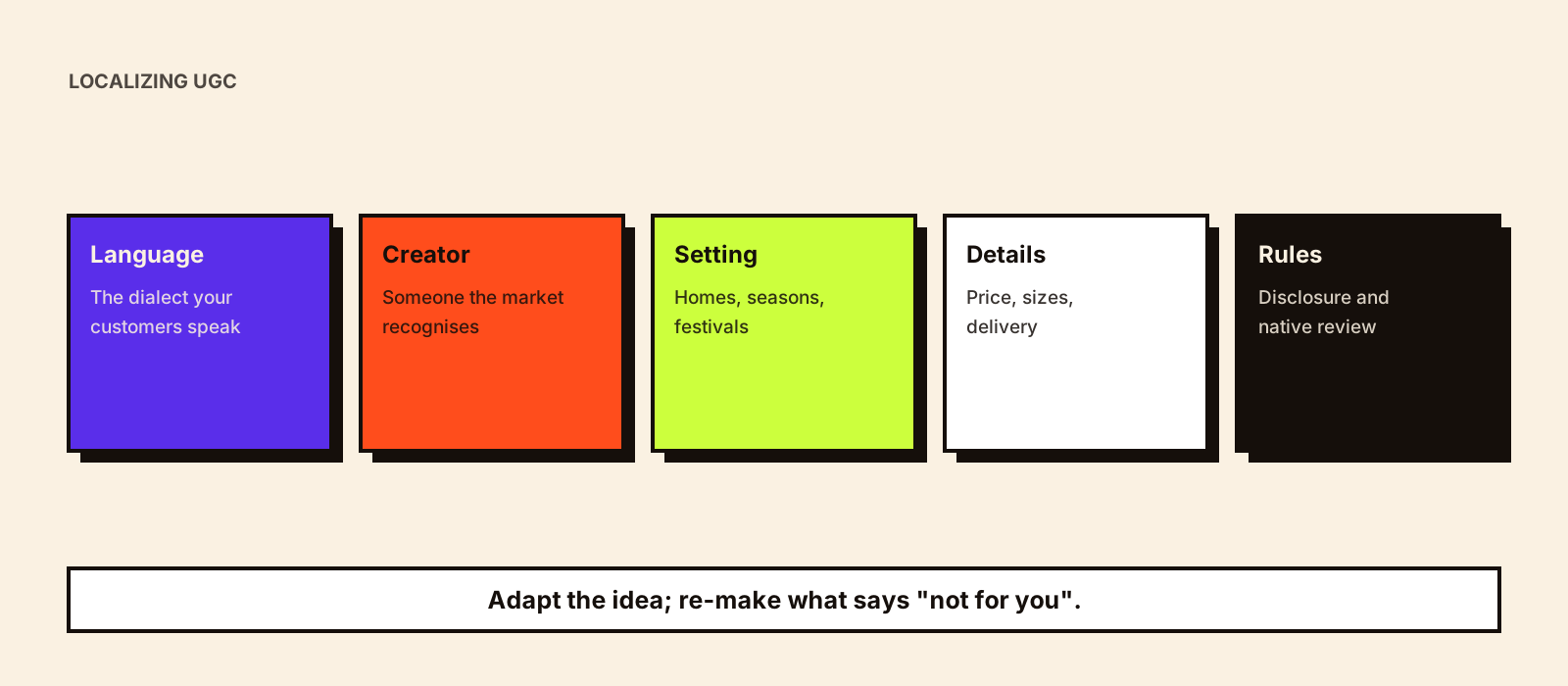
A UGC video that works in Mumbai rarely works unchanged in Dubai, London, Sydney or Singapore. It's not just the language: the bathroom looks different, the weather is different, the price is in a different currency, the delivery promise doesn't apply, and the creator doesn't look or sound like someone the viewer knows. Subtitles fix almost none of that.
Quick answer
Localize UGC by keeping the angle and proof points global and re-making the parts that signal 'not for you': cast local creators where possible rather than subtitling, use the language or dialect your customers actually speak, match settings, seasons and product details (price, sizes, delivery, payment) to the market, follow each market's disclosure and advertising rules, and have every version reviewed by someone from that market. Adapt rather than translate, and avoid stereotypes about any market.
Translate, adapt or re-cast?
| Approach | When it works | Risk |
|---|---|---|
| Subtitle or caption only | Product demos where the visual does the work; markets that share a language | Feels imported; spoken references may not land |
| Voiceover or dubbing | Explainers and tutorials | Lip-sync and tone can feel off; disclose clearly if AI voices are used |
| Adapt (same creator, new version) | Creators fluent in the market's language and context | Limited to creators who genuinely fit both markets |
| Re-cast (local creator, same angle) | Testimonials, routines and anything personal | Higher cost; needs a clear brief so the angle survives |
What to localize
| Element | What changes | Example |
|---|---|---|
| Language and dialect | The language and register customers use | Hindi or a regional language in India; Gulf Arabic in Saudi Arabia rather than another dialect; British or Australian English |
| Creator | Someone the audience recognises as like them | Local accent, skin and climate for beauty; local life stage and setting |
| Setting and season | Homes, weather, clothing, festivals | Australian summer at Christmas; Ramadan timing in the Gulf |
| Product details | Price, currency, sizes, variants, availability | Show only variants sold in that market |
| Commerce details | Delivery promises, payment methods, offers | Cash on delivery is common in India; offers must match local terms |
| Cultural fit | Humour, gestures, dress, music | Reviewed by someone from the market, not assumed |
| Rules | Disclosure labels, claims, permits | See the table below |
Market by market
| Market | Language and audience notes | Rules to check |
|---|---|---|
| India | English, Hindi and many regional languages; metro and tier 2 and 3 audiences respond to different creators | ASCI influencer guidelines; consumer protection rules on endorsements |
| UAE | Arabic and English, plus large expatriate communities with their own languages; Emiratis and residents are different audiences | Advertiser permit for creators who publish ads; media content standards |
| Saudi Arabia | Arabic first, in a Saudi register; Arabic content reviewed natively | Creator licensing (Mawthooq) where required; media regulation |
| United Kingdom | British English; regional and community differences matter | ASA and CMA influencer guidance; CAP Code |
| Australia | Australian English; seasons reversed from the northern hemisphere | Australian Consumer Law; ACCC and AANA guidance |
| Singapore | English widely used, with Mandarin, Malay and Tamil audiences; multilingual households | ASAS guidance and the CPFTA |
Market detail: regional and vernacular influencer marketing in India, Arabic UGC creators in the GCC, the GCC influencer marketing playbook, UK influencer advertising rules, Australian influencer advertising rules and ASAS social media guidance for Singapore.
Adapting an influencer campaign for several countries
Influencer campaigns localize differently from UGC. With UGC the brand controls the finished asset; with influencer content the creator speaks to their own audience in their own voice, so the job is to give local creators the right idea and boundaries, not a script to translate. Each market ends up with original content from its own creators, built on one shared idea.
| Shared across markets (the adaptation kit) | Decided in each market |
|---|---|
| The core idea and the proof viewers need to see | Which creators, in which language and dialect |
| Approved claims, adjusted to each market's rules | How each creator tells the story, with local examples |
| Brand must-haves: product shown correctly, logo use, what never to say | Settings, seasons and cultural references |
| KPI definitions and the reporting template | Offer, price, currency, delivery and where to buy |
| Disclosure principle: clear and upfront | The exact label wording and any creator licence or permit |
- Write a one-page global brief, then a short annex per market with local claims, offers, dates, rules and the review contact.
- Ask local creators to pitch their own take on the idea before filming; it surfaces cultural problems early.
- Have a native speaker of the exact language variety review concepts and final edits.
- Don't post the same creator video in every market unless the creator's audience is genuinely there and the rights cover it; local creators usually persuade better.
- Report each market against its own baseline before comparing markets.
Keeping the brand consistent while creators have freedom is covered in influencer brand consistency, the creative layer in influencer creative strategy, and the operating model across markets in the international influencer campaign playbook. For communities living abroad, see diaspora influencer marketing.
Rights and production across borders
- Name the territories in usage rights; a licence for India doesn't cover the UAE or UK unless it says so.
- Copyright defaults differ by country (for example, commissioned films and photographs in India versus the UK), so put ownership and licence terms in writing.
- Pay creators in a way that works for them and take tax advice on cross-border payments.
- Ship product from local stock where possible; customs and category restrictions can delay cross-border parcels.
- Check that music in each version is licensed for paid use in each market.
Usage terms are covered in UGC usage rights, and contracts, payments and reporting across countries in the international influencer campaign playbook.
Review with local eyes
Every localized version should be reviewed by a native speaker from the market for language, tone, cultural fit and claims, and by whoever owns compliance for that market. Machine translation and AI tools can speed up drafts but can't judge whether a joke, gesture or reference works, so treat them as a starting point, not the reviewer.
Measuring localized UGC
- Report each market separately, in local currency, against the same metric definitions.
- Compare localized versions with imported ones in the same market before deciding to re-cast everything.
- Read comments in the local language for confusion about price, availability or claims.
Common mistakes
- Subtitling a personal testimonial instead of re-casting it.
- Treating 'the Middle East' or 'Arabic speakers' as one audience.
- Showing products, prices or offers that aren't available in the market.
- Usage rights that don't name the new territory.
- No native review before launch.
Conclusion
Localizing UGC means keeping the idea and re-making what tells viewers it isn't for them: creator, language, setting, product details and rules. Re-cast personal content, adapt explainers, review every version with someone from the market, and name each territory in the rights.