Social Media Marketing for D2C Brands on a Small Budget: Where Should Founders Start?
A prioritisation guide for D2C founders with little money and less time: what to do now, what to leave for later and what to skip, a small-team weekly routine, and the shortcuts that cost more than they save.
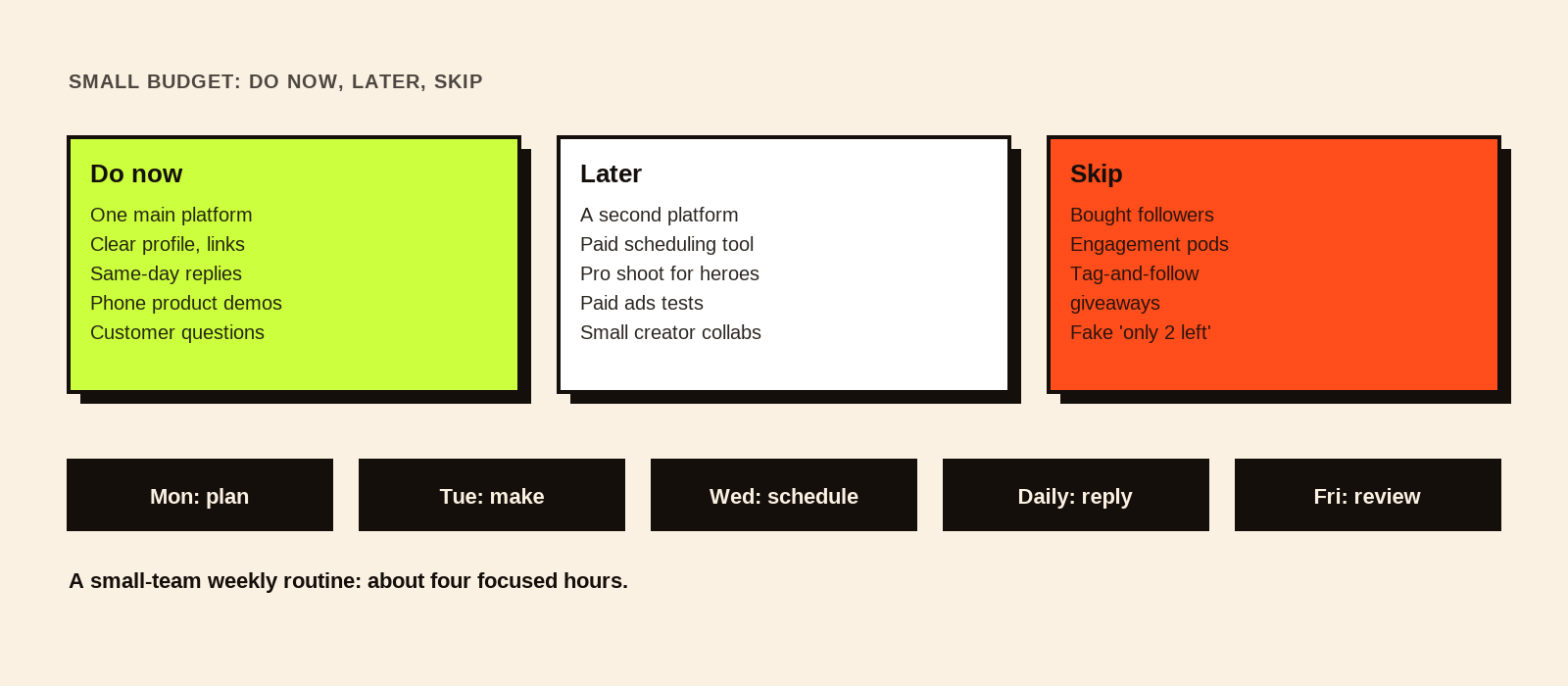
A founder runs a two-person candle brand from a rented unit. They pack orders in the morning, answer WhatsApp messages at lunch and try to post on Instagram at night, usually after scrolling competitors and feeling behind. They have heard they need Reels every day, a YouTube channel, LinkedIn thought leadership and a giveaway. They have about four hours a week.
Quick answer
On a small budget, start with one main platform where your customers already are, a clean profile that makes buying easy, three posts a week built from real product use and customer questions, and fast replies to every comment and DM. Leave extra platforms, paid tools and shoots for later. Skip bought followers, engagement pods and fake urgency entirely. Your time is the real budget, so protect it with a weekly routine.
What a small budget can and can't do
Organic social media costs time more than money. A small team can build trust, answer questions and give existing customers a reason to come back. It cannot reliably reach large new audiences on demand, which is what paid ads are for. Our guide to organic versus paid social media explains the difference in jobs. For a founder, the practical question is which hours produce the most useful content and the fewest regrets.
The prioritisation table: do now, later, skip
| Activity | Decision | Why |
|---|---|---|
| Profile: clear bio, product link, delivery and returns in Highlights | Do now | Every visitor sees it; low effort, lasting value |
| One main platform, posted consistently | Do now | Consistency on one beats absence on four |
| Replying to comments and DMs the same day | Do now | Questions are often buying signals |
| Product demos shot on a phone | Do now | Shows texture, size and use better than polished stills |
| Customer questions turned into posts | Do now | Free ideas that match real objections |
| Sharing customer photos with permission | Do now | Proof that costs nothing but a request |
| A second platform | Later | Add once the first runs without stress |
| Scheduling tool beyond the free native one | Later | Native schedulers cover a small calendar |
| Professional photo or video shoot | Later | Worth it for hero assets once you know what sells |
| Paid ads | Later | Test once the organic content and product page convert |
| Small creator collaborations | Later | Useful once the profile can convert their audience |
| Buying followers, likes or views | Skip | Breaks platform rules and misleads you about demand |
| Engagement pods and follow-for-follow | Skip | Fake signals from people who will never buy |
| Giveaways that only require tags and follows | Skip | Attracts prize hunters, not customers |
| Daily trend-chasing unrelated to the product | Skip | Uses hours, rarely sells |
Pick one main platform and one support channel
For many Indian D2C brands, Instagram is the main platform and WhatsApp is the support channel where questions turn into orders. That is not a rule. A home-appliance brand whose buyers research on YouTube, or a stationery brand with a strong Pinterest audience, may choose differently. Our guide to choosing social media platforms by business model walks through the decision.
If WhatsApp Business is your support channel, set up quick replies for common questions and an away message for out-of-hours. Both are features of the WhatsApp Business app at the time of writing (November 2026).
The small-team weekly routine
Four focused hours a week can keep a D2C account healthy if they are planned. Batch the work so you are not deciding what to post every evening. Meta Business Suite lets you schedule Facebook and Instagram posts in advance, which covers most small calendars without a paid tool.
MONDAY (45 min): Plan
- Read last week's comments, DMs and WhatsApp questions
- Pick 3 post ideas: 1 product demo, 1 customer question, 1 behind-the-scenes or customer photo (with permission)
- Note any stock, offer or delivery news to share

TUESDAY (90 min): Make
- Film 2 short phone videos in one session (good light, 20 to 40 seconds)
- Write all 3 captions; check every claim is true

WEDNESDAY (30 min): Schedule
- Schedule the 3 posts for the week
- Plan 2 to 3 simple Stories (packing orders, a poll, a restock)

DAILY (10 min, twice): Reply
- Comments and DMs, morning and evening
- Move order issues to WhatsApp or email

FRIDAY (30 min): Review
- What did people save, share or ask about?
- One line in a notes file: keep, change, drop
If you only have one hour a week
Reply to messages every day, post once a week with a product demo or a customer answer, and keep your profile up to date. That is enough to stay credible while the business grows.
Content that costs little and helps people buy
- Product in use: hands, texture, size next to a familiar object, before and after for function (not for health or body claims).
- Answers to questions customers really asked, one per post.
- Packing orders and making the product, which shows there are real people behind the brand.
- Customer photos and reviews, shared only with permission and never edited to change the meaning.
- Founder explaining one decision: a material, a price, a packaging change.
- Clear posts on delivery times, returns and payment options, pinned or saved to Highlights.
Our guide to customer testimonials and UGC covers permission and evidence rules, and the guide on turning Instagram followers into customers covers the path from post to product page.
Shortcuts to skip
Instagram's Help Centre warns against apps that offer likes and followers: giving them your login can expose your account, Instagram may remove the engagement they generate, and accounts that keep using them may have features limited. Meta's Community Standards on spam also prohibit buying, selling or exchanging engagement such as likes, follows and views. Beyond the rules, fake numbers ruin your own data: you can no longer tell which posts real customers liked.
- Do not buy followers, likes, views or comments.
- Do not join engagement pods or follow-for-follow groups.
- Do not post fake 'only 2 left' or resetting countdowns. The CCPA's November 2023 dark patterns guidelines name false urgency.
- Do not ask friends to post reviews of products they have not bought.
- Do not delete genuine criticism. Reply and fix the problem.
The CCPA guidelines are summarised in the Department of Consumer Affairs release on dark patterns.
When to spend the first rupees
Spend money where it saves the most time or removes the biggest weakness. Common first spends are a basic phone light and tripod, a part-time freelancer to edit videos, a one-day shoot for hero product images once you know your bestsellers, and small creator collaborations. Our guide to low-budget influencer marketing ideas covers that last option. When the founder's hours become the bottleneck, compare an in-house hire with outsourcing using our guides to in-house versus outsourced social media and to what drives social media management cost in India.
Measuring when you have no analyst
Track a few things in a spreadsheet each month: orders where the customer said they found you on social, DMs and WhatsApp chats that became orders, website visits from social links tagged with UTM parameters, and the questions people asked. Our guide on measuring whether social media generates sales for a small business sets this up in detail.
Where to start
This week, fix your profile and reply to every open message. Next week, run the routine once and note how long each step took. Add a second platform, a tool or a freelancer only when the first routine runs without dropping replies.
When the founder can no longer give it those hours, our social media management scope shows what a managed service covers on a monthly basis, so you can compare it with a hire.