Social Media Management for Construction Companies: Making Complex Projects Easier to Understand Online
How contractors, EPC firms and builders can turn site work into clear B2B content: explaining complex work, milestones, safety and process education, team introductions, recruitment and a site-to-post approval workflow.
Your team just finished a tricky foundation job under a live road, on time and without a single traffic diversion beyond what was planned. The project manager has two hundred photos on her phone. Six months later, the only post about it is a blurry crane shot captioned 'Another milestone achieved!' The client, the consultants and the engineers you want to hire never learn what was actually difficult or how your team solved it.
Quick answer
Social media management for construction companies means turning site work into clear content for clients, consultants, partners and future hires. Explain methods simply, mark milestones with specifics, share safety and process education without unverified claims, and introduce the people behind the work. LinkedIn usually leads. Build a site-to-post workflow where the project manager checks facts, the client approves anything showing their project, and confidential details stay off camera.
Who you're really talking to
Contractors and EPC firms don't sell to the public through social media; they build trust with people who influence tenders and partnerships. Each group needs something different:
| Audience | What they want to see | Content that serves them |
|---|---|---|
| Clients and developers | Reliability, quality, communication | Milestones, method explainers, project close-outs (with permission) |
| Architects, consultants and PMCs | Technical competence, coordination | Problem-and-solution posts, engineering decisions explained |
| Suppliers and subcontractors | A partner worth working with | Partner credits, process standards, site practices |
| Engineers and site staff you want to hire | Learning, safety culture, growth | Team introductions, day-on-site videos, training content |
| Local community near sites | Disruption, timelines, contact points | Approved notices about works, routes and contact details |
Unlike real estate developers, who sell homes to buyers, most construction firms are B2B. If you also develop and sell your own projects, our guide to social media management for real estate developers covers the buyer-facing side and RERA disclosures. For the wider B2B content method, see our B2B social media strategy guide.
Explaining complex work so non-engineers get it
Most construction content fails because it shows the work without explaining it. A photo of rebar tells a client nothing. 'Why we used post-tensioned slabs here, and what it saved the client in floor height' tells them a lot. Use a simple structure for technical posts:
- The constraint: what made this part of the job difficult (site access, soil, live traffic, a tight schedule)
- The decision: the method or sequence the team chose
- The reason: why it suited this site, in one or two plain sentences
- The result: what was completed, stated factually and dated
Short videos with an engineer talking over site footage work well for this, as do carousels with a simple diagram on each slide. Avoid jargon or explain it once. If a claim depends on numbers, such as time or cost saved, use only figures the project team has verified and the client has agreed you can share.
Milestones and site progress
Milestones give a construction feed its rhythm: ground-breaking, foundation complete, structure topped out, façade closed, handover. Make each one specific. Name the stage, date it, and add one line on what it took, credited to the team and partners involved. Progress posts between milestones, such as a monthly 'from the site' update, keep the account active without needing a big event.
Before posting, check that progress content doesn't reveal what a client hasn't announced: a tenant's identity, a launch date, a building's internal layout, or security features. Many contracts include confidentiality terms, so the client decides what can be shown and when.
Safety and process education without risky claims
Safety content can show that your company takes site practice seriously, and it helps recruitment. It also carries risk if handled carelessly. Educate rather than boast: explain why a toolbox talk happens before a shift, how a permit-to-work system works, or what a site induction covers. Show people wearing the protective equipment the task requires, because any image with a missing harness or helmet will be noticed.
- Don't publish safety records, incident-free hours or statistics unless they are verified, current and approved by your safety head
- Mention certifications only if you actually hold them, with the certifying body and validity checked
- Never post content from a site where an incident is under investigation
- Avoid footage of unsafe practice, even as a 'what not to do' example, unless it's clearly staged for training and labelled
- Get the client's and the site's permission before filming, and follow site rules on cameras and phones
Introducing the team and your experts
Clients hire people, not logos. Introduce project managers, site engineers, planners, safety officers and supervisors: what they work on, a decision they're proud of, what they'd tell a junior engineer. These posts build trust with clients and are among the most useful content for hiring. Get written consent from anyone featured, keep personal details out, and let people review their own quotes.
Recruitment deserves its own planned content stream, especially for site roles that are hard to fill. Our guide to social media employer branding covers employee stories, consent and a sample monthly calendar you can adapt for site teams.
Choosing platforms
| Platform | Role for a construction company | Typical content |
|---|---|---|
| The main B2B channel for clients, consultants and professional hires | Milestones, method explainers, leadership views, team introductions | |
| YouTube | A library of longer explainers and project films | Construction sequence videos, technical talks, project close-out films |
| Visual site storytelling and reaching younger site talent | Short site videos, time-lapses, day-on-site Reels | |
| Local communities near sites and regional hiring | Approved works notices, local hiring announcements |
Most firms do best with LinkedIn done well plus one visual platform, rather than four done thinly. Our guides to LinkedIn company page management and YouTube channel management for brands cover running those channels week to week.
The site-to-post workflow, with approvals
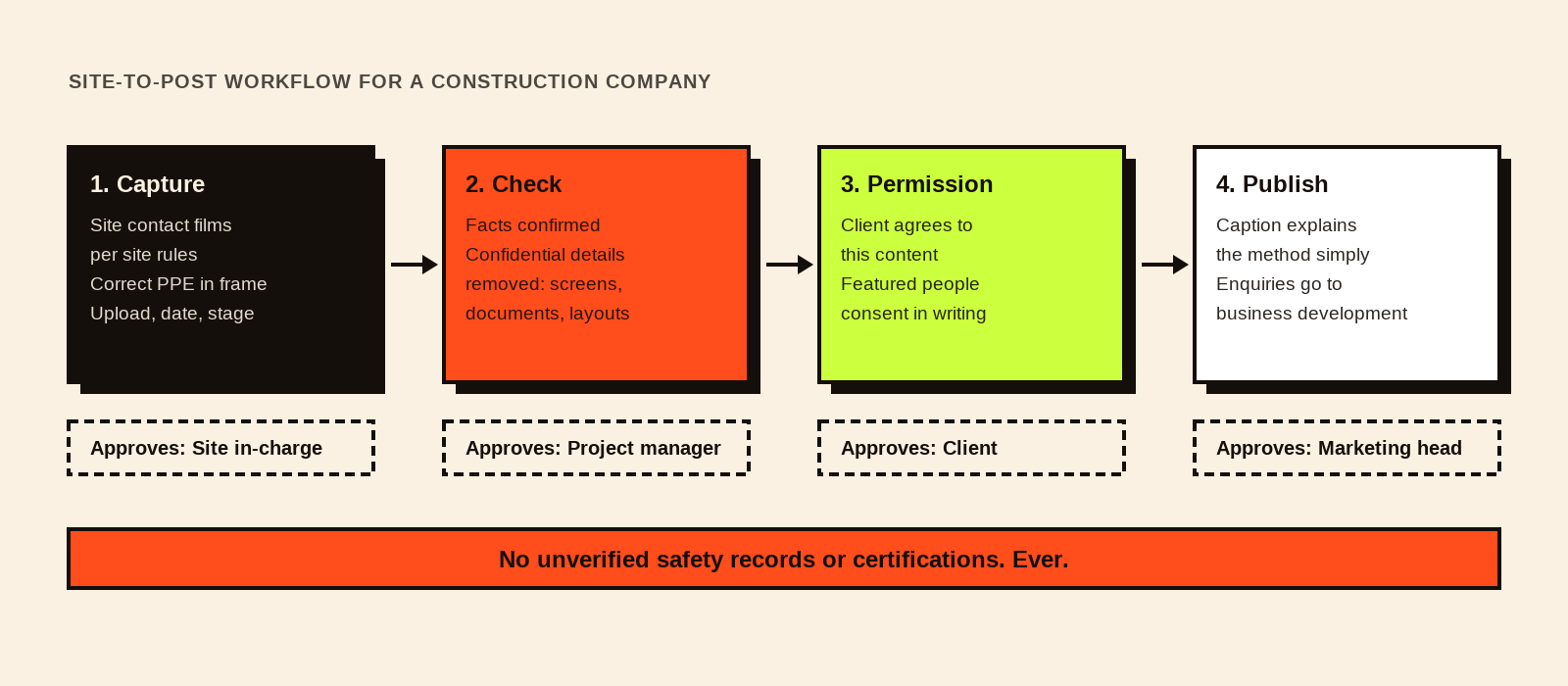
The biggest practical problem in construction social media is getting good material from site to screen safely. Site teams are busy, photos sit on personal phones, and nobody is sure what can be shown. A simple, written workflow solves most of it.
| Step | What happens | Who is responsible | Who approves |
|---|---|---|---|
| 1. Plan | Monthly list of milestones and stories to capture | Social team with project managers | Marketing head |
| 2. Capture | Photos and video taken following site rules and PPE requirements | Site engineer or a trained site contact | Site in-charge allows filming |
| 3. Upload | Files shared to one folder with date, project and stage noted | Site contact | Not needed |
| 4. Check | Facts, safety visible in frame, confidential details removed | Social team | Project manager confirms facts |
| 5. Permission | Client and any featured people agree to the specific content | Project manager | Client and individuals, in writing |
| 6. Draft and sign-off | Caption, design and video edit | Social team or agency | Marketing head; safety head for safety content |
| 7. Publish and respond | Post goes live; comments and enquiries routed | Social team | Business development owns tender and client enquiries |
Give site teams a one-page brief: what to capture (wide shots, process close-ups, people at work in correct PPE), what never to capture (client documents, screens, security layouts, unsafe practice) and where to upload. For setting turnaround times across approvers, see our guide to the social media content approval process.
Common mistakes
The usual problems are easy to spot. Captions that say 'milestone achieved' without saying which. Client projects posted without asking. Safety claims nobody can back up. Photos with someone working at height without a harness. A feed that goes quiet for months between handovers. And recruitment posts that list requirements but say nothing about what it's like to work on your sites. Each one is fixed by the workflow above and a monthly plan agreed with the project teams.
Where to start
Pick two live projects whose clients are happy to be featured, agree the site-to-post workflow with their project managers, and plan one milestone post, one method explainer and one team introduction per project for the next month. That's enough to show clients and candidates how your company actually works.
If capacity is the problem, our social media management scope covers planning, creative and editing from site footage you supply (on-location shoots are scoped separately), with facts, permissions and safety content approved by your own team. For creator partnerships on top of your own channels, see influencer marketing for construction companies.